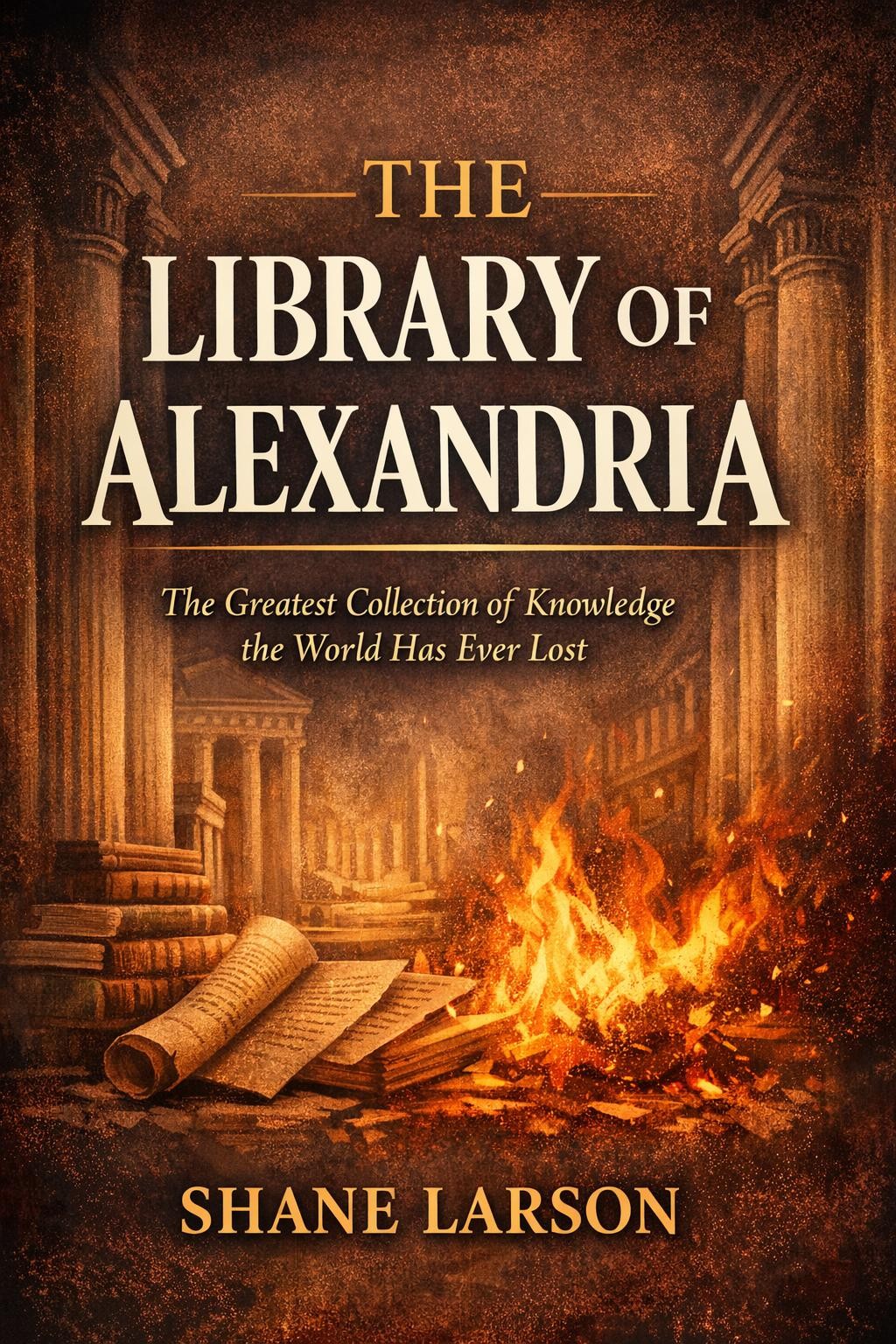
The Library of Alexandria
The Greatest Collection of Knowledge the World Has Ever Lost
By Shane Larson · The Bronze Age Collapse Chronicles (Book 11)
About This Book
The myth is more comforting than the truth.
A single fire. One catastrophic night. The greatest library in the ancient world — erased in a blaze that echoes across millennia. It's a clean story. It's also wrong.
The Library of Alexandria didn't end in flames. It died the way institutions always die: slowly, through underfunding, political neglect, religious pressure, and the quiet failure to copy a scroll one more time. The catastrophe wasn't dramatic. That's what makes it worse.
At its height, the Library wasn't just a building full of books — it was the Mouseion, the world's first funded research institution. Scholars collected on salary. A mission to acquire every text in existence, pursued with methods that were sometimes outright criminal. The accumulated work of Greek, Egyptian, Persian, and Babylonian civilization housed in a single place, copied nowhere else.
That concentration was its strength. It was also its fatal flaw.
The Library of Alexandria traces the complete arc — from Ptolemy I's founding vision to the final collapse of Alexandrian intellectual life — and separates the history from the mythology that has accumulated around it for two thousand years.
What you'll discover:
- The Mouseion as the ancient world's first research university — how Ptolemy I designed an institution that attracted Euclid, Eratosthenes, Aristarchus, and a generation of foundational scientific thinkers
- The acquisition methods behind the scroll collection: confiscations at the harbor, copied texts returned in place of originals, and a systematic effort to locate every written work in the known world
- What Caesar's fire in 48 BCE actually destroyed — and how ancient sources contradict the version most people know
- The destruction of the Serapeum in 391 CE and the murder of Hypatia in 415 CE as the symbolic endpoints of Alexandrian scholarship
- A precise accounting of what was lost: Sophocles' 113 missing plays, Aristotle's destroyed dialogues, entire fields of ancient science that were never transmitted to later centuries
- The counterfactual case — whether the library's survival might have accelerated the Scientific Revolution by centuries, and why the honest answer is more complicated than either optimists or skeptics admit
- How the myth of a single catastrophe persists, and why humans consistently prefer it to the more instructive truth of a long, preventable decline
The complete story of the greatest library ever built — from founding ambition to slow erasure — told without mythology, without comfort, and without the single catastrophic fire that never quite happened.
Part of Shane Larson's Ancient History series, alongside Cleopatra's Egypt*,* Alexander's Generals*,* The Persian Empire*,* The Bronze Age World*,* Sparta: The Warrior State*,* Hannibal's War*,* The Hittite Empire*, and* Assyria*.*
Included with Kindle Unlimited — read it free if you're a member.
New Ancient History releases and free chapters — no spam, unsubscribe anytime.
More in The Bronze Age Collapse Chronicles
View series →
More in This Genre
View all →