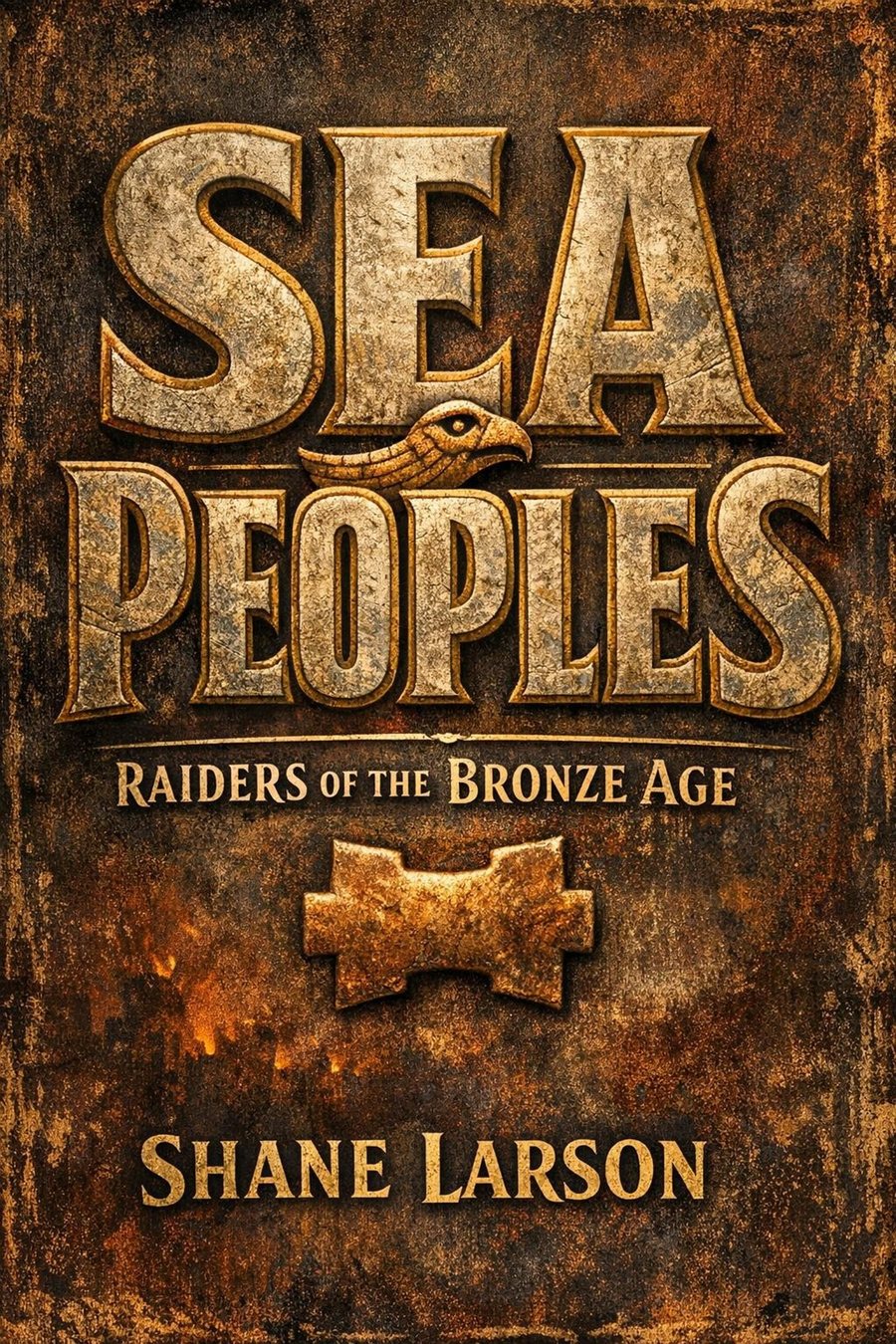
Around 1200 BCE, the most advanced civilizations on Earth were destroyed within a single generation.
The Hittite Empire — gone. Mycenaean Greece — gone. The great trading port of Ugarit — burned and never rebuilt. The palace economies, the diplomatic networks, the bronze-age prosperity that had connected the Mediterranean world for centuries — gone. An entire civilization erased in a cascade of fire, famine, and war so complete that writing itself disappeared from the region for generations.
At the center of the destruction: a mysterious coalition of raiders the Egyptians called the Sea Peoples.
Who were they? Where did they come from? And did they actually bring down the Bronze Age — or were they one piece of something far larger and more terrifying?
The first globalized world
The great powers of the Bronze Age — Egypt, the Hittites, Mycenaean Greece, the merchant kingdoms of the Levant — were bound together by trade, treaties, and royal marriages into something the ancient world had never seen and would not see again for a thousand years. Then, in a few short decades, it all came apart. Cities burned. Empires vanished. An entire writing system was forgotten for four centuries.
At the center of the wreckage: a force that toppled kingdoms and then dissolved into history, leaving behind burned ruins, a scatter of clues, and a question archaeologists still argue over today.
Drawing on the latest evidence — from ancient DNA and climate science to the haunting last letters of a doomed city — this is the story of who they were, what they destroyed, and why the collapse of the first globalized world should still keep us up at night.
What’s inside
- The world at its peak. The interconnected Bronze Age world, and why its greatest strength was also its fatal vulnerability.
- The Egyptian record. What the inscriptions at Medinet Habu actually say about the Sea Peoples, and why they have to be read as a victory monument.
- The last letters of Ugarit. The final letters from the doomed city, written as enemy ships appeared on the horizon.
- The Battle of the Delta. Ramesses III’s stand to keep Egypt from sharing the fate of everyone else.
- Where the Philistines came from. What a 2019 study of ancient DNA from Ashkelon found, and what it could not pin down.
- Why everything failed at once. The systems collapse model, and what it reveals about our own interconnected world.
- The evidence still coming in. What archaeology, climate science, and genetic research are still uncovering about a 3,000-year-old mystery.
Questions
Does the book say who the Sea Peoples were?
Not as a single answer, because the evidence does not give one. It goes through the named groups one at a time and says how firm each identification is. Only two, the Peleset as the Philistines and the Lukka as the people of Lycia, are accepted by a broad consensus of scholars. The rest it treats as names and speculation.
Does it blame them for the collapse?
It calls them both cause and consequence: the wave that broke the seawall, when the seawall was already cracked by drought, famine and failing states. It sets out the single-cause theories in turn, shows where each falls short, and adopts the view that several stresses hit a tightly connected system at once.
How does it handle the ancient texts?
Letters and inscriptions are given in paraphrase and in the author’s own words, apart from a handful of brief phrases from public-domain translations. The Egyptian accounts are treated as what they are: royal victory monuments, to be mined for detail and distrusted for triumph.
Is this the same book as the earlier edition?
No. This is a completely rewritten and expanded edition, rebuilt from scratch with new research, primary source quotations, and twice the depth of the original.
What background does it assume?
None. No academic jargon and no padding. All dates are BCE and approximate, and where a date is especially contested the text says so.
No academic jargon. No padding. Just the evidence, the mystery, and the story of the people who lived through one of history’s greatest catastrophes.