The argument
Latin had a word for leisure, otium, and it built its word for business out of that one. To say business a Roman said negotium: not-leisure. Greek worked the same way. The base idea was free time, seriously used, and being occupied was defined as its absence.
We have turned that inside out. Our base word is work, and everything around it is “time off.” Somewhere between the first factory bell and the shared office calendar, being busy stopped being a misfortune and became a boast.
Busyness is only impressive while output is hard to come by. For about a century and a half it was, so long hours became a stand-in for worth. That logic is failing. Volume is cheap now. A day spent generating and reacting is a day spent on the part of the work that has just lost its value.
The part that has kept its value looks, from outside, like idleness. Choosing the one thing that deserves a year. Staying with a single problem long enough to see what is wrong with it. Caring about a detail no one requested. In the ancient world it took a household of other people to pay for that, and the book says so. In ours it takes about an hour.
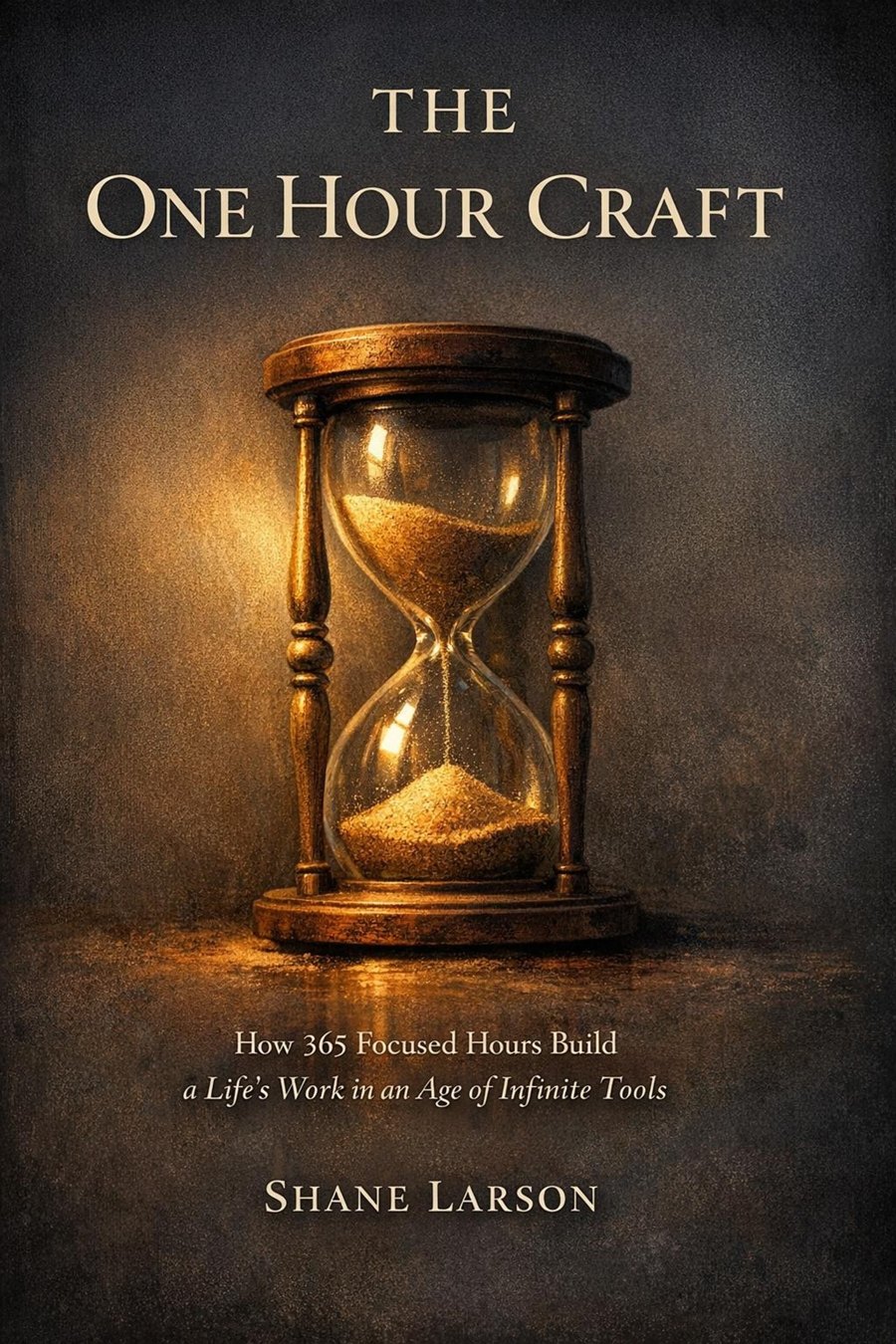
So the second half of the book is a manual for that hour. The arithmetic is modest and stated honestly: 365 hours is roughly nine working weeks. That will not make anyone a master of anything. It is enough to write a book, build a small product, or get properly good at one skill, if every hour lands on the same work.
The reader this is written for has a job and is keeping it. The hour is built beside the job, with the salary as its patron.
What’s inside
- Leisure as the ancients meant it. Aristotle’s claim that work exists for the sake of leisure, Roman otium, and Seneca’s unsparing portrait of the perpetually occupied, along with a plain account of whose labor made that leisure possible.
- Work before the clock. How farms, households and craft shops organized labor around the task instead of the hour, and what the ladder from apprentice to master offered that a career does not.
- How busy became a virtue. The factory bell, the time sheet, and the moment the well-off stopped displaying leisure and started displaying their hours.
- What cheap production changes. Why average output becomes worthless when tools can supply it on demand, and why judgment, taste and persistence become expensive.
- Three tests for choosing the work. A ceiling you will not reach, an interest that survives boredom, and use to someone other than yourself.
- The real arithmetic of 365 hours. What an hour a day has produced for people who worked around a day job, and what cannot be done an hour at a time.
- Protecting the hour. Why morning suits most people, what to do if it cannot be morning, and the one rule about the phone.
- Aiming the hour. The difference between motion and progress, the question to settle the night before, and how to use AI inside the hour without turning the hour into reaction.
- The middle months. Month five, missed days, why streaks are the wrong measure, and how to tell a dull patch from a wrong direction.
- Work that keeps working. Leverage explained without jargon, the slow business of being found by the right people, and the difficult parts told straight.
Questions
Can you really accomplish anything meaningful in one hour a day?
Yes, within limits the book is careful about. An hour a day for a year is about nine full working weeks of attention on one thing, which is more than most long-postponed projects have ever received. It is enough for a draft, a first product or a solid working skill. It is not enough for mastery.
Do I have to quit my job?
No, and the book argues against treating the job as the enemy. The practice is designed to sit beside full-time work. A steady income is what allows most people to spend a year on something that does not pay yet.
Does the hour have to be first thing in the morning?
Morning works best for most people because nothing has yet made a claim on the day. The book also covers the people for whom morning is impossible, including parents of small children, shift workers and carers.
Is this a book about how to use AI?
Not in the sense of prompts and tools. It is about what to do with your attention in a world where the tools exist. One chapter covers using AI inside the hour so that it serves the work, and no products are named.
What if I do not know what my life’s work is?
Then you start with a provisional choice. The book gives three tests for a direction worth a year and suggests looking at what you already return to. A year is long enough to learn whether the choice was right and short enough to survive if it was not.
One unhurried hour, one piece of work, and a year from now something that is yours and did not exist before.