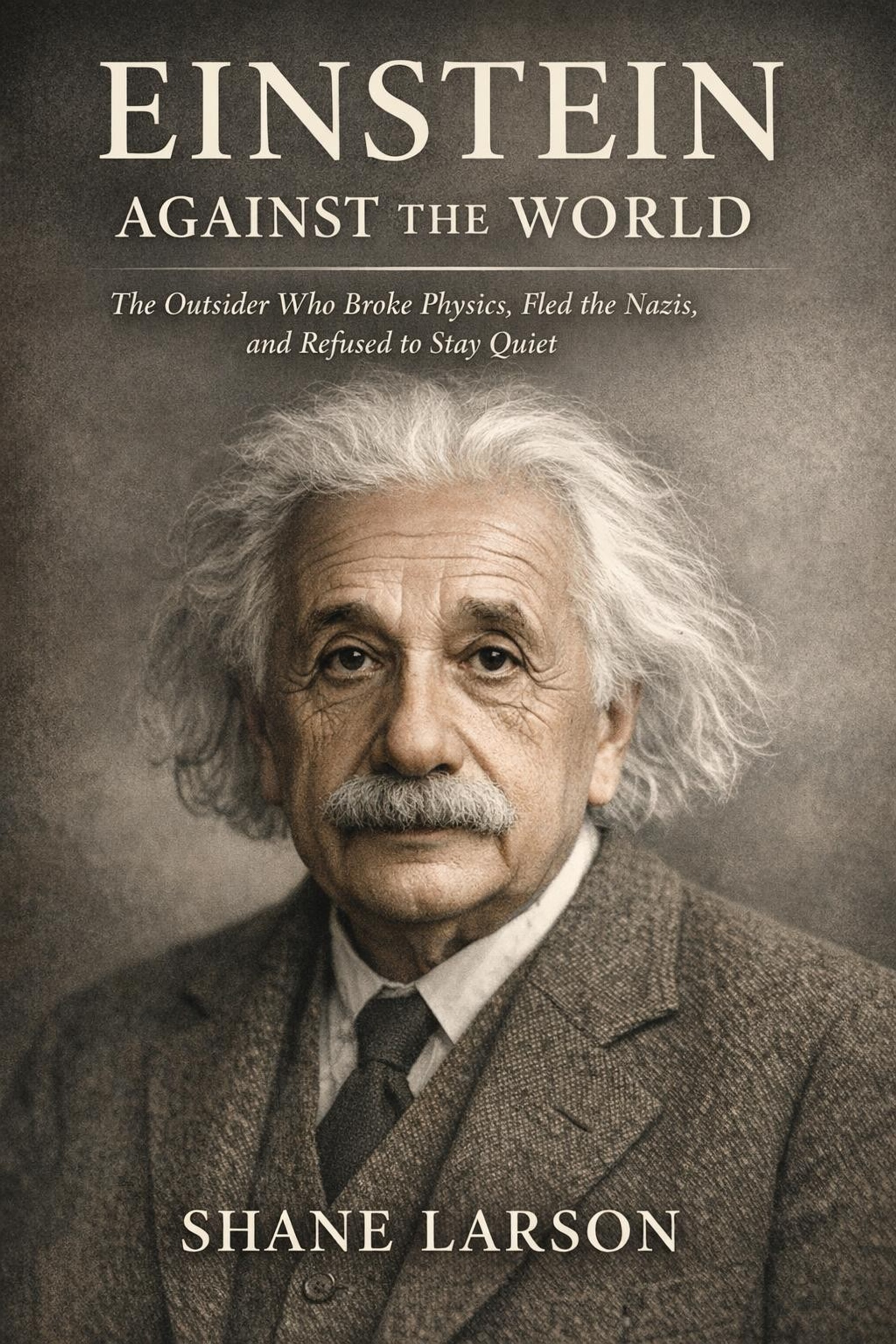
Einstein Against the World
The Outsider Who Broke Physics, Fled the Nazis, and Refused to Stay Quiet
By Shane Larson
About This Book
He had a 5,000-mark Nazi bounty on his head, a 1,427-page FBI file, and a brain that ended up in a cookie jar in Kansas.
You've seen the poster. You don't know the man.
The Einstein on the coffee mug is a tongue-out grandfather with hair like static electricity. The actual Albert Einstein was a Jewish refugee fleeing Hitler, a patent clerk who broke physics on lunch breaks, a husband who walked out on the brilliant first wife who'd helped with his math, and the new American citizen who used his oath of allegiance to denounce Jim Crow. He was the most-watched scientist in J. Edgar Hoover's filing cabinet — and the man who put up Marian Anderson at his Princeton home when no hotel in town would rent her a room.
This is the actual life. Plain English, no reverence, no skipping the parts that make him hard to love.
What you'll discover
- The patent clerk who broke physics — how a 26-year-old who couldn't land an academic job published four papers in 1905 that turned the universe upside down
- The escape from Berlin — two months before the Reichstag fire, Einstein left Germany for the last time, never to return
- The letter that started the bomb — why he signed Roosevelt's 1939 warning, and why the Manhattan Project then refused him a security clearance
- The American dissident — his friendship with W.E.B. Du Bois and Paul Robeson, his civil rights speeches, and the McCarthy-era letter telling teachers to refuse the loyalty oath
- The long argument with Bohr — "God does not play dice" — and why being wrong like Einstein matters more than being right by going along
- The brain in the jar — the pathologist who stole it at the autopsy, the cookie jars in a Kansas basement, and what the studies actually found
This book is for you if
- You loved Oppenheimer and want the prequel
- You read Walter Isaacson, Erik Larson, or Sam Kean
- You want a single readable volume — not a 675-page doorstop
- You're tired of Einstein-as-saint biographies and want the real human
- You want to actually understand the physics — without taking a college course
From a German schoolboy who renounced his citizenship at sixteen, to the patent clerk who shattered physics, to the refugee who fled Hitler, to the civil rights advocate the FBI couldn't break — Einstein's life is one coherent story about an outsider who refused to defer to power.
Includes four appendices: the physics without the math, the Manhattan Project timeline, the FBI file, and a guide to further reading.
Peak Grizzly On-Site Description
In December 1932, Albert Einstein boarded a ship from Antwerp to New York. He told friends it was a temporary academic visit. He had a return ticket. He left a fully furnished house in Berlin and a sailboat on a lake outside the city.
He never set foot in Germany again.
Two months later, the Reichstag burned. The Nazi government published a list of enemies of the state with bounties attached. Einstein's name was near the top — five thousand marks, dead or alive. His Berlin apartment was raided. His sailboat was seized. His books were burned in public squares. The most famous scientist on earth, the man whose face had been on the cover of Time, was now a stateless Jewish refugee with a price on his head.
This is the Einstein you didn't learn in school.
The actual life behind the poster
The pop-culture Einstein is a kindly grandfather who stuck out his tongue at a photographer. The actual Einstein was angrier, harder, lonelier, and more politically engaged than the icon suggests. He walked out on his first wife, Mileva Marić — herself a trained physicist who had worked through the math of his early papers — and married his cousin. He spent the last thirty years of his life in a doomed argument with Niels Bohr about the nature of reality. He used his American citizenship oath as a platform to condemn American racism, and he meant it: when the contralto Marian Anderson was refused a hotel room in Princeton, Einstein invited her to stay at his house, and she did, every time she sang in the area, for the rest of his life.
He was also the man who, in 1939, signed his name to the letter that started the Manhattan Project — and whom the project then quietly refused to clear for security work. He was the most-watched scientist in the FBI's filing cabinet: 1,427 pages, fed personally by J. Edgar Hoover, who suspected him of being a Soviet asset and never quite gave up looking for proof.
This book is the whole life — the physics, the politics, the marriages, the refugees he sponsored, the violin he played badly, the brain that was stolen from his body at the autopsy and ended up in cookie jars in a Kansas basement. Told in plain English. Without reverence. Without skipping the parts that make him hard to love.
What's Inside
- 1905, the miracle year — How a third-class patent clerk in Bern, rejected by every university he applied to, wrote four papers in one calendar year that established the photon, proved the existence of atoms, founded special relativity, and produced E=mc². On a desk meant for evaluating other people's inventions.
- Mileva Marić — The brilliant Serbian physicist who became Einstein's first wife, did the math on his early papers, and was discarded when she stopped being useful. The letters survive. They are not flattering to him.
- The flight from Hitler — How Einstein read the political weather earlier and more clearly than most German Jews, and how he used his fame to sponsor refugees out of Europe — including the ones the U.S. State Department tried to keep out.
- The bomb letter — The August 1939 letter to FDR that Leo Szilard wrote and Einstein signed. What it actually said. What Einstein later said about signing it. Why the Manhattan Project then denied him a security clearance.
- The civil rights years — Einstein in Princeton, refusing to lecture at segregated universities, joining the NAACP, defending W.E.B. Du Bois at the height of the McCarthy panic, telling American teachers in print to refuse the loyalty oath.
- The Bohr debates — "God does not play dice." The thirty-year argument with Niels Bohr over whether the universe was fundamentally probabilistic. Einstein lost. The argument made quantum mechanics sharper. The book explains it without equations.
- The autopsy and after — Thomas Stoltz Harvey, the pathologist who removed Einstein's brain without permission in 1955, kept it for forty-three years, and drove it across the country in a Tupperware container. What the histological studies eventually showed. What they didn't.
- The physics, made readable — A full appendix that walks through special relativity, general relativity, and Einstein's quantum work in the language of analogy and example. No calculus. No condescension.
Why I Wrote This
I got tired of Einstein biographies that fell into one of two camps: the 700-page academic doorstop you'll never finish, or the inspirational coffee-table book that turns him into a wise old wizard.
The real story is more interesting than either. Einstein was a refugee. He was a political dissident in two countries — Germany before he fled, and America after he arrived. He was wrong about quantum mechanics in ways that turned out to be productive. He was unkind to his first wife. He was extraordinarily kind to strangers, especially refugees and Black artists in segregated America. He had a 1,427-page FBI file that nobody really talks about anymore.
I wanted a single readable volume that took all of that seriously — the physics and the politics, the public hero and the difficult husband, the German Jewish exile and the American conscience. Something you could read in a long weekend and come away knowing the actual man.
This is that book.
Frequently Asked Questions
Do I need a physics background to follow this book?
No. The biographical chapters require no math or physics at all. The physics itself is explained in plain English with analogies, and there is a dedicated appendix at the end ("The Physics Without the Math") that walks through special relativity, general relativity, and the quantum debates for readers who want a deeper but still non-technical explanation.
How is this different from Walter Isaacson's Einstein: His Life and Universe?
Isaacson's book is excellent and exhaustive — and 675 pages long. This is a tighter, more readable single volume that doesn't try to be the definitive academic biography. It also leans harder into the political life: the FBI file, the civil rights work, the McCarthy-era dissent, and the refugee sponsorship are given the space they deserve rather than treated as side notes.
Does it cover the personal stuff — the marriages, the affairs, the rumored daughter?
Yes. The first marriage to Mileva Marić, the lost daughter Lieserl, the second marriage to his cousin Elsa, and the documented affairs are all addressed honestly. The book doesn't sensationalize any of it, but it also doesn't airbrush him into a saint.
What about the brain? Is that really a chapter?
It is. The story of Thomas Stoltz Harvey — the pathologist who took Einstein's brain at the 1955 autopsy, kept it in jars for forty-three years, and eventually drove it across the country to deliver pieces to researchers — is one of the strangest postscripts in scientific history. The chapter covers what actually happened, what the histological studies found, and what they didn't.
Is this part of a series?
It's a standalone biography, but it pairs naturally with other Peak Grizzly history and science titles — particularly those covering 20th-century science, the Manhattan Project, and the politics of the wartime and postwar era.
Is the book available on Kindle Unlimited?
Yes. The Kindle edition is enrolled in Kindle Unlimited, so KU subscribers can read it at no additional cost.
If You Liked This, You Might Like
- The Manhattan Project — The full story of the program Einstein's letter helped start, and the scientists whose work he never quite stopped worrying about.
- Oppenheimer's Trial — The 1954 security hearing that destroyed the man Einstein had warned could not be controlled by politicians.
- Cold War Science — How American physicists, Einstein among them, became targets of the same security apparatus they had helped create.
- The Refugees Who Saved Physics — The European Jewish scientists who fled Hitler and rebuilt American science in the 1930s and 40s.
Closing
A patent clerk who broke physics. A refugee with a Nazi bounty. An American citizen who used his oath to denounce his new country's racism. A husband, a friend, a difficult man, and one of the great moral voices of the twentieth century. This is Einstein with the poster taken down.
Included with Kindle Unlimited — read it free if you're a member.
New Biography / History of Science releases and free chapters — no spam, unsubscribe anytime.
More in This Genre
View all →