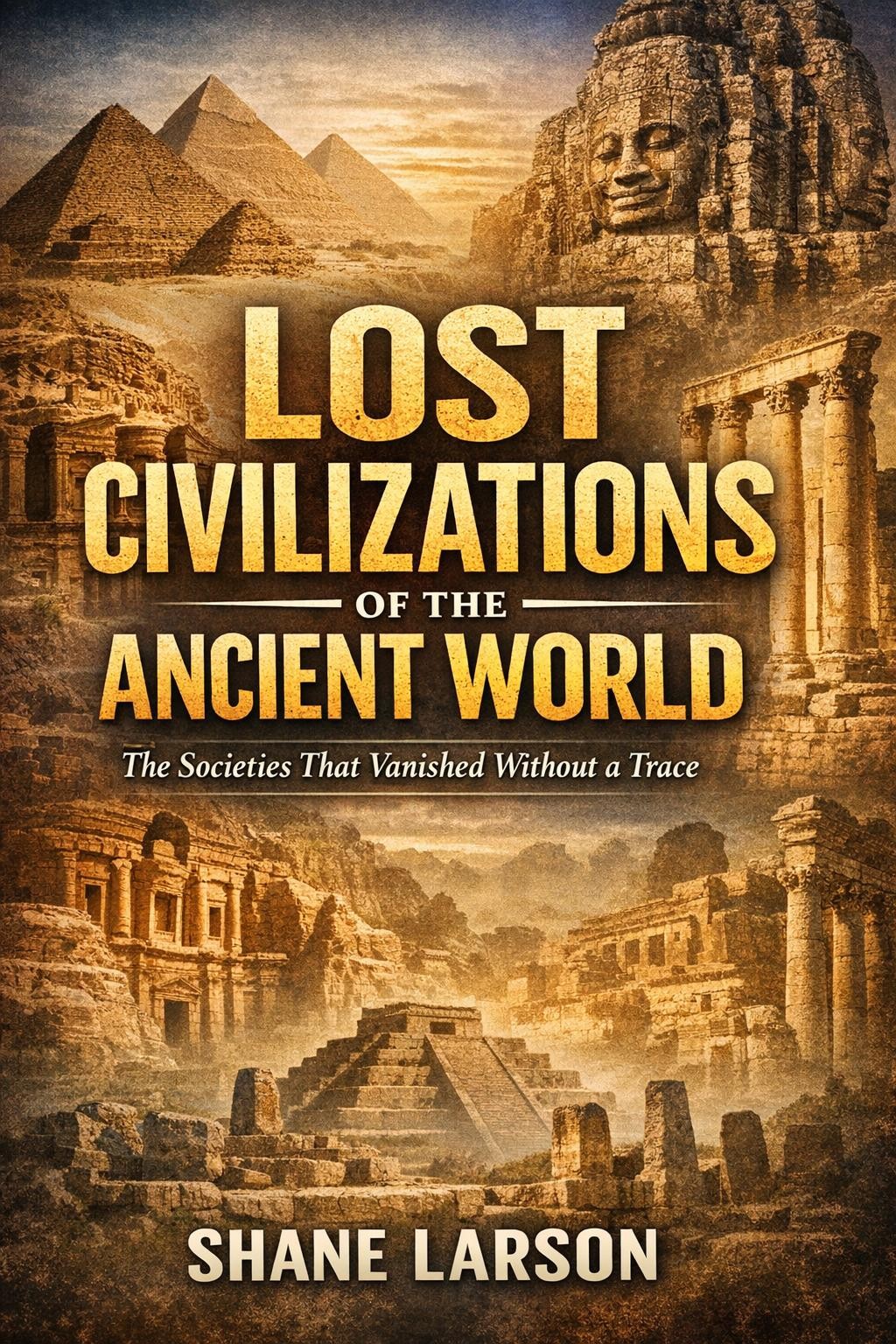
Lost Civilizations of the Ancient World
The Societies That Vanished Without a Trace
By Shane Larson
About This Book
Most civilizations don't vanish. They get absorbed — conquered, renamed, overwritten by whoever came next. What survives in the history books is whatever the winners chose to remember.
That's not history. That's a highlight reel.
Before Rome, before Classical Greece, before the pharaohs were building pyramids, other societies were solving the same problems of scale, governance, agriculture, and trade — and solving them well. Cities with sewers. Hydraulic systems feeding a million people. Trade networks spanning three continents. Writing systems no modern linguist has cracked. Not primitive precursors to civilization. Civilizations in their own right, fully realized, and then lost — swallowed by deserts, jungles, climate collapse, or the deliberate erasure of the empires that replaced them.
Lost Civilizations of the Ancient World covers ten of them.
What you'll discover:
- Indus Valley — the largest civilization of the Bronze Age had grid-planned cities, standardized weights across a thousand miles, and sophisticated urban sanitation. We still cannot read their writing.
- The Minoans — indoor plumbing, multi-story palace complexes, and a Mediterranean trade network a thousand years before Classical Greece. Then a single generation of catastrophe, and gone.
- The Etruscans — Rome didn't invent the arch, the toga, or gladiatorial combat. It inherited all three from the people it absorbed and forgot to credit.
- The Nabataeans — desert engineers who carved Petra from living sandstone and monopolized the most profitable trade corridors in the ancient world before Rome noticed them.
- The Tocharians — mummified European remains discovered deep in western China rewrote assumptions about Bronze Age population movement that archaeologists had held for a century.
- The Kingdom of Aksum — one of the four dominant powers of the ancient world, controlling Red Sea trade and minting its own coinage, erased from Western history almost entirely.
- Great Zimbabwe — a stone city of such scale and sophistication that colonial-era archaeologists invented elaborate theories rather than accept it was built by Africans.
- The Olmec — Mesoamerica's oldest major civilization carved fifty-ton basalt heads and originated the writing and calendar systems the Maya would later perfect.
- Norte Chico — monumental architecture in the Americas by 3000 BCE, with no pottery, no writing, and no evidence of organized warfare. A civilization that doesn't fit any model.
- The Khmer Empire — Angkor Wat was only the most visible part of a hydraulic network that sustained a city larger than medieval London, until climate shift brought the whole system down.
Three continents. Five thousand years. Ten civilizations that achieved things history has spent centuries either ignoring or misattributing.
The record is incomplete. These chapters fill part of the gap.
Also in the Peak Grizzly ancient history catalog: The Bronze Age World*, The Hittite Empire, Assyria, Sparta, Cleopatra's Egypt, and others.*
Included with Kindle Unlimited — read it free if you're a member.
New Ancient History releases and free chapters — no spam, unsubscribe anytime.
More in This Genre
View all →