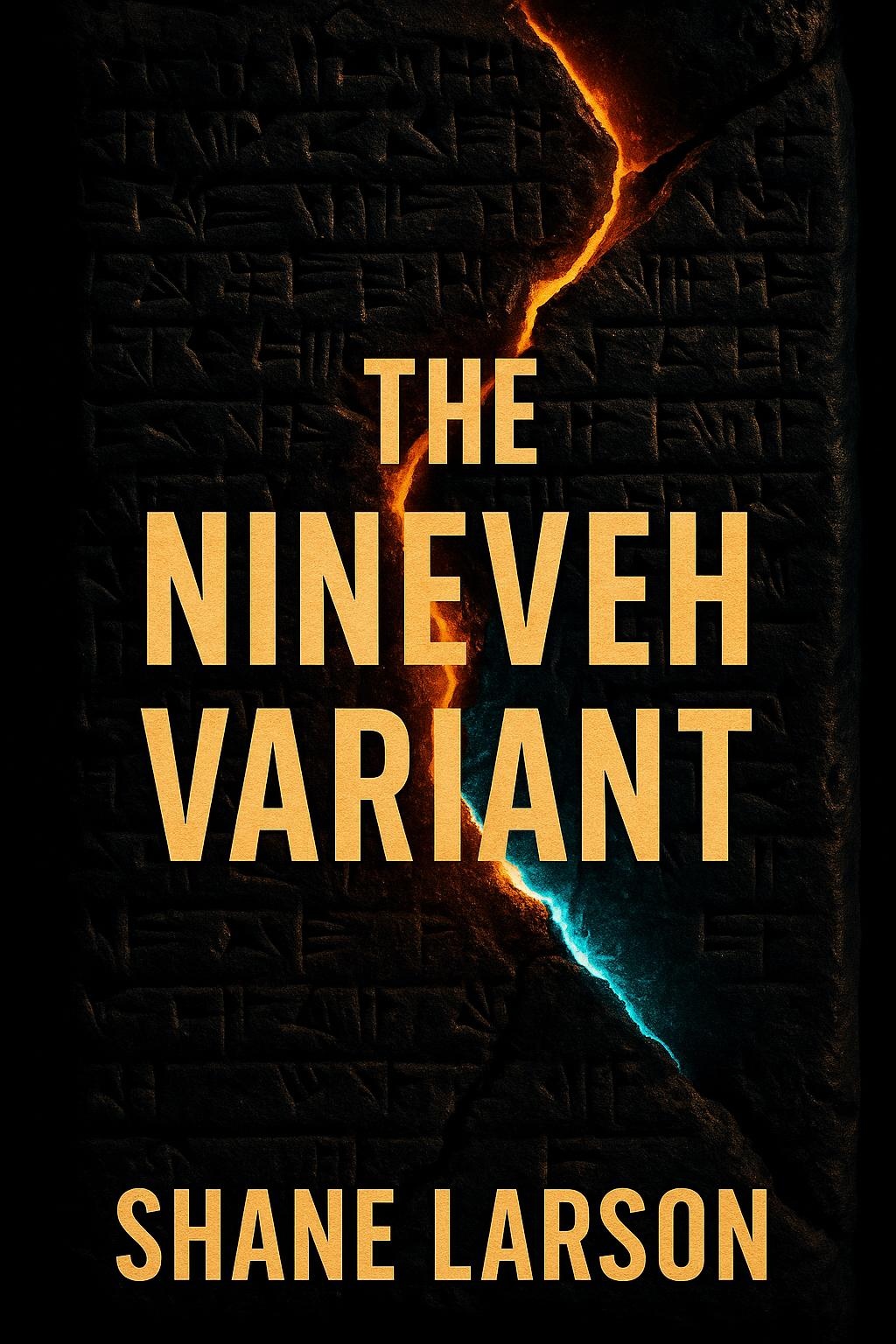
The Nineveh Variant
What the Clay Remembers
By Shane Larson
About This Book
A scribe in a temple complex on the Tigris presses a reed stylus into wet clay. He is recording grain shipments — ordinary, tedious, forgettable work. Except he isn't. Folded into the accounting, invisible to anyone reading the way readers were meant to read, he is hiding a message. He knows that what he witnessed is being erased, that the men erasing it will outlive him, and that clay outlives everyone. He buries the truth in the numbers and hopes.
Thirty-two centuries later, a machine learns to read.
The Nineveh Variant is an archaeological thriller about what happens when artificial intelligence is turned loose on the largest unread archive in human history — the hundreds of thousands of cuneiform tablets sitting in museum drawers, most of them never translated by a living scholar — and finds the message the scribe left behind. It also finds something else: someone, in the present day, who already knows the message is there and will do anything to keep it from being read.
The Story
Dr. Mara Veyrat did not come to California to make history. She came to debunk a software error. A Silicon Valley nonprofit has trained an AI model on the entire scanned corpus of ancient cuneiform, and the model keeps flagging a statistical impossibility: administrative tablets from cities separated by centuries and hundreds of miles that correlate in ways no human philologist has ever noticed. The engineers assume it's a hallucination. Mara — a brilliant, abrasive Assyriologist whose career cratered the last time she was right too loudly — is brought in to bury the anomaly with expert authority.
She can't. Three unrelated tablets carry the same deliberately encoded irregularity, the fingerprint of something scrubbed from the written record during the chaos of the Late Bronze Age Collapse. Not lost. Removed. What the model has surfaced is the residue of an organized purge in ancient Mesopotamia — and a hidden ledger naming the people who ordered it.
Then Mara's old mentor recognizes the pattern, and within days he is dead of a sudden heart attack with his research wiped down to the cloud backups. Around the world, the specific tablets the model's analysis depends on begin disappearing from collections and excavation sites — always just before they can be scanned. Someone is poisoning the dataset from outside the building, completing in the digital age an erasure that began three thousand years ago.
The chase runs from museum storerooms in London and Berlin to a salvage excavation racing a rising reservoir in Iraqi Kurdistan. Mara's only allies are the idealistic engineer who built the model and refuses to let it be dismissed, an antiquities fixer whose charm conceals loyalties she can't map, and the scribe himself — a dead man whose defiant handwriting keeps surfacing wherever the trail leads, as if he anticipated her. Standing across from all of them is a patient, cultured collector who has spent a fortune acquiring the past for one purpose: deciding which parts of it remain unreadable forever.
To prove what was erased, Mara has to reconstruct the oldest cover-up in recorded history from broken fragments, before the last authentic tablet vanishes into a private vault — and before she joins the growing list of people who saw the pattern and didn't survive it.
What You'll Find Inside
- A heroine built for the genre's smartest readers: an Assyriologist whose weapon isn't a gun or a whip but philology — grammar, scribal habit, and the forensic reading of 3,200-year-old clay.
- An AI premise grounded in a real frontier: machine learning models genuinely are being trained to read cuneiform today, and the novel's central question — what happens when a machine notices what generations of scholars missed — is closer than it sounds.
- A conspiracy with two timelines: the ancient purge carried out during the Bronze Age Collapse, and the modern operation working to finish the job before the evidence can be digitized.
- A villain who never raises her voice: a collector who buys history rather than burning it, on the theory that ownership is the most permanent form of censorship.
- Locations that earn their place: the tablet rooms of European museums, the server floors of Silicon Valley, and a dam-flood salvage dig in Iraqi Kurdistan where archaeology runs on a countdown clock.
- A thread of genuine emotion underneath the chase — the strange intimacy of reading the handwriting of someone who hid the truth for you, personally, three millennia before you were born.
Why I Wrote This
I publish narrative history about the Bronze Age, and I build software with AI — and for years those two halves of my work never touched. Then I learned how much cuneiform sits unread in museum basements. Not a few crates. Hundreds of thousands of tablets, more than every living specialist could translate in a hundred lifetimes. Meanwhile, researchers really are training models to read them. At some point I asked the obvious thriller question: if a machine could finally read everything, what's the one thing somebody would least want it to find? The answer turned into Mara, the scribe, and the collector. I wrote the novel I wanted to read — one where the archaeology is real enough to trust and the danger comes from what the clay actually says.
Frequently Asked Questions
Is The Nineveh Variant based on real cuneiform scholarship?
Yes — the scholarly texture is real. Cuneiform tablet archives, the backlog of untranslated texts, the mechanics of how Assyriologists date and attribute tablets, and the current push to apply machine learning to ancient-language translation are all grounded in actual practice. The conspiracy, the characters, and the variant itself are fiction.
Do I need to know anything about the Bronze Age Collapse to follow the story?
No. Everything the plot needs is explained inside the story, through Mara's investigation. If you've never heard of the Late Bronze Age Collapse, the novel works as a thriller; if you have, you'll catch an extra layer of detail.
Is this part of a series?
The Nineveh Variant is a standalone novel with a complete, resolved story. No cliffhanger, no required reading order with any other Peak Grizzly title.
How does it compare to Dan Brown or James Rollins?
It shares the propulsive, puzzle-driven structure of those authors — short timelines, international locations, a mystery buried in the past — but the puzzles here come from real philology rather than invented symbology, and the AI angle gives it a contemporary edge those classic thrillers don't have.
Is it available on Kindle Unlimited?
Yes. Like most of the Peak Grizzly catalog, it's enrolled in Kindle Unlimited, so subscribers can read it at no additional cost.
If You Liked This, You Might Like
- Assyria — the real history of the empire that gave Nineveh its name, and the library that made cuneiform survival possible.
- The Bronze Age World — the nonfiction account of the interconnected civilization whose collapse hides the novel's central secret.
- Sea Peoples: Raiders of the Bronze Age — the unsolved historical mystery at the heart of the same catastrophe Mara is investigating.
- Silent Protocol — another Peak Grizzly thriller about what happens when machines start noticing things they weren't asked to notice.
Three thousand years ago, someone decided which records the future would be allowed to read. The Nineveh Variant is the story of the machine that found the gap — and the woman who has to survive filling it in.
Included with Kindle Unlimited — read it free if you're a member.
New Archaeological / techno-thriller releases and free chapters — no spam, unsubscribe anytime.
More in This Genre
View all →