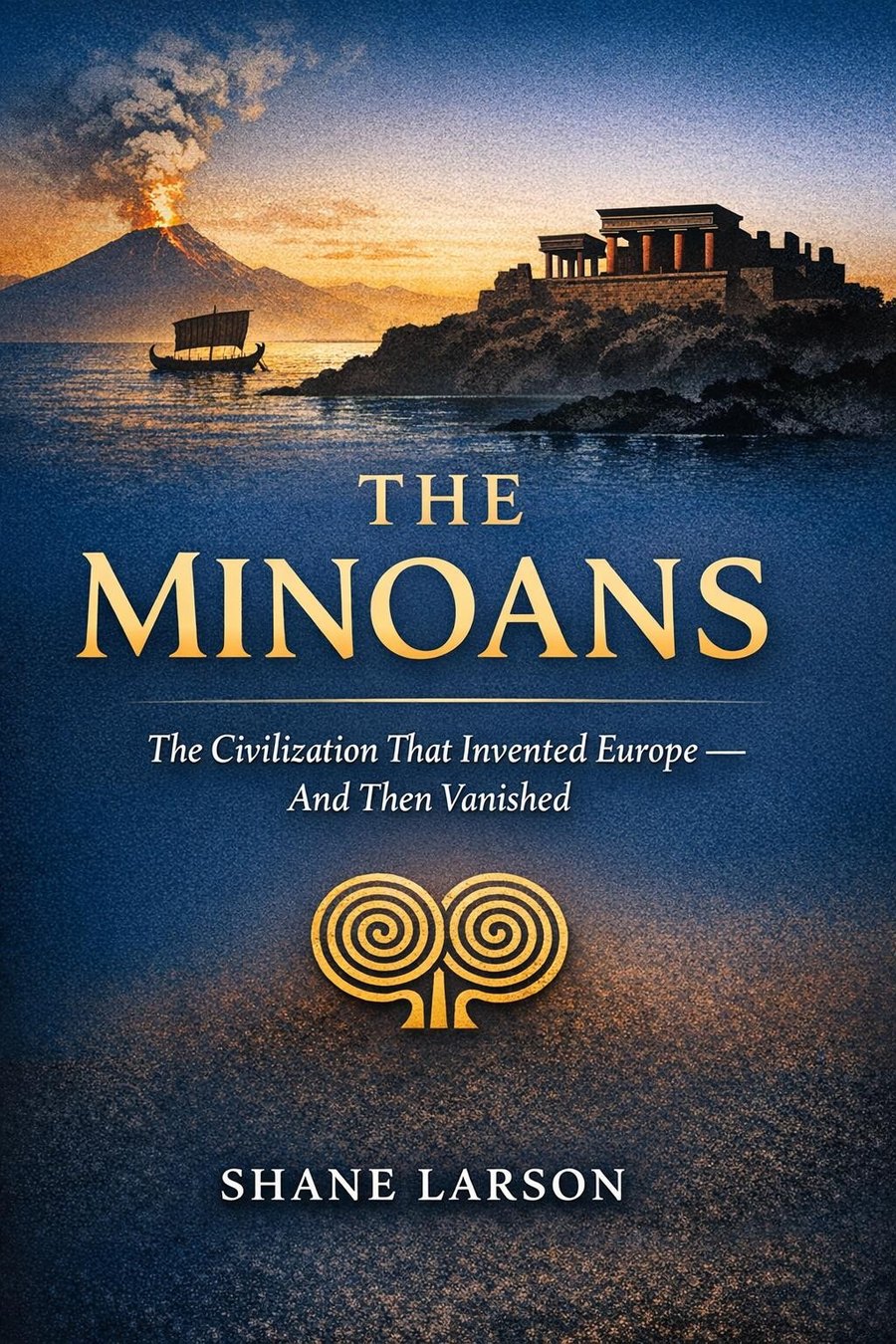
Around 1450 BCE, the palaces of Crete burned. The fires took the roofs, the timber framing, the painted plaster — and they baked the clay tablets stacked in the record rooms hard enough to survive three and a half thousand years in the ground.
This is the central irony of Minoan archaeology. The catastrophe that ended the civilization is the only reason its writing exists at all. Wet clay crumbles; fired clay lasts. Somewhere in the tablets pulled out of Knossos, Phaistos, and Hagia Triada are inventory lists, personnel records, quantities of oil and wool and grain, and possibly the names of Minoan gods and the titles of Minoan officials.
Nobody can read a word of it. Linear A has resisted every attempt at decipherment for over a century. We can count the signs. We can pronounce many of the syllables, because a later script borrowed them. We can identify the numerals and the commodity symbols. What we cannot do is understand the language underneath — which means we are looking at Europe’s first civilization entirely from the outside, reconstructing a whole society from its architecture, its rubbish, its art, and its bones.
An argument built from silence
Minoan Crete is the best-documented civilization in the ancient world that has left no readable account of itself. Everything we say about it is inference.
That constraint runs through the whole book, because it is what makes the subject genuinely difficult rather than merely old. Consider the most famous claim about the Minoans: that they were peaceful. The evidence is real — in something like seven centuries of art, across thousands of frescoes, seal stones, and painted vessels, warriors and battle scenes are close to absent, and the great palace centres were built without fortification walls in an age when everyone else fortified everything. But absence of war imagery is not absence of war, and a civilization that ran a maritime network reaching Egypt and the Levant certainly had the capacity for organised violence. What the Minoans chose was not to glorify it. That distinction is the honest reading, and it is more interesting than the myth.
The same problem shapes everything else. Women dominate Minoan art with an authority they hold nowhere else in the Bronze Age — but prominence in imagery is not proof of political power, and the debate over what it actually means is unresolved. The eruption at Thera was among the largest in human history, and it did not end Minoan civilization: Crete survived it, rebuilt, and carried on for roughly two more centuries before the palaces burned and Greek-speaking Mycenaeans took over the accounts. Even the dating of the eruption is contested by up to a century, with the scientific and archaeological evidence pulling against each other.
And then there is Sir Arthur Evans, who began digging at Knossos in March 1900 and did not so much uncover Minoan civilization as partly build it. The reconstructed concrete columns, the restored frescoes, the “Priest-King” assembled from fragments that probably belong to two or three different figures — a great deal of what millions of visitors photograph on Crete is an Edwardian interpretation set in poured concrete. Separating what was found from what was supplied is one of the real jobs of any honest book on the subject.
What’s inside
- The palace economy. What a Minoan palace actually was — less a royal residence than the administrative core of a redistributive economy, with storage capacity at Knossos running to hundreds of thousands of litres of olive oil.
- Bull-leaping, and whether anyone really did it. The most striking image the Minoans left, examined for what it plausibly records and what it may stylise.
- Two undeciphered scripts. Linear A and the Phaistos Disc, why Linear B fell to Michael Ventris in 1952 while Linear A has not fallen to anyone, and what a single readable tablet would change.
- Akrotiri under the ash. The Theran town buried and preserved intact — and the detail that it contained no bodies, because its inhabitants had warning enough to leave.
- The takeover. How Mycenaean Greeks came to be running Knossos, and why the transition looks less like a conquest and more like an absorption.
- Atlantis, traced backwards. How a real island civilization destroyed by a real catastrophe became the most durable legend in Western thought, and where that reading holds up against Plato’s actual text.
- What ancient DNA settled. The 2013 and 2017 genetic studies, what they established about Minoan origins, and the older theories they retired.
- Evans himself. The founder of the field, his genuine achievements, and the specific errors he built into the site in concrete.
Questions
Do I need to read the other Bronze Age Collapse Chronicles books first?
No. This one stands alone and is chronologically the earliest thread in the series. If you want the wider collapse story afterwards, The Mycenaeans picks up directly where this book ends.
Is this a narrative history or an academic study?
Narrative history, written for a general reader, but it does not simplify away the disagreements. Where specialists are still arguing — the eruption date, the political structure, the nature of Minoan religion — the book lays out the competing positions rather than picking one quietly.
How much of what I would see at Knossos is actually Minoan?
Less than most visitors assume, and the book is direct about which parts are reconstruction. The restored upper storeys, several of the best-known frescoes, and the colour scheme are substantially Evans’s work.
Does it take a position on when Thera erupted?
Deliberately not. The scientific dating and the archaeological dating disagree by close to a century, the argument is unresolved, and the book explains why the gap exists instead of asserting a date it cannot support.
What background does it assume?
None. No prior reading in Aegean archaeology, no Greek, no familiarity with Bronze Age chronology.
An attempt to read that record carefully, mark clearly where the reading runs out, and resist filling the gap with something more satisfying than the truth.