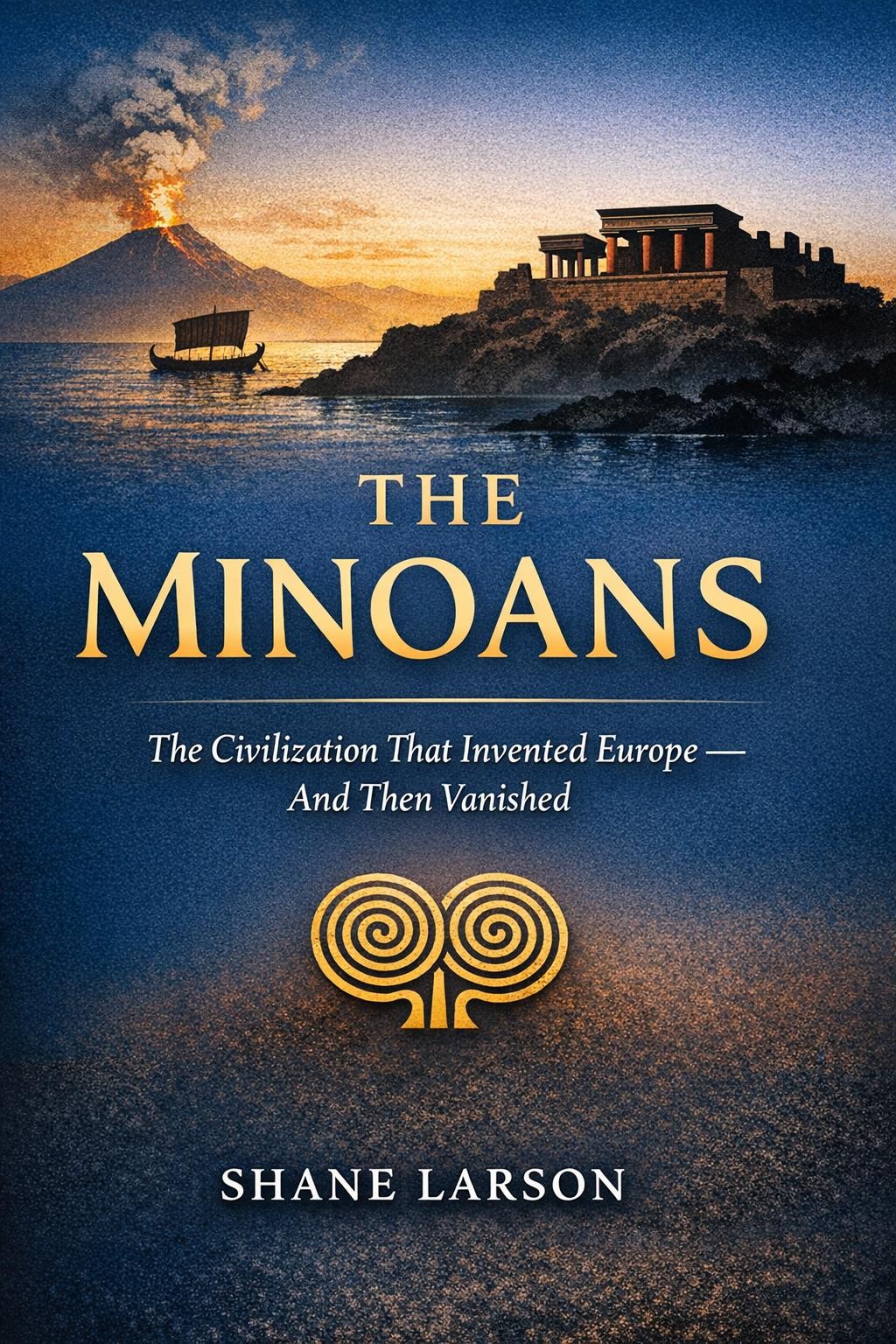
The Minoans
The Civilization That Invented Europe — And Then Vanished
By Shane Larson · The Bronze Age Collapse Chronicles (Book 2)
About This Book
Europe's first great civilization had indoor plumbing when the rest of the continent was living in huts. They built multi-story palaces with light wells and drainage systems. They painted frescoes of breathtaking precision — dolphins in mid-arc, athletes vaulting over charging bulls. They controlled the eastern Mediterranean with a navy so dominant they never bothered to build walls around their cities.
We still cannot read their writing.
The Minoans ruled the Aegean for seven hundred years. Then the palaces burned, the cities fell to the Mycenaean Greeks, and the writing vanished — replaced, like everything else, by the civilization that came after. The people survived. The civilization did not. And what remained behind was art too beautiful to ignore, ruins too sophisticated to dismiss, and a script that has defeated every attempt at decipherment for over a century.
Centuries after the collapse, Plato wrote about Atlantis: an island empire of extraordinary wealth, destroyed by the gods in a single catastrophe. He wasn't writing fantasy. He was writing memory.
The Minoans reconstructs Europe's founding civilization from what it left behind — its palaces, its frescoes, its DNA, and the silence of its undeciphered words.
What you'll discover:
- Knossos and the palace system — multi-story complexes with throne rooms, grand staircases, and storerooms holding enough olive oil to supply an empire, built without a single defensive wall
- The bull-leapers — the extraordinary athletic ritual depicted across Minoan art with an energy and dynamism no other ancient civilization came close to capturing
- Art without armies — a civilization whose frescoes show dolphins, saffron gatherers, and festival crowds but almost never soldiers or conquest
- Linear A and the Phaistos Disc — two writing systems developed across seven centuries, neither of which anyone has deciphered, and what that silence means for everything we think we know
- Women in Minoan power — the prominence of female figures in art, religion, and possibly governance at a level unmatched anywhere in the ancient world
- The Thera eruption — one of the most powerful volcanic events in human history, the buried town of Akrotiri, and why the volcano alone doesn't explain the collapse
- The Atlantis connection — how the destruction of a real Aegean civilization became the most enduring legend in Western history
- Arthur Evans and the invention of the Minoans — the obsessive archaeologist who discovered Knossos in 1900 and then partly rebuilt it in concrete, creating the colorful ruins tourists visit today
- The genetic evidence — what DNA studies revealed about Minoan origins and what that settled, permanently, about where Europe's first civilization came from
This book is for you if:
- You want the full Minoan story — not a chapter in a survey, but fourteen chapters and three appendices of deep narrative history
- You're planning a trip to Knossos, Santorini, or the Heraklion Archaeological Museum and want the complete context
- The detective work of reconstructing a civilization from art and ruins — when the writing refuses to yield — is exactly the kind of history you read for
- You've read The Bronze Age World, The Sea Peoples, or Ancient Apocalypse and want the deepest book in the catalog
They left behind their palaces, their art, their bulls, and their mystery. The one thing they didn't leave behind is the ability to read their words.
The civilization that started everything. The one we still can't fully decode.
Part of the Peak Grizzly Publishing Bronze Age series, alongside The Bronze Age World, The Sea Peoples, The First Dark Age, Iron Age Dawn, and The Hittite Empire.
Included with Kindle Unlimited — read it free if you're a member.
New Ancient History releases and free chapters — no spam, unsubscribe anytime.
More in The Bronze Age Collapse Chronicles
View series →
More in This Genre
View all →