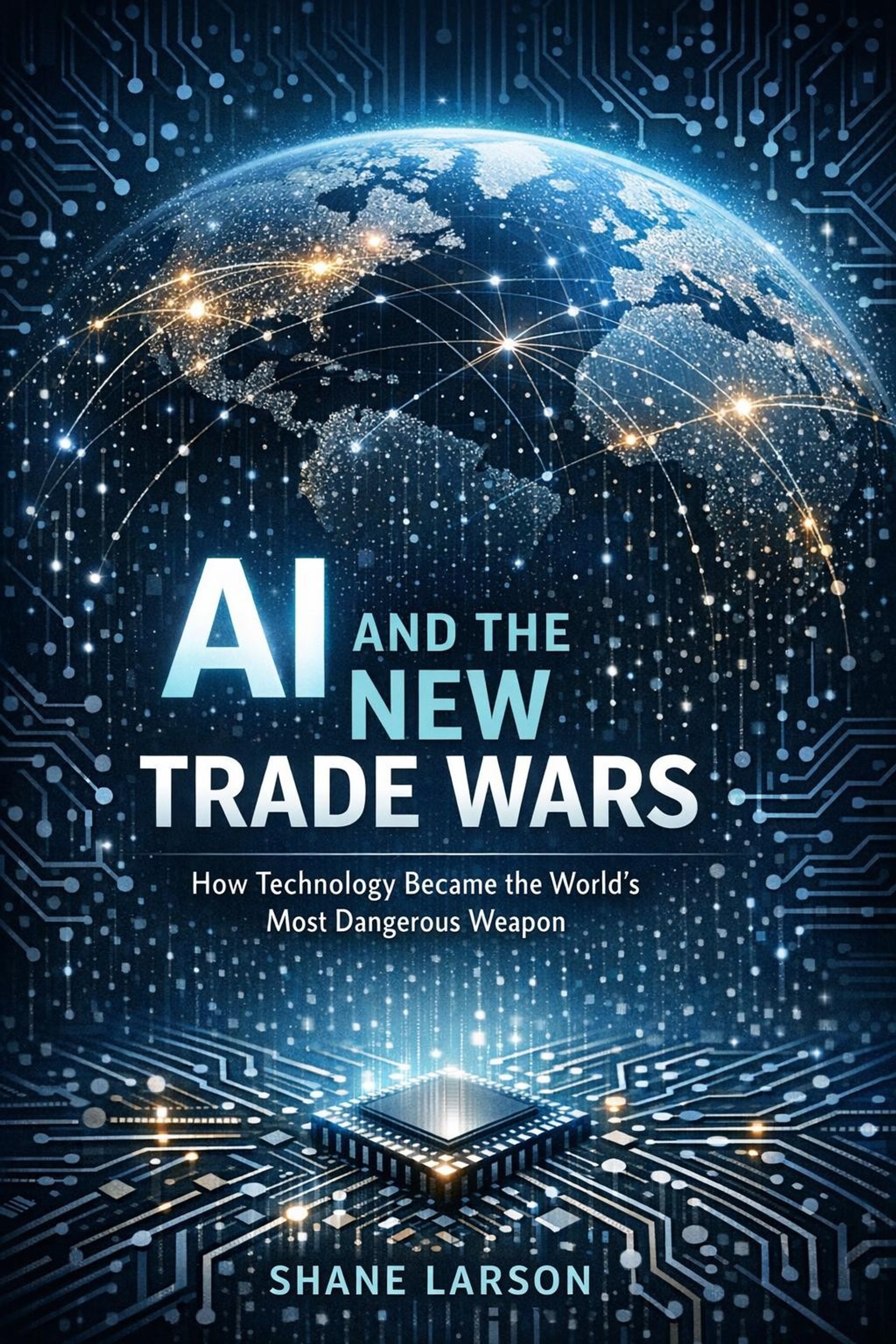
AI and the New Trade Wars
How Technology Became the World's Most Dangerous Weapon
By Shane Larson
About This Book
There is a machine in the Netherlands the size of a city bus that costs roughly as much as a commercial airliner. It uses light so precise it has to be generated by vaporizing droplets of molten tin with a laser, twice. Without it, the most advanced AI chips on earth cannot be made. A handful of companies on the planet are even allowed to buy one—and which ones get to is now decided not in a boardroom, but in a foreign ministry.
That single fact tells you almost everything about the decade we're living through. The race to build artificial intelligence and the slow shattering of the global economy into rival technology blocs are not two stories. They are one story, watched from two windows. The chips that train frontier models, the export rules that decide who can purchase them, the rare-earth minerals packed inside them, and the technical standards that let them talk to each other have become the most contested resources on earth—and the contest is reshaping trade, policy, and business strategy in ways most coverage never connects.
AI and the New Trade Wars is the book that connects them. It's written for the reader who follows the AI boom closely, senses there's a larger geopolitical machine turning underneath the headlines, and wants to actually see the gears.
The Argument
The premise is simple and, once you see it, hard to unsee: technology has quietly replaced oil as the strategic resource nations fight over—except the supply chain is far stranger, far more concentrated, and far more fragile than anything in the petroleum age.
The book maps that supply chain end to end. It walks through the semiconductor pipeline, from raw silicon and exotic lithography equipment to the fabs that turn designs into hardware, and shows why each link is a potential chokepoint. It traces how export controls evolved from an obscure regulatory backwater into a primary instrument of foreign policy. It examines the global scramble for AI talent, the politics of where data is allowed to live, the unglamorous but decisive fight over technical standards, and the rare-earth bottleneck that almost no company plans for until it's too late.
Then it does the thing most geopolitics books skip: it turns to the operator. If the world is fragmenting into parallel technology ecosystems, what does that mean for the company trying to ship products across both? AI and the New Trade Wars offers frameworks for thinking about technology risk the way you'd think about currency or supply risk—and closes with three concrete scenarios for the next ten years, each with a different posture you can prepare for now.
It is deliberately non-partisan. It doesn't pick a flag to wave or forecast collapse. It's an analytical, anti-hype field guide to the forces actually driving the news.
What You'll Discover
- Why one advanced semiconductor now carries more strategic weight than a barrel of crude—and what that reframing changes about how nations behave
- How export controls quietly became a frontline weapon of statecraft, and what that means for any business with a global supply chain
- Why the contest for AI researchers and engineers is as decisive as the contest for hardware, and harder to fix with money
- How data sovereignty rules and obscure technical standards shape who wins, long before the public ever hears about them
- Why rare-earth minerals are a single point of failure most companies have never mapped
- How regulation, parallel tech stacks, and the often-overlooked rest of the world fit into one coherent picture
- Practical frameworks for running an operation, a supply chain, or a strategy function inside a fragmenting market
- Three plausible ten-year scenarios—and the specific moves each one rewards
Why I Wrote This
I spend my working life as an enterprise architect, which mostly means I worry about dependencies—the quiet ones, the ones nobody notices until they break. So when I watched the AI coverage and the trade-war coverage run in separate lanes, it bothered me the way a missing dependency in a system diagram bothers me. These were obviously the same system. The chip your model trains on, the rule that governs whether it can be exported, the mineral inside it, the standard it speaks—those aren't four topics. They're one architecture.
Most of what I read either hyped the technology or moralized about the politics. Almost nothing just laid the machine out flat so a smart, busy person could understand how the pieces fit and make better decisions. That's the book I wanted on my own shelf, so I wrote it. No alarmism, no cheerleading—just the wiring diagram.
Frequently Asked Questions
Do I need a technical or economics background to follow this?
No. The book assumes you're intelligent and curious, not that you already understand fab economics or trade law. Every specialized concept—lithography, export licensing, data localization—is explained in plain language as it comes up, then used to build the larger picture.
Is this a partisan or alarmist book?
Neither. It doesn't take a side between nations or predict doom. The goal is analytical clarity: understand the forces, see the chokepoints, and reason about them calmly. If you're tired of both hype and catastrophizing, this is written for you.
How is this different from Chip War or AI Superpowers?
Those books brilliantly cover pieces of the picture—the semiconductor history, the national AI race. This one connects the full set: chips and talent and data and standards and rare earths and regulation, then translates all of it into practical implications for businesses operating in the middle of the fragmentation. Think of it as the chapter that comes after those books.
Is there anything in here for business leaders specifically?
Yes—that's a core part of the book. The back half moves from explanation to application: frameworks for assessing technology risk, planning around supply-chain concentration, and positioning for a market splitting into rival ecosystems. The three closing scenarios are built to be planned against, not just read.
Is this part of a series?
No, it stands entirely on its own. It does sit alongside other Peak Grizzly titles on AI, technology strategy, and how complex systems fragment and fail—several are linked below if you want to go deeper.
Is it available on Kindle Unlimited?
Yes. It's enrolled in Kindle Unlimited, so KU members can read it as part of their subscription.
If You Liked This, You Might Like
- The Talent Bottleneck — Picks up the talent-war thread in depth: why the scarcest resource in technology isn't hardware, it's people.
- The Technology Collapse Pattern — A structural look at how dominant technologies die, which pairs naturally with the chokepoint and fragmentation themes here.
- The Next Ten Years — A forward-looking companion for readers who want to sit longer with the scenario-planning the final chapters open up.
- Governing at Machine Speed — Goes deeper on the regulatory front, where law and policy struggle to keep pace with the technology they're trying to steer.
Understand the contest quietly reorganizing the global economy—and exactly what it asks of the businesses caught inside it.
New AI & Technology releases and free chapters — no spam, unsubscribe anytime.
More in This Genre
View all →