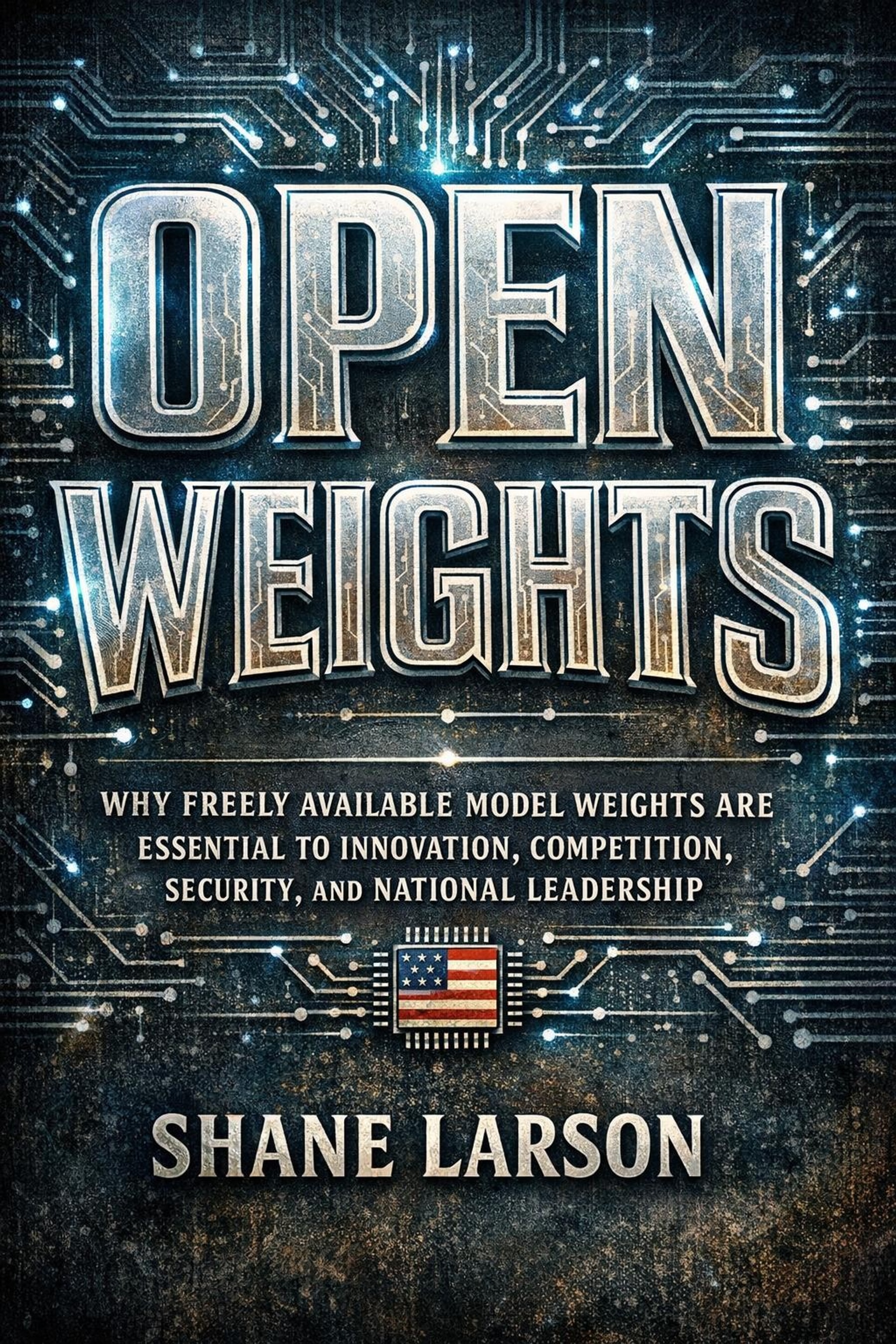
Open Weights
Why Freely Available Model Weights Are Essential to Innovation, Competition, Security, and National Leadership
By Shane Larson
About This Book
On July 24, 2026, a group of companies that spend most of their time suing each other, poaching each other's engineers, and undercutting each other's products all signed the same piece of paper. NVIDIA and Microsoft. Meta and IBM. Palantir and Mozilla — organizations that agree on almost nothing — put their names on a joint statement arguing that America's future in artificial intelligence depends on model weights being freely available for anyone to download, modify, and run.
That should stop you for a second. Companies do not casually endorse giving things away. When the most commercially aggressive firms in technology jointly argue that open distribution is a strategic necessity, something structural is going on underneath the press release.
Here is one version of what that something looks like. A regional hospital wants to use a language model to summarize patient records. It cannot legally ship that data to a third-party API — the law says no. Its only real option is a capable model it can run inside its own walls. Multiply that hospital by every factory with proprietary process data, every credit union, every defense contractor, every agency with sovereignty requirements, and you see the shape of the actual AI economy — the one outside the demo videos.
The Argument
The prevailing story about AI competition is a horse race: whichever country or company builds the single most capable frontier model wins. This book argues that story is wrong, and that believing it leads to bad policy and bad strategy. National leadership in a general-purpose technology has never been decided by who possesses the most impressive artifact. It is decided by diffusion — how quickly the technology soaks into the ordinary economy, into the hands of people who use it to do actual work.
The evidence is not hypothetical, because the same fight already happened once. Open-source software was denounced in nearly identical language two decades ago — a threat to intellectual property, a security nightmare, a gift to adversaries. Then it became the substrate of the entire digital economy, including the infrastructure today's frontier labs train on.
Open weights extend that logic to models. A downloadable model can be inspected, fine-tuned, audited, and run wherever the data lives. That matters for cost, because self-hosting imposes price discipline on API vendors. It matters for competition, because a world where three companies rent intelligence to everyone else is a concentration risk without precedent. It matters for security, because obscurity has never beaten transparency over the long run. And it matters geopolitically, because China has made capable open models an instrument of statecraft — and a nation whose builders standardize on another nation's models has ceded ground no export control can recover.
The book does not pretend the hard questions away. Distillation, misuse, the limits of openness at the extreme frontier — each gets an honest chapter rather than a hand wave. The conclusion is not "open everything." It is that the burden of proof belongs on restriction, and that America's most durable advantage is an ecosystem nobody can switch off.
What's Inside
- A working definition that actually works. What model weights are, what "open" does and does not mean, and why the difference between open weights and open-source AI keeps confusing people who should know better.
- The rerun nobody noticed. How the arguments deployed against open weights map, almost clause for clause, onto the arguments once deployed against Linux — and how that earlier fight resolved.
- The economics of self-hosting. Why downloadable models discipline API pricing, and when running your own model beats renting one.
- Concentration as a national risk. What it would mean for the U.S. economy if access to machine intelligence were metered by two or three vendors, and why antitrust thinking arrives too late to help.
- The defender's dilemma, examined honestly. Why transparency has historically favored defenders over attackers, where that logic holds for AI models, and where it genuinely gets uncomfortable.
- The distillation debate without the shouting. What distillation can and cannot extract, and why treating it as theft misunderstands how technical knowledge propagates.
- China's open-weight strategy, taken seriously. How releasing capable models became an instrument of influence, and what a serious American response looks like.
- Policy that fits the problem. National compute access, shared open assets, narrowly scoped export controls aimed at hardware rather than math — and the restrictions that would hurt the U.S. more than any adversary.
- What to do with this. Concrete implications for founders choosing a stack, enterprises weighing API dependence, and investors reading the market structure.
Why I Wrote This
I build systems for banks and credit unions — institutions that cannot send their data to whichever API is trendy this quarter. For years that constraint shaped everything I architected, and when I started building AI agents, it didn't go away; it got sharper. The clients who need this technology most are frequently the ones least able to use it through a rented endpoint.
I also lived through the open-source fight the first time. I watched the same institutions that called Linux a threat quietly rebuild their businesses on top of it. When the July 24 letter appeared — with signatories who compete viciously on everything else agreeing on this one thing — I recognized the moment. The letter is two pages. The reasoning it compresses deserves more room than that, and nobody else seemed to be writing it down. So I did.
Frequently Asked Questions
What is the difference between open weights and open source AI?
Open weights means the trained model parameters are published and you can download, run, and modify the model. Open source, strictly applied, would also require the training data and full training code, which almost no major lab releases. The book uses "open weights" deliberately and spends a chapter on why the distinction matters — and why weights alone still deliver most of the practical value.
Are open-weight AI models a national security risk?
Some risks are real, and the book separates the credible concerns from the theatrical ones. But restriction carries its own security costs: it blinds defenders, concentrates capability, and pushes the world onto foreign models. Both openness and secrecy have risk profiles, and secrecy's is worse than its reputation suggests.
Do I need a technical background to read this book?
No. The mechanics of weights, fine-tuning, and distillation are explained in plain language before they are used in any argument. Policy, strategy, and investment readers can follow every chapter; engineers will not feel talked down to.
Does the book cover China's open-source models like DeepSeek and Qwen?
Yes — a full chapter examines how Chinese labs turned open releases into a strategic export and what it means when developers worldwide standardize on those models. The point is not alarm; it is that the U.S. cannot respond by restricting its own openness.
What is the July 2026 open weights letter?
A joint industry statement, released July 24, 2026, in which a broad coalition of American technology companies argued that freely available model weights are essential to U.S. innovation, competition, security, and AI leadership. This book gives that compressed argument the full treatment — evidence, counterarguments, and policy detail a public statement can't hold.
Is this book against closed or proprietary AI models?
No, and it says so plainly. The argument is about the ecosystem, not any single model: a country with only closed models has a product; a country with a thriving open layer underneath them has an economy.
If You Liked This, You Might Like
- AI and the New Trade Wars — the geopolitical flip side of this book: chips, export controls, and the fragmenting global AI economy that open weights have to survive in.
- Governing at Machine Speed — where this book argues what AI policy should say, that one examines how institutions can make and enforce policy at all when the technology moves faster than they do.
- The Next Ten Years — the longer trajectory: if diffusion decides leadership, this is the decade in which the diffusion happens.
- The Alignment Problem (For Normal People) — a plain-language companion on AI safety, useful context for the security and transparency chapters here.
The race that matters is not for the best model in a vault. It is for the deepest bench of people who can put good models to work — and this book is the case for building that bench in the open.
Included with Kindle Unlimited — read it free if you're a member.
New AI & Technology releases and free chapters — no spam, unsubscribe anytime.
More in This Genre
View all →