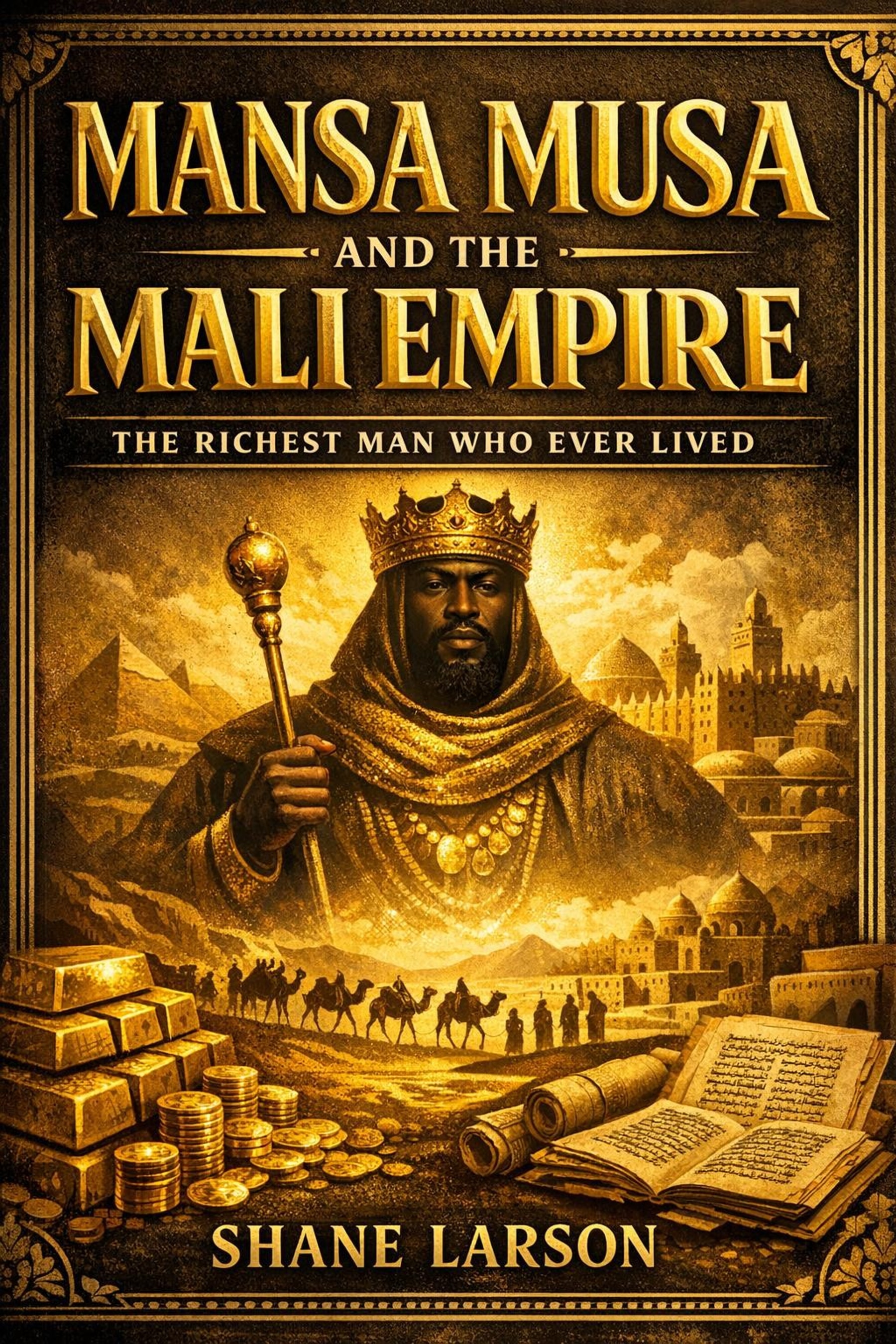
Mansa Musa and the Mali Empire
The Richest Man Who Ever Lived
By Shane Larson
About This Book
A merchant in Cairo in 1325 could have told you something was wrong with the price of gold, even if he didn't know why. It had been falling for months. Too much of it had come into the city the previous year — handed out in the markets, pressed on officials, spent freely by a foreign king and his enormous entourage on their way to Mecca. The metal that anchored the wealth of the Mediterranean had been devalued by the generosity of one man, and it would not fully recover for more than a decade.
That man was Mansa Musa, ninth ruler of the Empire of Mali, and his 1324 pilgrimage across the Sahara is one of the few moments in West African history that the medieval Mediterranean wrote down in detail. The empire he governed stretched wider than Western Europe and sat astride the gold fields that fed half the known world's coinage. He is remembered today, when he is remembered at all, through a single viral statistic — the richest man who ever lived — stripped of the empire, the trade, and the people that made the claim mean anything.
This book puts them back. It tells the story of Mali as narrative history, grounded in the surviving sources and honest about where those sources run thin — which, for an empire this large, they often do.
The Story
The account doesn't begin with Musa. It begins roughly a century earlier with Sundiata Keita, the exiled prince whose victory over a rival king founded the empire, and whose deeds the griots — West Africa's hereditary oral historians — have carried in epic form for seven hundred years. From there the book follows the two commodities that made Mali matter: gold moving north across the desert, and salt moving south to meet it, exchanged at trading towns where fortunes were made on the markup of a mineral most people now take for granted.
Onto that economic foundation comes the pilgrimage that announced Mali to the wider world, and then the city that became its lasting symbol. Timbuktu survives in English as a punchline — shorthand for the most remote place imaginable. It was once the opposite: a center of Islamic scholarship with mosques, universities, and private libraries holding tens of thousands of manuscripts. The book traces how a city of books became a byword for nowhere.
It also asks the harder question. Cairo knew about Mali. So did Fez, and the mapmakers of Europe, who drew Musa on their charts holding a golden orb. So how did an empire that was common knowledge across three continents fall out of the Western story of the past almost entirely — and what does the answer reveal about how that story was assembled?
What's Inside
- The 1324 hajj reconstructed from the sources — how the caravan crossed the desert, what it carried, and how the spending in Cairo depressed the local gold price for years
- The trans-Saharan economy of gold and salt, and why Mali sat at the profitable center of it
- Sundiata Keita and the founding of the empire, including how the griot epic functions as historical evidence
- Timbuktu's rise as a hub of learning, manuscripts, and trade — and the long collapse of its reputation in the Western imagination
- The North African traveler Ibn Battuta's firsthand account of the Mali court when he visited in 1352
- The slow unraveling: the rise of Songhai, the Moroccan gunpowder army that broke it at Tondibi, and the Atlantic shipping routes that quietly drained the desert trade of its purpose
- How African history was written out of the record — and how oral epic, surviving manuscripts, and modern archaeology have been used to write it back in
Why I Wrote This
I kept running into Mansa Musa the same way everyone does now: as a number. A chart of the richest people in history with a medieval African king sitting implausibly at the top, and a caption that never explained anything beyond the wealth. The fact that the figure is essentially unverifiable bothered me less than the fact that the empire behind it had been reduced to a single bragging point.
So I went looking for the actual history, and found that a lot of it is genuinely recoverable — through Arabic chroniclers, through Ibn Battuta, through the griot tradition and the archaeology of the trade towns — and that the reason most of us never learned it has more to do with how Western history was organized than with any shortage of evidence. This book is my attempt to read the whole map instead of one gold coin on it. I've tried to be clear throughout about what we know, what we're inferring, and what we simply can't say.
Frequently Asked Questions
Is this a narrative history or an academic textbook?
It's narrative history written for the general reader. There's no jargon and no background assumed, but the sources are taken seriously and the limits of the evidence are stated plainly rather than papered over.
Do I need to know anything about medieval Africa to follow it?
No. The book starts from the founding of the empire and builds the context as it goes. If you've never read a word about Mali, Songhai, or the Sahara trade, you'll be fine.
Is the "richest man in history" claim actually true?
That's one of the questions the book tackles directly. The short answer is that the figure can't be verified in any modern sense, and the book explains where the claim comes from, why it's so hard to pin down, and why the obsession with it obscures the more interesting story.
Does it cover Timbuktu and the manuscripts?
Yes — Timbuktu gets substantial attention, both as a real center of scholarship and as the source of its strange afterlife as a synonym for the ends of the earth. The fate of its manuscript libraries is part of the story.
How does the empire actually end?
The final chapters follow the transition to the Songhai Empire, the Moroccan invasion that shattered it at the Battle of Tondibi, and the longer economic shift as Atlantic sea routes pulled trade away from the trans-Saharan caravans.
If You Liked This, You Might Like
- The Sea Peoples — another narrative reconstruction of an empire-shaking moment that the standard histories tend to skip past. (verify slug before publishing)
- Canaan to Carthage — for the trade-empire angle: how a commercial network became a power that the Mediterranean couldn't ignore. (verify slug before publishing)
- Ancient Apocalypse — pairs well if the rise-and-fall of a major power is what drew you here. (verify slug before publishing)
The empire was real. The gold was real. The people who built it were real, and the record of them survived — in manuscripts, in oral epic, in the ground itself. This is the history that got left off the map.
Included with Kindle Unlimited — read it free if you're a member.
New Ancient & Medieval History releases and free chapters — no spam, unsubscribe anytime.