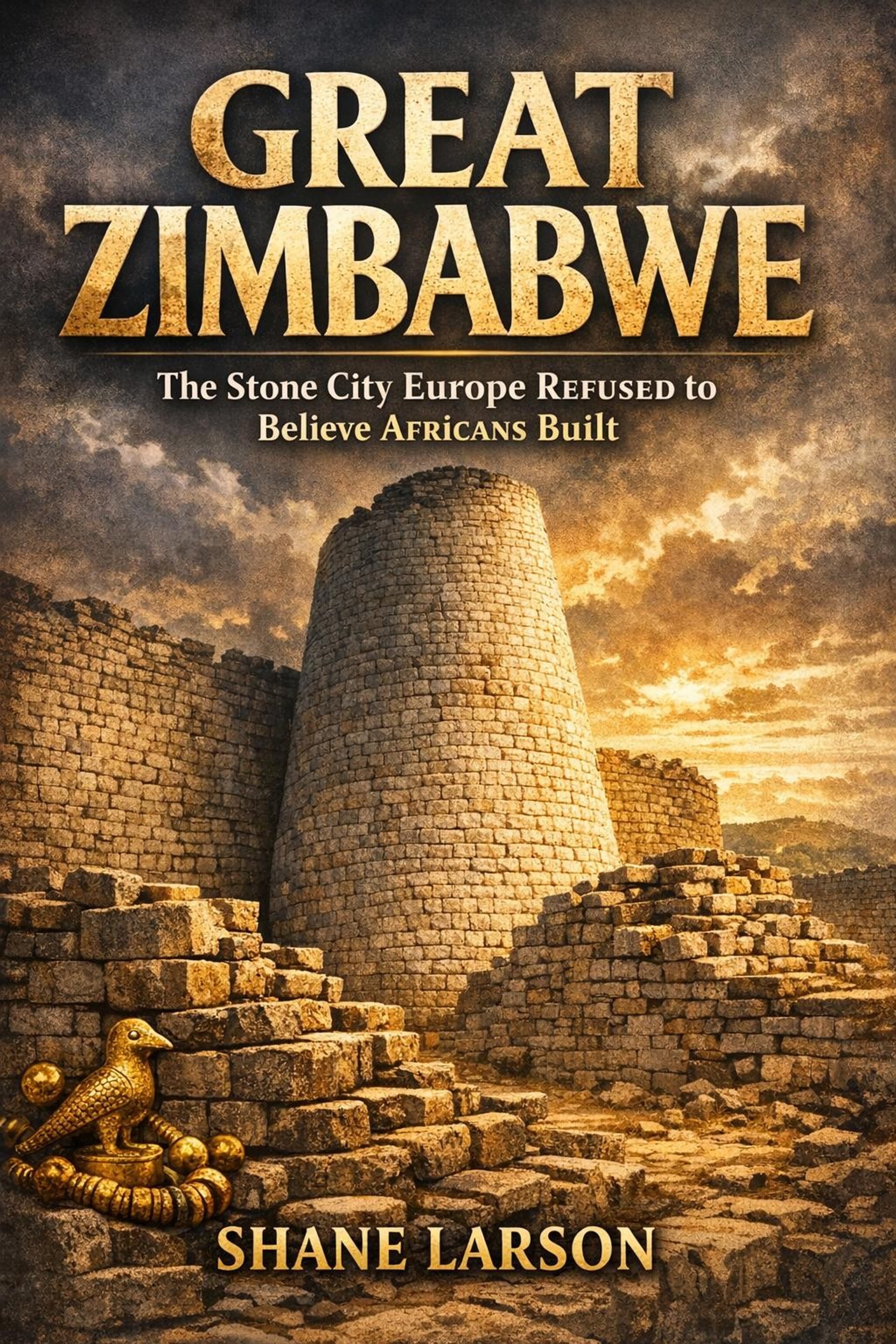
Great Zimbabwe
The Stone City Europe Refused to Believe Africans Built
By Shane Larson
About This Book
Stand inside the Great Enclosure at dusk and the scale stops making sense. The outer wall runs more than 800 feet around, rises over 30 feet in places, and was laid course by course in shaped granite blocks with no mortar holding any of it together. Nothing is carved into the stone. No inscription names a king, marks a date, or explains who raised the walls or why. For most of the twentieth century, a colonial government treated that silence as proof of something — proof, it claimed, that the builders had left no record because the builders could not possibly have been African.
They were African. The evidence was always there, in the soil and the stone and the gold. The story of how that obvious fact was buried — literally dug up and thrown away — is one of the cleanest examples we have of how history gets erased on purpose.
This book follows both threads at once: the rise of Great Zimbabwe as the capital of a wealthy southern African state, and the ninety-year campaign to deny that it was African at all.
The Story
Around the year 1300, roughly eighteen thousand people lived on this plateau between the Limpopo and the Zambezi rivers. They were rich, and the source of the wealth was two things: cattle and gold. Herds were currency and status. Gold was mined across the region and moved down the river systems to the Indian Ocean coast, where it entered a trade network that ran far beyond Africa. Archaeologists working the site have recovered Song-dynasty porcelain from China, glass beads from Persia, and goods from the Arab and Indian markets that fed on East African gold. A city a thousand miles inland was plugged into a maritime economy that stretched to the South China Sea.
Then, sometime in the fifteenth century, Great Zimbabwe was abandoned. The reasons are still argued over — exhausted grazing land, shifting trade routes, drought, political fracture, or some combination — and the book lays out the leading theories without pretending the question is closed. Power moved north and west to successor states: the kingdom of Mutapa, which the first Portuguese visitors wrote about, and Torwa to the southwest. The stone city emptied, but the civilization that built it did not vanish.
What happened next is the second half of the book. When Portuguese explorers heard of inland stone ruins and inland gold, they reached for the Bible and called it Ophir, the legendary source of King Solomon's wealth. Centuries later the German geologist Karl Mauch saw the ruins and decided they were Phoenician. By the time Cecil Rhodes's regime controlled the territory, the denial had hardened from speculation into policy. Sympathetic excavators cleared away the African archaeological layers as if they were rubble; archaeologists who correctly identified the site as medieval and African were contradicted, sidelined, and ignored. The official story held until the country won independence in 1980 — and named itself Zimbabwe, after the very city its former rulers had refused to believe Africans built.
What's Inside
- The engineering of the walls — how mortarless dressed-granite construction actually works, and what the building techniques reveal about the people who used them
- The gold-and-cattle economy: where the wealth came from, how it was measured, and how it powered the city's growth
- The Indian Ocean trade connection, traced through the Chinese porcelain, Persian glass, and coastal links that put an inland African capital on a global map
- The competing explanations for the fifteenth-century abandonment, weighed against the available evidence
- The successor kingdoms of Mutapa and Torwa, and what the earliest European accounts got right and wrong
- The Ophir myth, Karl Mauch's Phoenician theory, and how a misreading became a colonial conviction
- How Rhodes-era archaeology destroyed evidence and suppressed the researchers who told the truth
- Why Great Zimbabwe stands as the clearest case study in how a civilization's history can be taken from it — and recovered
Why I Wrote This
I kept running into Great Zimbabwe sideways — a footnote in a trade-history book, a single paragraph in something about the medieval Indian Ocean — and every time, the actual story was bigger and stranger than the space it was given. Then I read about the early excavations, the ones where the diggers cleared out exactly the layers that would have proved the site's African origin, and I couldn't let it go.
Most "lost city" books trade on mystery. The mystery here is partly manufactured. The walls were never lost; they were standing the whole time, in plain view, while an empire spent decades insisting they meant something other than what they obviously meant. I wanted to tell the real history — the gold, the cattle, the trade, the building — and then tell the second, uglier story of what was done to it, because you can't understand one without the other. This isn't ancient-aliens material. It's a documented case of how knowledge gets unmade.
Frequently Asked Questions
Do I need to know African history to follow this book?
No. It's written for a general reader with no background assumed. If you've read accessible narrative history about Greece, Rome, or Egypt and want something outside those familiar lanes, this is built for exactly that reader.
Is this an academic text or a narrative history?
It's narrative history — written to be read straight through, not consulted like a reference. The scholarship is there underneath, but the goal is a clear, paced story rather than a citation-heavy monograph.
Why is the city called Great Zimbabwe, and is that connected to the modern country?
Directly. "Zimbabwe" comes from a Shona term for stone houses or a chief's dwelling. When the country gained independence in 1980, it took its name from the ancient stone capital — a deliberate reversal of the colonial-era claim that Africans hadn't built it.
Does the book settle why the city was abandoned?
It doesn't pretend to. The abandonment is genuinely unresolved, so the book presents the strongest competing theories — environmental strain, trade shifts, drought, political change — and explains the case for each rather than declaring a winner.
Is this available on Kindle Unlimited?
Yes. It's enrolled in Kindle Unlimited, so it's free to read for KU subscribers, alongside the rest of the Peak Grizzly ancient-history catalog.
If You Liked This, You Might Like
- Mansa Musa and the Mali Empire — the West African gold empire whose ruler became the richest man in recorded history; the natural companion read for anyone drawn to medieval African wealth and trade.
- Aksum — another major African civilization that mastered long-distance trade and minted its own power before fading from the popular story.
- The Maya Collapse — a parallel mystery of a great society that built monumentally and then walked away, for readers fascinated by abandonment and decline.
- The Empire Collapse Pattern — steps back from any single civilization to ask why the mightiest powers fall, putting Great Zimbabwe's end in a wider frame.
The city was real, the builders were African, and the walls never stopped standing. This is the history they held up the whole time — and the long fight to take it back.
Included with Kindle Unlimited — read it free if you're a member.
New Ancient & Medieval History releases and free chapters — no spam, unsubscribe anytime.