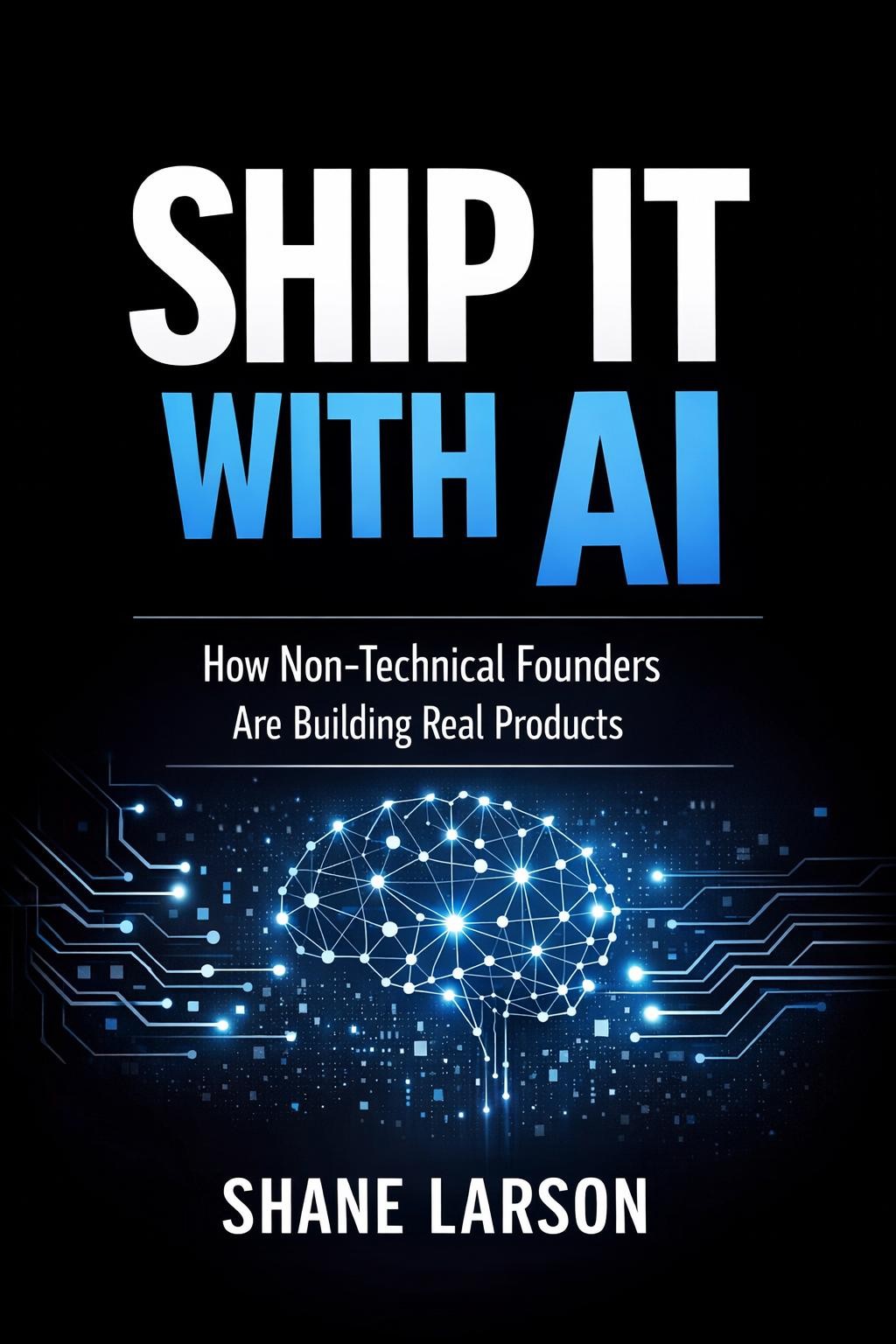
Ship It With AI
How Non-Technical Founders Are Building Real Products
By Shane Larson
About This Book
Somewhere there is a notebook — or a notes app, or a folder of abandoned pitch decks — full of product ideas that were never built. Not because the ideas were weak. Because the person who had them couldn't write the code, couldn't afford a developer, and couldn't talk a technical co-founder into taking the risk. For twenty years, that was where most software ideas quietly went to die: not in the market, but in the gap between knowing what to build and being able to build it.
That gap just closed.
A new class of founder has started shipping real, revenue-generating products without an engineering background — no CS degree, no dev team, no resentful weekends spent forcing themselves to learn syntax. They are operators, consultants, and domain experts who understand their customers better than any contractor ever could, and AI coding tools have removed the single barrier that always stood between them and a working product.
The Argument
Ship It With AI makes a simple, slightly uncomfortable case: now that AI can handle the building, the part that decides whether you succeed was never the building in the first place. It was the judgment around it. What to build. Who it's for. Whether anyone will pay. How they'll ever find it.
This is deliberately not a coding book. It assumes you can describe what you want in plain language and follow a clear process — and from there, it treats AI coding tools as exactly what they are: powerful, fast, and genuinely capable of producing a real product, but not a substitute for knowing your market or scoping your idea. The book walks the full arc a non-technical founder actually travels, from a vague "someone should build this" to a deployed application with paying customers, and it leads every step with the business decision before it touches the implementation.
What makes the AI-enabled builder different from the no-code dabbler is seriousness about fundamentals. Validation still matters — arguably more, because cheap building makes it dangerously easy to build the wrong thing fast. Distribution still matters. Pricing, retention, and the unglamorous work of getting a stranger to trust you with a credit card all still matter. The tools changed who gets to attempt this. They did not change what the attempt requires.
What's Inside
- Validation before code. A framework for pressure-testing a product idea before you build any of it, built around the reality that AI makes building the easy part and choosing wisely the hard part.
- A tool map, not a tool list. Which AI coding tools to reach for, when, and how to combine them — written for someone evaluating them as a founder, not as an engineer.
- The five decisions that matter. The small set of architecture choices that actually shape a first product, explained so you can make them confidently in a single afternoon and stop second-guessing the rest.
- Conversation-driven development. How to assemble a complete MVP by describing intent and iterating in plain language, rather than wrestling with code you didn't write.
- The infrastructure you can't skip. Authentication, payments, deployment, and hosting — the genuinely non-negotiable pieces — explained without the jargon that usually hides them.
- Your first ten paying customers. How to reach them through audiences and channels you already have, instead of waiting on a marketing budget you don't.
- Life after launch. Reading real feedback, iterating without breaking what works, scaling without a team, and the honest signals that tell you when it's finally time to hire engineers.
- Founder stories throughout. Concrete accounts of domain experts who built and shipped, used to anchor each concept in something that actually happened.
Why I Wrote This
I've spent my career as a software engineer and architect, and more recently building production AI agents — including inside a regulated financial institution, where "move fast" is not exactly the house style. So I watched this shift happen from the inside, and what struck me wasn't the technology. It was the people it suddenly unblocked.
For years I'd meet operators and consultants with genuinely sharp product instincts who had simply accepted that building software wasn't for them. The wall was always the same: the code, or the cost of someone to write it. When AI tools knocked that wall down, a lot of the resulting advice swung straight into hype — "anyone can build anything, no skills required." That's not true, and pretending it is sets people up to fail. What is true is that the technical barrier is gone and the business barriers are exactly where they've always been. I wrote this for the capable, non-technical person who's ready to take the business seriously now that the building no longer requires permission.
Frequently Asked Questions
Do I need to know how to code to follow this book?
No. The book assumes you can describe what you want clearly and work through a structured process, but it does not teach programming and does not expect you to write code yourself. The whole premise is building through AI tools and good judgment rather than through engineering skill.
Is this a technical manual or a business book?
It's a business book first. Every chapter leads with the decision — validate, scope, price, distribute — and then shows the practical implementation. If you're looking for deep code-level instruction, the technical companion below is the better starting point.
How is this different from The Vibe Coded SaaS?
The Vibe Coded SaaS is the technical companion: it goes deeper into the actual build using AI agents and tools like Claude Code. Ship It With AI is the business playbook that sits alongside it — validation, distribution, pricing, and the founder decisions that determine whether the thing you build becomes a business. They're designed to be read together, in either order.
Will the specific AI tools mentioned go out of date quickly?
Individual tools move fast, and the book is honest about that. But the bulk of it is about durable decisions — how to validate, how to scope, how to find customers — that outlast any particular tool. The aim is to leave you able to evaluate whatever ships next, not dependent on this month's favorite.
Who is this book not for?
It's not for someone hunting a passive get-rich-quick scheme, and it's not for an experienced engineer who wants advanced architecture theory. It's for the domain expert or operator who has real product instincts, has been blocked by the technical barrier, and wants an honest, business-first path to shipping something people will pay for.
If You Liked This, You Might Like
- The Vibe Coded SaaS — the technical companion to this book, walking through an actual build with AI agents and Claude Code.
- Ship It Saturday — for the founder who wants to compress the whole build-and-launch arc into a single focused weekend.
- The Zero Employee Company — what happens after the MVP: building a business that runs on AI instead of headcount.
- AI for Busy Professionals — practical, no-code ways to put AI to work first, if you're not ready to build a full product yet.
For the expert who always had the idea and never had the path: the path is open now, and the work that remains is the work that always mattered.
New AI & Technology releases and free chapters — no spam, unsubscribe anytime.
More in This Genre
View all →