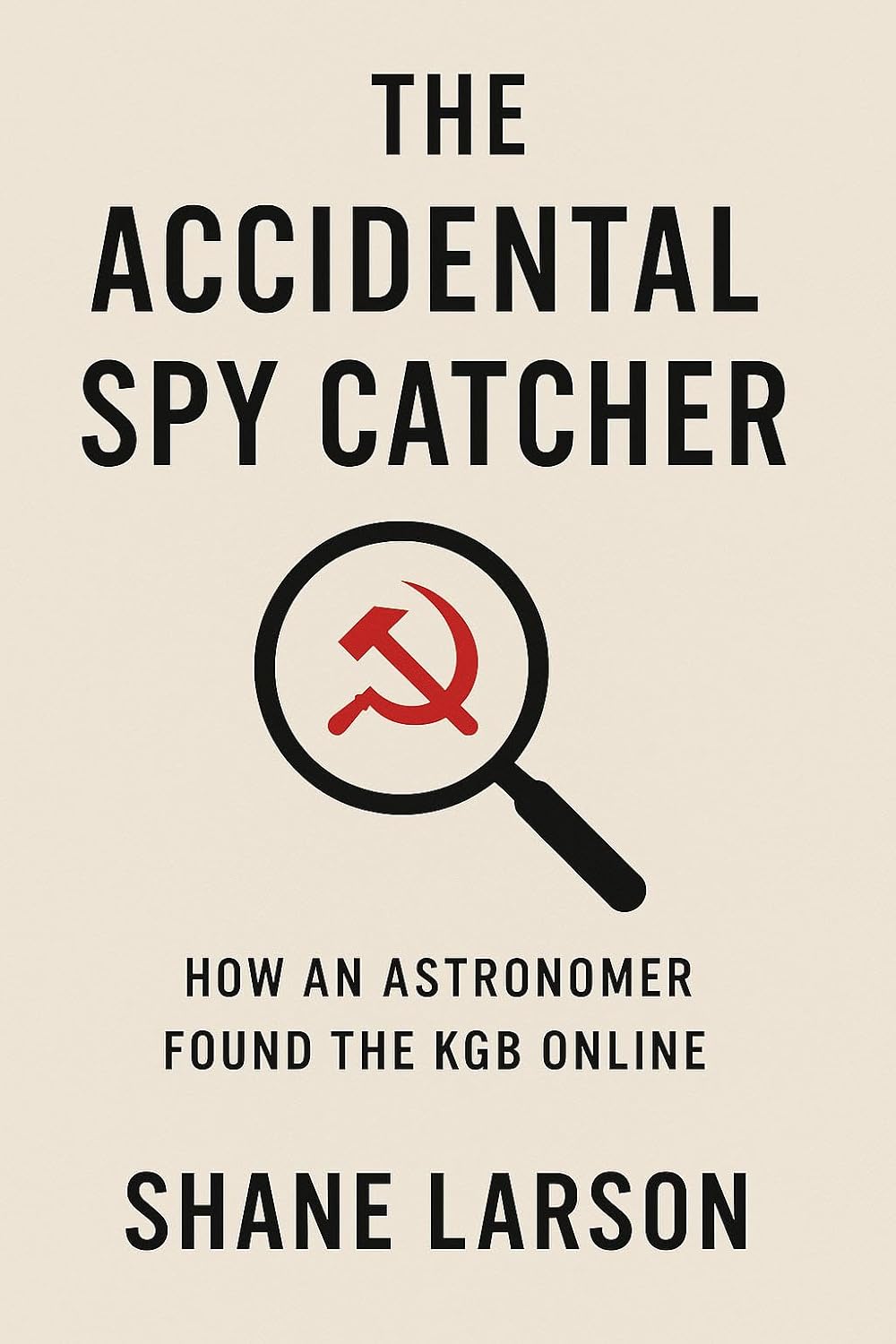
The Accidental Spy Catcher
How an Astronomer Found the KGB Online
By Shane Larson · Digital Outlaws (Book 5)
About This Book
A 75-cent accounting error. A year-long obsession. The first cyber spy hunt in history.
In 1986, Cliff Stoll was an astronomer doing system administration work at Lawrence Berkeley Laboratory — the kind of job you take when grant funding runs out. When someone asked him to track down a minor billing discrepancy in the computer system, he expected a clerical error. What he found instead was a hacker moving systematically through American military networks, stealing secrets and selling them to the KGB.
The FBI wasn't interested. The CIA passed. The NSA wouldn't return calls. Nobody in the American national security establishment believed that a moderately funded hacker with a modem represented a serious intelligence threat.
Stoll decided to catch him anyway.
With no budget, no training, and no institutional backing, he built a one-man surveillance operation in the basement of a national laboratory — monitoring intrusions in real time, tracing connections across international phone networks, and eventually engineering the first honeypot trap in the history of cybersecurity. What began as a 75-cent discrepancy ended with the unmasking of a West German hacker ring working directly for Soviet intelligence.
What you'll discover:
- How a minor accounting error became the first documented case of international cyber espionage
- Why every American intelligence agency refused to investigate — and what their blind spots reveal about institutional failure
- The mechanics of the honeypot trap that finally worked — and why it was as much psychology as technology
- What the KGB was actually after, and what they paid for it
- The techniques Stoll pioneered that became foundational to modern threat hunting
- Why a case from 1986 remains one of the most instructive stories in the history of network security
This is a true story about an amateur who accomplished what the entire American national security apparatus couldn't — and in doing so, helped invent a field that didn't yet have a name.
The Soviet Union wanted America's secrets. They didn't expect an astronomer to be watching.
Book 5 in the Digital Outlaws Series.
Included with Kindle Unlimited — read it free if you're a member.
New Cybersecurity History releases and free chapters — no spam, unsubscribe anytime.
More in Digital Outlaws
View series →
More in This Genre
View all →