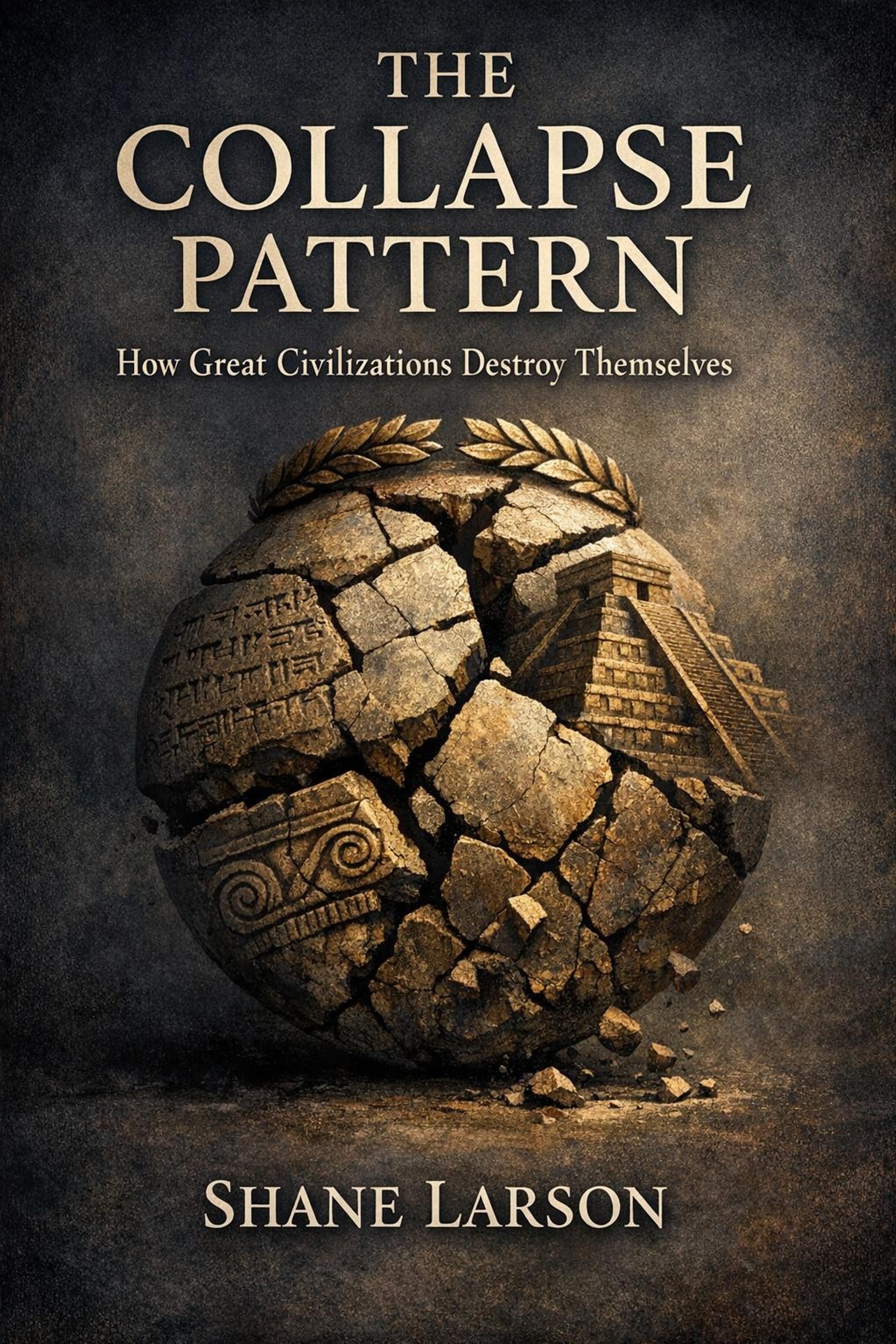
The Collapse Pattern
How Great Civilizations Destroy Themselves
By Shane Larson · The Collapse Pattern (Book 1)
About This Book
Sometime in the late 1200s AD, in a canyon alcove in what is now southwestern Colorado, a family swept the floor of their room. They left a jar of corn in the corner, stacked their tools against the wall, and raked the ash in the fire pit flat. Then they fitted a shaped sandstone slab into the doorway, chinked the gaps with mortar, and walked out.
There is no destruction layer at Mesa Verde. No burned roof beams, no arrowheads in the doorways. The evidence reads like people closing up a house for the winter, fully intending to come back. Nobody came back. The cliff dwellings stood empty for six hundred years, until two ranchers chasing stray cattle through a snowstorm in 1888 looked across a canyon and saw a stone city in the rock face. The corn was still in the jars.
Twenty-four centuries earlier and half a planet away, the king of Ugarit — a wealthy Syrian port where merchants did business in half a dozen languages — wrote to the king of Cyprus in something close to panic. Enemy ships had burned his towns, and he could do nothing: his army was in Anatolia serving the Hittites, his fleet deployed far to the west. Ugarit burned. The clay tablets carrying that last correspondence were baked hard by the fire that destroyed the city, which is the only reason anyone can read them today.
A family that packed carefully and left. A kingdom that burned with its final letters undelivered. On the surface, nothing in common. Stand back far enough and they are chapters of the same story.
The Argument
Every civilization that has ever collapsed has been handed its own private explanation. Akkad fell because a king offended the gods — that is what the Mesopotamians themselves concluded. Rome fell to the barbarians, or the Christians, or lead in the water pipes, depending on which century's historians you consult. The Maya fell to drought, or warfare, or overpopulation. Each catastrophe gets treated as a singular tragedy with local causes.
Put them side by side and the local details fall away. What is left is a sequence, and it is the same sequence in societies that had no contact with one another. A society solves its problems by adding complexity — more administration, more infrastructure, more specialization, more layers between a problem and its fix. This works, which is exactly why it keeps happening: every new layer is a rational answer to a real problem. But complexity has to be fed, and over time each layer returns a little less than the one before while costing at least as much. Meanwhile the trade routes and tribute networks that made the society rich quietly become the channels along which failure travels. The people running the system, insulated by wealth and distance from its rough edges, are reliably the last to notice anything is wrong. Then the environment shifts — a drought that lasts decades instead of seasons — and a shock the society would have shrugged off a century earlier brings the whole structure down.
Complexity past its returns. Dependencies deepening invisibly. Elites disconnected from consequence. A shock arriving through the very channels that carried prosperity. That recurrence is the first claim of this book. The second is the one that matters: the pattern is visible while it is happening. The king of Ugarit could see the ships. Maya kings watched reservoir levels drop year after year and responded, in several cities, by building larger monuments — as though grandeur were a hydraulic policy.
This is not a book of predictions. It is careful about the difference between recognizing a pattern and forecasting an outcome, and it is built from archaeology, climate proxy records, and the documents the collapsing societies left behind.
Why I Wrote This
I kept running into the same frustration. Nearly every good book about a collapsed civilization is about one civilization — deep, careful, and hermetically sealed. The Maya specialists talk to Maya specialists. The Bronze Age people talk to Bronze Age people. Everybody has their own drought, their own invaders, their own theory, and nobody puts the files next to each other.
So I put them next to each other, mostly to see whether the resemblance I thought I was noticing would survive contact with the evidence. It did, more strongly than I expected. The uncomfortable part is not that civilizations end. It is how ordinary the last century looks from the inside, and how much of the record is people describing the symptoms accurately and drawing exactly the wrong conclusion.
Frequently Asked Questions
Is this a doom book about modern collapse?
No. Roughly one chapter deals with the present, and much of it is about the limits of the comparison — what pattern recognition can legitimately claim and where it turns into fortune telling. The other eleven chapters are history. If you want a forecast, this will disappoint you on purpose.
Do I need to read the other Collapse Pattern books first?
No. This is Book 1, and the origin of the framework the rest of the series applies to companies, economies, empires, technologies, and institutions. Any of them reads alone, but this is the one that builds the argument from the ground up.
What background knowledge does it assume?
None. Every civilization is introduced from scratch, with dates and geography supplied where they matter. Nothing is written over a newcomer's head.
Which collapse gets the most attention?
The Late Bronze Age and the Maya carry the heaviest chapters, because both offer unusually good climate data alongside written records — the combination that makes the sequence legible. Rome gets a chapter largely devoted to correcting how it is usually told.
How is this different from a general "rise and fall of empires" history?
Those books are organized by civilization. This one is organized by mechanism — the case studies exist to test a claim, so they are compared rather than narrated in sequence, and the two chapters on survival and recovery run as long as any collapse chapter.
If You Liked This, You Might Like
- Collapse Proof — the inverse question: this book asks why societies fail, that one asks what the survivors had in common.
- The Ecological Collapse Pattern — takes the environmental thread from Chapter 3 all the way down, into societies that dismantled the ground they stood on.
- When the World Burned — Chapter 5 compresses the Bronze Age collapse because it has four other civilizations to reach; this is the full account.
- The Maya Collapse — the best test case for collapse without invaders, given room for the drought record and the cities that quietly did not collapse at all.
Five civilizations, no contact between them, the same sequence running to the same halt. The value is not in knowing they ended. It is in recognizing what the last century looked like from inside, while it was still being lived.
Book 1 of The Collapse Pattern series.
What You'll Learn
- **Five collapses examined in full**, not summarized: the Akkadian Empire, the Late Bronze Age system, Rome, the Classic Maya, and the Ancestral Puebloans of the Colorado Plateau.
- **Why complexity is a trap rather than a mistake.** Joseph Tainter's diminishing-returns thesis, applied to societies solving genuine problems right up until the solutions cost more than the problems.
- **What the climate record now proves.** The 4.2-kiloyear drought under Akkad, the dry twelfth century BC, the Maya mega-droughts, the Great Drought of 1276 — dated, measured, and in every case survivable on its own.
- **The case against the word "fall."** Rome is the standard example of sudden collapse and a terrible one; the scholarly argument about transformation versus catastrophe is engaged directly rather than waved at.
- **Collapse that looks like a decision.** The Ancestral Puebloans did not lose a war. They executed a generation-long migration, and the sealed doorways show how deliberately.
- **The warning signs, itemized:** elite insulation from consequence, short-term thinking inside long-term systems, extraction outrunning regeneration, institutional knowledge walking out the door, and dependencies nobody has mapped.
- **Why some societies survived what destroyed their neighbors** — Egypt, China, Byzantium — how much was resilience versus luck, and what survivors did afterward, with simplification treated as a strategy rather than a defeat.
- **The modern parallels, handled honestly**, including a straight account of what the historical record cannot tell us about our own century.
Included with Kindle Unlimited — read it free if you're a member.
New The Collapse Pattern Series releases and free chapters — no spam, unsubscribe anytime.
More in The Collapse Pattern
View series →
More in This Genre
View all →