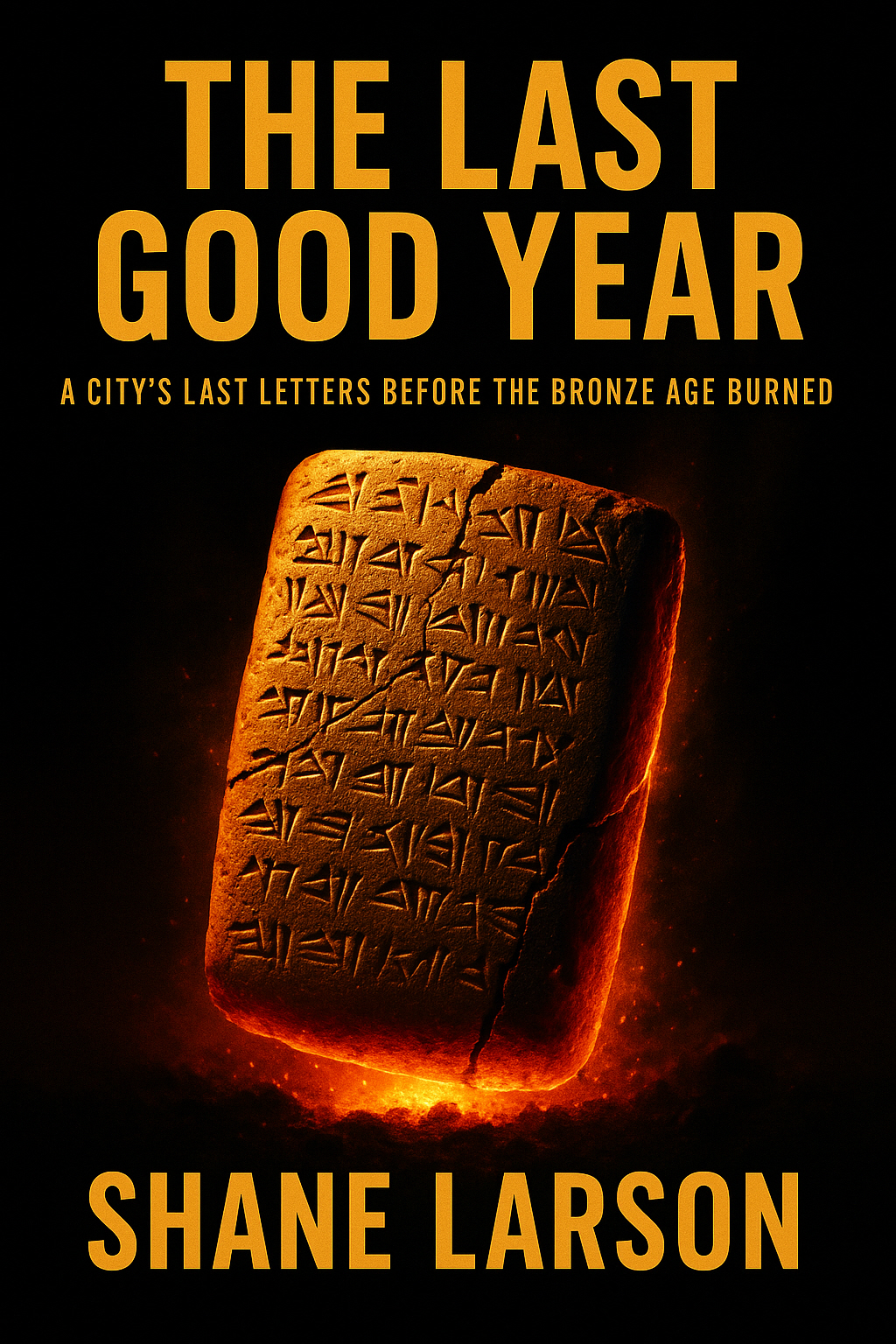
The Last Good Year
A City's Last Letters Before the Bronze Age Burned
By Shane Larson
About This Book
Most lost civilizations had to be reconstructed from the outside — from ruins, from conquerors' boasts, from guesswork. Ugarit is different. When the fire swept through the city around 1185 BC, it did something no scribe could have planned: it baked thousands of unfired clay tablets rock-hard, preserving the city's archives at the exact moment of its destruction. The catastrophe that erased Ugarit also sealed its memory. Trade ledgers, lawsuits, ration lists, love-hate diplomatic correspondence — an entire functioning society, frozen mid-sentence.
The Last Good Year uses that accidental time capsule to do something rare in ancient history: tell the story of the Bronze Age collapse from street level, in the words of the people it happened to.
The Story
In the early twelfth century BC, Ugarit was one of the busiest commercial hubs on the eastern Mediterranean. A small Syrian port-kingdom wedged between superpowers, it grew rich the way small trading states always do — by being indispensable to everyone and threatening to no one. Copper from Cyprus, grain from Egypt, textiles, timber, tin: nearly all of it moved through Ugarit's harbor, and nearly all of it left a paper trail in clay.
Then, within roughly a decade, the entire system came apart. Harvests failed inland. Emergency grain shipments started appearing in the correspondence. The Hittite Empire — Ugarit's nominal protector — began making desperate demands of its vassal instead of offering protection. And finally, the letters turn frantic: enemy ships sighted off the coast, the city's own troops deployed far away in Hittite service, urgent pleas for reinforcement sent to allies who could no longer help anyone. One of those pleas was still sitting in a kiln, waiting to be fired, when the raiders arrived.
This book reconstructs that final decade chronologically and from the inside. Rather than surveying the wider Bronze Age collapse from the historian's balcony, it stays inside one well-documented city and follows what its people actually knew, wrote, worried about, and tried to do as their world unraveled. The result is less a postmortem than a diary — the record of a prosperous society experiencing its own ending in something close to real time.
It is also, inevitably, a book about systems. Ugarit didn't fall to a single enemy. It fell to a convergence — drought, famine, imperial overstretch, severed trade routes, and seaborne raiders arriving at the precise moment every safety net had already failed. The tablets let us watch each thread snap individually, which is exactly what makes the final cascade so unsettling to read.
What You'll Discover
- The accidental miracle of the Ugarit archives — how a destroyed city became one of the best-documented places in the entire ancient world, and how scholars decipher what survived
- A working portrait of daily life on the Late Bronze Age coast: harvest cycles, festivals, dowry negotiations, scribal schools, and household economies recorded in the inhabitants' own contracts and receipts
- Why being the indispensable middleman of Mediterranean trade made Ugarit wealthy and fragile at the same time — prosperity and exposure as two sides of one ledger
- The early-warning system nobody recognized: crop failures, drought correspondence, and emergency grain convoys that signaled trouble years before any enemy fleet appeared
- How the Hittite Empire's slow-motion crisis stripped Ugarit of its protection — and its army — at the worst possible moment
- The final cluster of letters, read closely and in sequence: sightings of hostile ships, pleas for aid, and the unanswered question of how much time passed between the last tablet and the fire
- What the Sea Peoples were — and weren't — based on what the documents can actually support, separated honestly from a century of speculation
- The larger anatomy of collapse: what one city's ending reveals about how interconnected, complex societies fail in general
Why I Wrote This
I'd read plenty about the Bronze Age collapse — the big-picture books, the Sea Peoples theories, the debates about drought versus invasion versus systems failure. What kept nagging at me was that almost all of it is written from above, at the altitude of empires and centuries. But Ugarit left something almost no ancient city left: its own paperwork, right up to the end. Receipts. Complaints. Letters that were never answered. I wanted to know what collapse looked like to someone standing inside it — someone with a harvest to bring in and a daughter's dowry to negotiate while the world quietly came undone around them. Writing this book meant resisting the urge to narrate from hindsight and instead staying at ground level, where nobody knows they're living through the last good year. That turned out to be the whole point.
Frequently Asked Questions
Do I need to read 1177 B.C. or any other Bronze Age book first?
No. The book is fully self-contained and explains the political landscape — Hittites, Egypt, Cyprus, the trade network — as the story needs it. If you've read Eric Cline's 1177 B.C., this works as the ground-level companion to that big-picture account, but it stands entirely on its own.
Is this an academic book or a narrative history?
Narrative history, built on documentary evidence. Every chapter is grounded in the actual tablets recovered from Ugarit, and the book is careful to distinguish what the documents say from what historians infer — but it reads as a story, not a monograph. No footnote-wading required.
Does it cover the Sea Peoples?
Yes, and from an unusual angle. Rather than rehashing the Egyptian reliefs and the standard theories, it focuses on what Ugarit's own correspondence reveals about the raiders — sightings, warnings, and military dispatches written by people who were about to face them.
How does this relate to The Sea Peoples and the rest of the Bronze Age series?
It's a natural companion. The series volumes cover the collapse era region by region and theme by theme; this book narrows the lens to a single city and a single decade. You can read them in any order.
Is this book available on Kindle Unlimited?
Yes. Like the rest of the Peak Grizzly catalog, it's enrolled in Kindle Unlimited, so subscribers can read it at no additional cost.
Did anyone survive Ugarit's destruction?
The book addresses this directly in its closing chapters — what the archaeology suggests about the city's final hours, why Ugarit was never rebuilt while other destroyed cities were, and what traces of its people and language persisted afterward.
If You Liked This, You Might Like
- The Sea Peoples — the wider story of the raiders who appear in Ugarit's final letters, traced across the whole eastern Mediterranean.
- Ancient Apocalypse — the full panorama of the Bronze Age collapse, covering the empires and trade systems Ugarit depended on.
- The Hittite Empire — the rise and fall of the superpower whose failure left Ugarit defenseless at the critical moment.
- The First Dark Age — what came after the fires: the centuries of silence and slow recovery that followed the collapse.
A city kept its own records until the morning it ceased to exist — and by burning, those records became permanent. The Last Good Year is the chance to read them in order, and to watch a world that believed itself permanent discover otherwise.
Part of the Peak Grizzly Publishing ancient history catalog.
Included with Kindle Unlimited — read it free if you're a member.
New Narrative nonfiction / popular ancient history releases and free chapters — no spam, unsubscribe anytime.