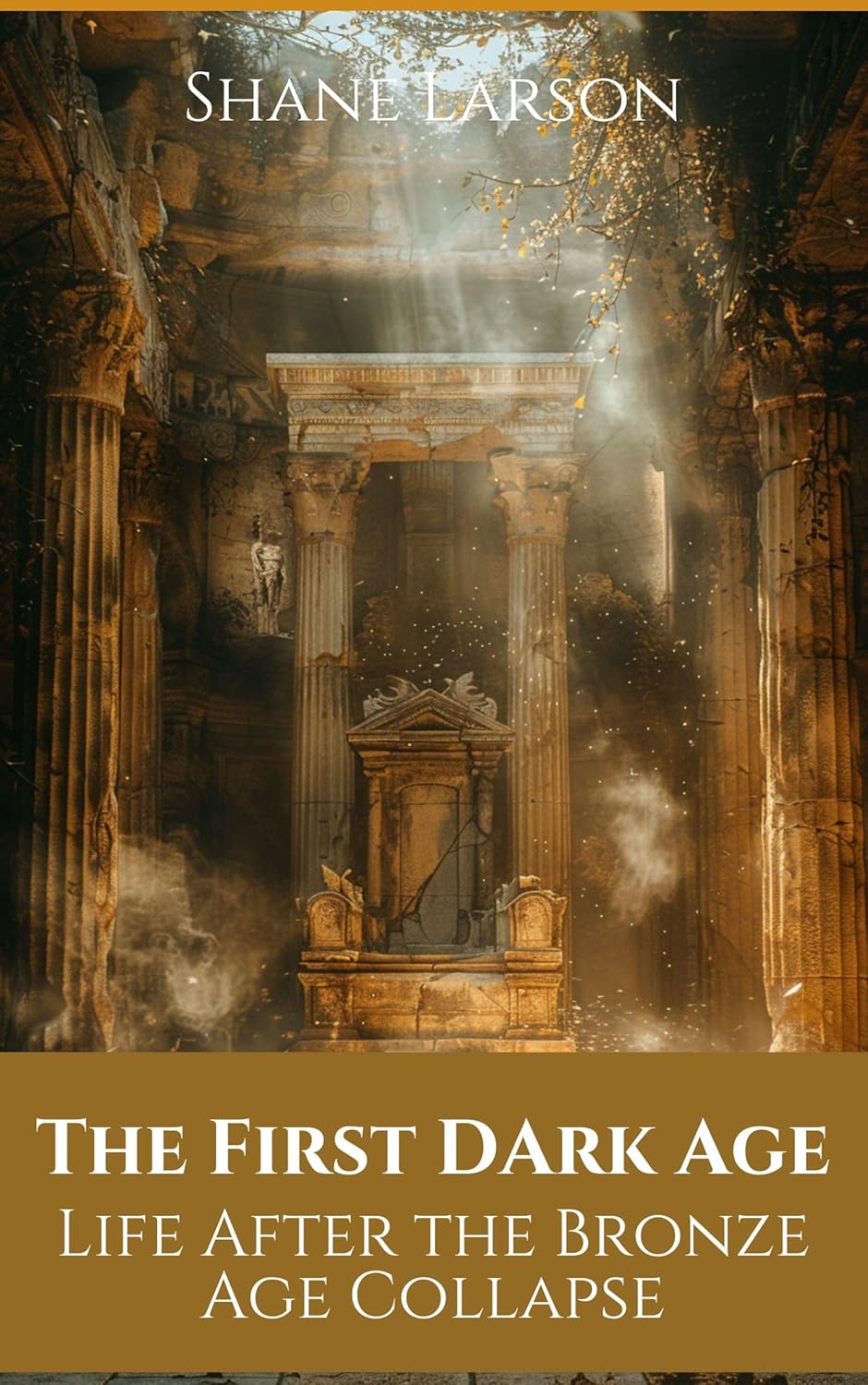
The First Dark Age
By Shane Larson · The Bronze Age Collapse Chronicles (Book 7)
About This Book
Imagine standing in the ruins of a palace that once coordinated the lives of thousands—its storerooms emptied, its record-keepers gone, its name already fading from anyone's memory. Now imagine being born two generations later, in a village that has never known anything else. To you, this isn't the end of the world. It's simply the world.
That is where The First Dark Age lives: not in the catastrophe of 1177 BC, but in the long, strange centuries that followed it.
The Story This Book Tells
Most accounts of the Bronze Age collapse build toward a single dramatic moment—the burning palaces, the vanished trade routes, the sudden silence of writing systems that had recorded inventories and treaties for centuries. Then they stop. The survivors are left offstage, and the next time history's spotlight turns on, we are already in classical Greece, as if the intervening three hundred years were an empty corridor between two lit rooms.
They were not empty. They were where everything was rebuilt.
This book picks up exactly where the disaster narratives end. With the great palace economies gone, ordinary people had to feed themselves, defend themselves, and organize their own communities without the centralized systems their ancestors had leaned on for generations. They simplified. They migrated. They lost old skills and improvised new ones. And in doing so they laid down the foundations of the Mediterranean world that Greece and Rome would later inherit.
It is also the story of who thrived. While the old empires crumbled, the Phoenicians extended their reach across the sea, turning the wreckage of a collapsed trade system into an opportunity. Iron—long treated as a poor cousin to bronze—came into its own and reshaped warfare and labor. And out of the wreckage came something deceptively small and world-changing: an alphabet simple enough that the people of a fractured age could actually use it. The Bronze Age collapse didn't just destroy. It cleared the ground.
What You'll Discover
- Life after the palaces. How households and small communities survived once the centralized economies that distributed grain, metal, and labor disappeared overnight.
- The Phoenician exception. Why a single seafaring people flourished during the same Greek Dark Age that hollowed out the kingdoms around them.
- The iron revolution. How a metal once considered second-rate replaced bronze, and why that swap rewired everything from farming to armies.
- The alphabet's origins. Where our writing system actually came from, and why a collapsed world needed something far simpler than the scripts it lost.
- What the Greeks remembered. The half-memories, distortions, and gaps in how later Greeks recalled their own heroic past.
- The road to the classical world. How three centuries of so-called darkness became the seedbed for Greece, Rome, and the Western tradition.
Why I Wrote This
I kept running into the same frustrating wall. Almost every book on the Bronze Age collapse builds to the catastrophe and then quietly closes the door. The "dark age" gets a sentence or two—usually some variation of and then, after a long decline, classical Greece emerged—and that's it. Three hundred years of human experience compressed into a transition.
But that gap was the part I actually wanted to understand. What did people do? How do you live when the system that organized your entire world is simply gone? The more I read, the clearer it became that this wasn't a void at all. It was one of the most consequential recovery periods in history, and almost nobody was telling it as a story in its own right. So I wrote the book I wanted to read—about the survivors, not the ruins.
Frequently Asked Questions
Do I need to read Ancient Apocalypse first?
No. The First Dark Age stands completely on its own. Ancient Apocalypse covers the collapse itself; this book covers what happened afterward. They pair well in either order, but neither depends on the other.
Is this a narrative history or an academic text?
It's narrative history written for curious general readers. The research is serious, but the goal is to tell the story clearly and keep you reading—no jargon, no prerequisites, no assumption that you already know the period.
How is this different from 1177 B.C. by Eric Cline?
Cline's excellent book explains why the Bronze Age collapse happened and largely ends with the catastrophe. The First Dark Age starts where that story stops, following the three centuries of recovery that turned a ruined world into the classical one.
What time period does it actually cover?
Roughly the three hundred years following the collapse around 1177 BC—the stretch often labeled the Greek Dark Age—through the early emergence of the classical world.
Is it available on Kindle Unlimited?
Yes. The First Dark Age is enrolled in Kindle Unlimited, so KU members can read it as part of their subscription.
If You Liked This, You Might Like
- Ancient Apocalypse: The Fall of the Bronze Age — The companion volume: the full story of the collapse that this book begins after.
- Iron Age Dawn — Follows the metal that changed everything as the world rebuilt around it.
- Canaan to Carthage: The Phoenician Civilization — The seafaring people who turned collapse into a trading empire.
- The Collapse Pattern — Steps back to ask why great civilizations fall apart in the first place—and what the wreckage tends to leave behind.
The end of the Bronze Age wasn't the end of the story. It was the beginning of ours.
Included with Kindle Unlimited — read it free if you're a member.
New Ancient History releases and free chapters — no spam, unsubscribe anytime.
More in The Bronze Age Collapse Chronicles
View series →