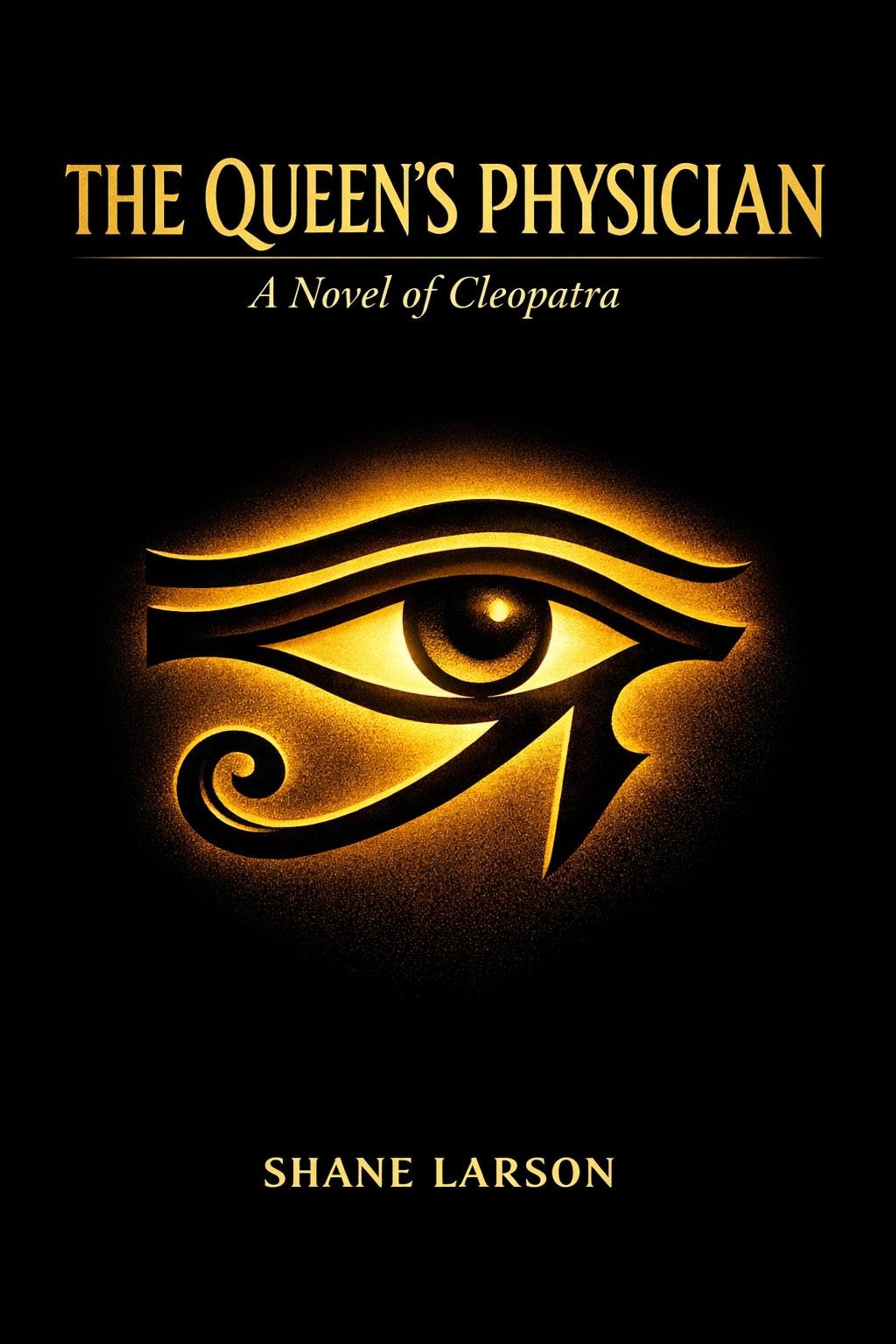
The Queen's Physician
A Novel of Cleopatra
By Shane Larson
About This Book
The room smells of resin and old ink. A girl sits at a writing desk that doesn't belong to her, with a teacher's body still warm in the next chamber, and she asks the young physician across from her one question: Can you do what he did? She is seventeen. She is already a queen, and already alone. She will not be alone again until the last summer of her life, thirty years from now, when she sends for the same physician and asks him for something quieter, and harder, than survival.
Between those two rooms — the night she hires him, and the morning she dies — runs the real story of Cleopatra VII Philopator. Not the seductress of Roman propaganda. Not the asp on a basket of figs. The queen as her own physician saw her: brilliant, careful, frightened by very little, fluent in seven languages and the chemistry of half a dozen poisons, fighting a war she could not win against a republic that had already decided she had to die.
The Queen's Physician is told by Olympos, the doctor Plutarch named almost in passing as a source for Cleopatra's final days — and then never quoted from again. This is the memoir history lost.
The Story
Alexandria, 51 BCE. Olympos is twenty-two, newly trained at the Museion, and convinced his work is the cleanest in the city. Doctors heal. Doctors don't take sides. Then a litter arrives after midnight, his teacher is dying of something the textbooks don't name, and the new co-regent of Egypt — a girl barely younger than he is — offers him the dead man's post and the dead man's enemies in the same sentence.
He takes it. He spends the next three decades regretting and not regretting that decision in roughly equal measure.
The novel follows him through the war with Ptolemy XIII, through Julius Caesar's siege of the palace quarter and the burning of the great harbour, through the birth of Caesarion, through Caesar's murder in Rome and the long uneasy peace that followed. Then Antony, and Tarsus, and the gold-leaf years in which a queen and a Roman general tried to build something the world would not let them keep. Then Actium. Then the mausoleum. Then the last morning, and what Olympos brought with him to it.
This is a novel about medicine as much as it is about Egypt. The Greeks had one word, pharmakon, for the cure and the poison both, and the physician to the last Ptolemy lives inside that word for thirty years. Every cup he hands the queen could keep her alive or kill her, and only one person in the palace can always tell the difference. The deadliest weapon in Alexandria isn't the army. It's the medicine chest, and he holds the key.
It is also, quietly, a love story. Not the legend's love story — that one belongs to Antony, and it is told here from the outside, by a man watching the queen he serves disappear into a Roman she cannot save. The love story in this book is older and smaller and never spoken aloud, and it is the reason Olympos is still in the room on the last day, when a smarter man would have run.
What's Inside
- A Cleopatra you have not met before — not the seductress of Roman pamphlets, not the cartoon of the asp and the figs, but the working monarch her own physician saw: a scholar-queen who read Aristotle in the original, ran a navy, and knew exactly what every cup in her cabinet would do.
- The siege of Alexandria from the inside, hour by hour — the fire jumping the warehouses, the harbour boiling, Caesar trapped in the palace quarter with a teenage king as his hostage and a teenage queen as his secret guest.
- The court as a poisoner's workshop — the long, unglamorous truth that Ptolemaic Egypt killed its own family more reliably than any foreign army ever did, and that someone had to mix what they drank.
- Antony's last campaign through the eyes of a non-combatant — the boats, the desertions, the long retreat south, told by a man whose only weapon was a satchel.
- A friendship between a Greek doctor and an Egyptian queen that survives Caesar, survives Antony, survives Octavian's fleet, and ends in the only place it could.
- The historical Olympos — the physician Plutarch cites and then loses, restored to the only book that could plausibly contain his testimony.
- An ending you already know, told from inside the room — and made, against all odds, new.
Why I Wrote This
I came to Cleopatra the way most people do, sideways — through Shakespeare, then Plutarch, then a string of biographies that all agreed she was extraordinary and all disagreed on what kind of extraordinary. The thing that kept catching me was Olympos. Plutarch names him. Plutarch says he wrote a book. Then Plutarch stops talking about him, and so does everyone else, for two thousand years.
That bothered me. It bothered me more the longer I sat with it. A physician at the side of one of the most documented women in antiquity, present for the events Plutarch had to reconstruct from rumour, and we have nothing of his. Either the book was suppressed, or it was lost, or it never existed at all and Plutarch was bluffing. Any one of those is interesting. The third is the kind of gap a novelist is allowed to step into.
I wrote The Queen's Physician because I wanted to read it. I wanted Cleopatra placed back inside her own century and her own court, told by someone who could see her wash her hands and brush her hair, instead of a Roman writing a hundred years later about a woman his empire had a vested interest in turning into a monster. That's the book. I hope it lands.
— Shane Larson
Frequently Asked Questions
Is this a historical romance?
Not in the genre sense. There is a love story in it — two of them, actually — but the book is closer to literary historical fiction than to romance. Think The Song of Achilles or Memoirs of Hadrian rather than a Roma-Antony bodice-ripper. Readers looking for a steamy Antony-and-Cleopatra retelling will find the relationship present but observed from the outside; the heart of the book sits elsewhere.
How accurate is the history?
The major events — the war with Ptolemy XIII, Caesar's siege, the births of Cleopatra's children, the Donations of Alexandria, Actium, the suicide — follow the historical record closely. Olympos is named by Plutarch as a source for the final days, which is the historical license the novel takes: it gives him the memoir Plutarch implies but never quotes. Poisons, court medicine, the layout of the palace quarter, and the Greek-Egyptian texture of Alexandria are drawn from current scholarship.
Do I need to know anything about ancient Egypt or Rome to read it?
No. The novel introduces its world from the ground floor, through the eyes of a young man learning his way around the palace for the first time. If you remember the names Caesar and Antony from school, you have enough. If you don't, the book will give them to you in context.
Is this part of a series?
The Queen's Physician is a standalone novel. It is, however, the first piece of fiction Peak Grizzly has published set in the ancient Mediterranean — a world that the catalog's narrative-history titles (the Bronze Age books, the Carthage books) cover from a different angle. Readers who enjoy this novel may want to follow it into those nonfiction histories, where the same world is told straight.
How long is the book?
Around 110,000 words — a full-length literary novel, roughly the length of The Song of Achilles. It is structured in three parts: the early years (Ptolemy XIII through Caesar), the long middle (Antony, Parthia, the children), and the final summer.
Is this available on Kindle Unlimited?
Yes. The ebook is enrolled in Kindle Unlimited, so KU subscribers can read it at no additional cost. The novel is also available for purchase as an ebook and in paperback.
If You Liked This, You Might Like
- The Bronze Age World — the Mediterranean a thousand years before Cleopatra, when the palace cultures she descended from were just learning to write each other letters in tin and gold.
- Last Days of Carthage — another Mediterranean power crushed by Rome's slow patience, told as narrative history rather than fiction.
- The Library of Alexandria — the institution that trained Olympos, and burned during the siege he lived through.
- Cleopatra's Egypt — the nonfiction companion volume for readers who finish the novel and want the history straight.
Included with Kindle Unlimited — read it free if you're a member.
New Historical Fiction releases and free chapters — no spam, unsubscribe anytime.