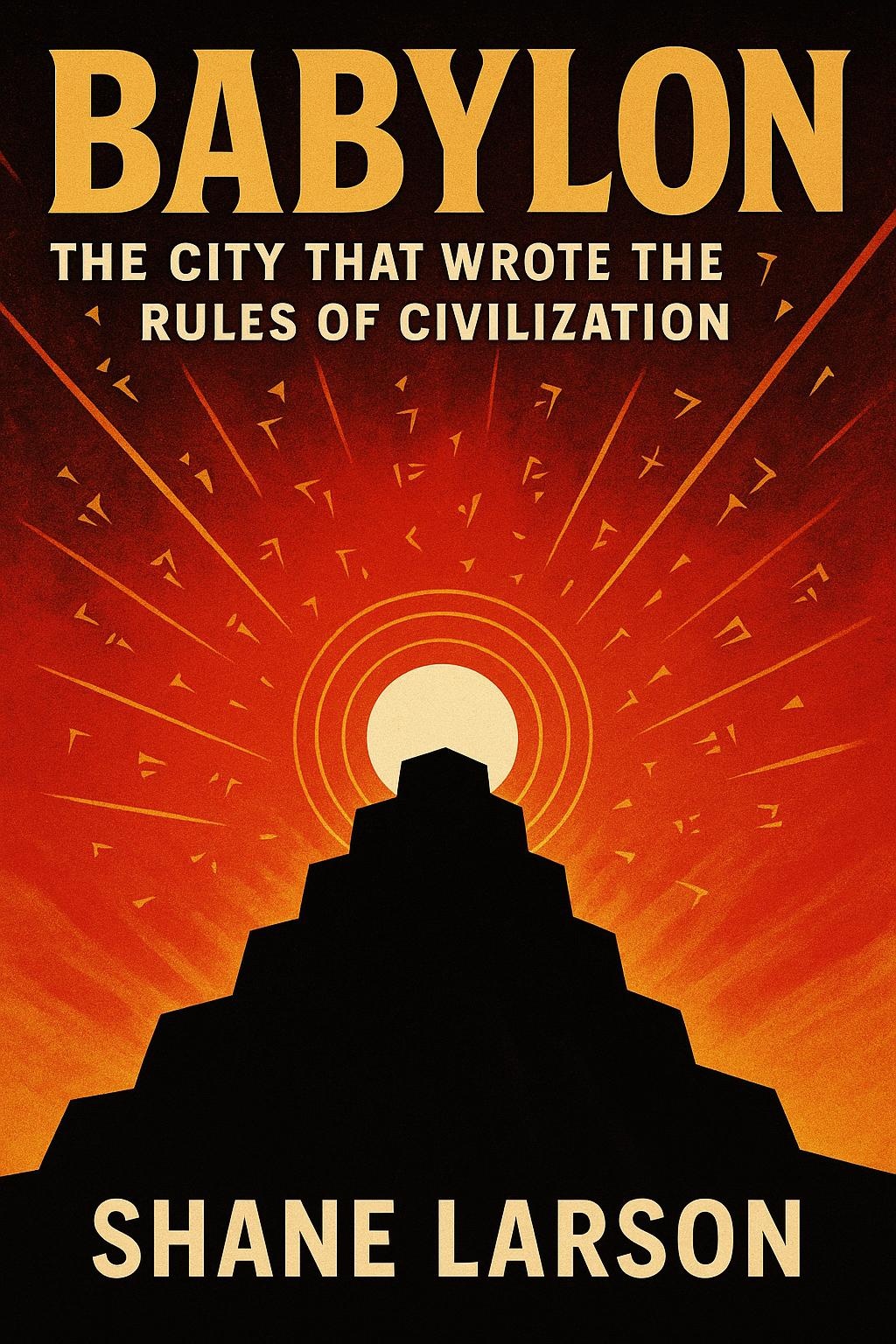
Babylon
The City That Wrote the Rules of Civilization
By Shane Larson
About This Book
In a temple courtyard above the Euphrates, an astronomer watches a point of light cross the sky and presses the observation into wet clay. He has no telescope, no theory of gravity, no idea that empires will rise and fall before anyone reads what he wrote. He is simply doing his job: keeping the record. That clay tablet will outlast his city, his language, and his gods — and the numbers on it will still be dividing your hour into sixty minutes thousands of years later.
That is the real Babylon, and almost nobody knows it. The name has become a punchline and a warning: the Hanging Gardens, the Tower of Babel, the drunken kings, the biblical city of sin. We inherited the legend and lost the metropolis. Behind the myth stood a working capital of scribes, merchants, priests, and stargazers who quietly assembled the operating system the rest of us still run on — written law, recorded science, the mathematics of time and the circle.
Babylon sets out to recover that city from three thousand years of caricature. This is the documented Babylon, not the symbolic one: the place where humanity first wrote its laws on a public stone and declared them binding even on the king, where temple astronomers logged the heavens for centuries until they had built the world's first scientific database, where a decision to count in base-60 still governs every clock face and compass rose on Earth.
The Argument
The book follows a single propulsive thread: the Babylon of fact matters far more than the Babylon of legend, and the evidence is hiding in plain sight. It moves from Hammurabi's towering basalt stele — the law code carved where any citizen could see it — to Nebuchadnezzar's blue-glazed Ishtar Gate, from the real ziggurat that stands behind the Tower of Babel story to the Persian and Greek conquerors who carried Babylonian learning westward into the foundations of European thought.
Along the way it refuses the easy myths. The Hanging Gardens, that wonder of the ancient world, may never have stood in Babylon at all — and the case for where they actually were is more interesting than the legend. The Tower of Babel was not a fable but a building, and we know roughly what it looked like. The "decadent" city the Bible turned into an eternal emblem of pride and exile was, in daily practice, a place of schools and contracts, debt and litigation, temple bureaucracy and women with legal rights.
What ties it together is transmission. Babylon's fingerprints did not vanish when the walls came down; they were absorbed, copied, and carried forward. The sixty-minute hour, the 360-degree circle, the very habit of writing rules down and holding power accountable to them — these are Babylonian inheritances we use without ever crediting the source. The book is grounded in real scholarship but paced like a story, because the true history turns out to be the better one.
What You'll Discover
- Hammurabi's law code, decoded — what the famous stele actually said, and why the simple act of publishing rules in public reshaped the relationship between rulers and the ruled for good.
- The math still strapped to your wrist — how Babylonian base-60 counting survives in every watch, every navigational bearing, and every 360-degree circle you've ever drawn.
- The first astronomers — the anonymous tablet-keepers whose centuries of eclipse and planetary records became the raw data behind the first genuine science of the sky.
- The Hanging Gardens problem — why one of the Seven Wonders may have been misfiled, and the surprisingly strong argument that it belonged to a different city entirely.
- The building behind the Tower — what the ziggurat of Babylon really was, and how a feat of engineering became a story about divine punishment.
- The Bible's Babylon — how a real Near Eastern empire was transformed into a timeless symbol of corruption, exile, and doom, and what the scripture leaves out.
- Ordinary life on the Euphrates — schools, marriage contracts, loans, temple economies, and the legal standing of women in a city we remember only for its kings.
- The long afterlife — how Babylonian ideas outlived conquest to shape Persia, Greece, and ultimately the modern mind.
Why I Wrote This
I kept tripping over Babylon without recognizing it. Every time I checked the clock, set a heading, or measured an angle, I was using a system somebody invented on the Euphrates — and I'd never once thought about who, or why. Meanwhile the only Babylon most of us carry around is the cartoon version: gardens, towers, sin, collapse. The gap between the city that actually existed and the city we remember started to bother me enough to spend a long time closing it.
What hooked me was how little of the real story requires exaggeration to be astonishing. You don't have to inflate a civilization that put its laws on public display and tracked the planets for three centuries. You just have to clear away the legend and let the tablets speak. I wanted to write the book I'd wanted to read — one that takes the scholarship seriously but never forgets it's telling the story of a living place full of real people.
Frequently Asked Questions
Do I need to know anything about Mesopotamia to read this?
No. The book assumes you're starting from the legends and nothing more, and it builds the real context as it goes. If your entire knowledge of Babylon is the Hanging Gardens and the Tower of Babel, you're exactly the reader it was written for.
Is this a narrative history or an academic textbook?
It's narrative history grounded in current scholarship. There are no footnote thickets or jargon walls — the goal is the pace of a story with the accuracy of the evidence. Specialists will recognize the sources behind it; general readers won't feel they've wandered into a seminar.
Does it really argue the Hanging Gardens weren't in Babylon?
It lays out the case honestly, including the strong scholarly argument that the famous gardens belonged somewhere else, and lets you weigh the evidence. It's one of several places where the documented record turns out to be more surprising than the myth.
How does this connect to the Babylon of the Bible?
A full thread of the book examines how a real empire became a scriptural symbol of pride and exile — what the biblical writers were reacting to, what they kept, and what they left out. If you read ancient-religion history and want the world behind the text, that's deliberately built in.
Is it available on Kindle Unlimited?
Yes. Like the rest of the Peak Grizzly ancient-history catalog, Babylon is enrolled in Kindle Unlimited, so KU members can read it as part of their subscription.
If You Liked This, You Might Like
- Twilight of the Ziggurats — the Sumerian world that invented the city, the school, and the first writing, centuries before Babylon inherited it all.
- Assyria — Babylon's fearsome northern rival and sometime conqueror, the war-machine empire that ruled Mesopotamia before the Persians arrived.
- The Persian Empire — the power that absorbed Babylon and carried its knowledge westward toward Greece and the modern world.
- The Collapse Pattern — if Babylon's long arc of rise, dominance, and fall interests you, this traces the recurring structure behind how great civilizations come apart.
The myths have had their three thousand years. What follows is the city underneath them — the one that wrote the rules we're still living by.
Included with Kindle Unlimited — read it free if you're a member.
New Narrative Nonfiction — Ancient History releases and free chapters — no spam, unsubscribe anytime.