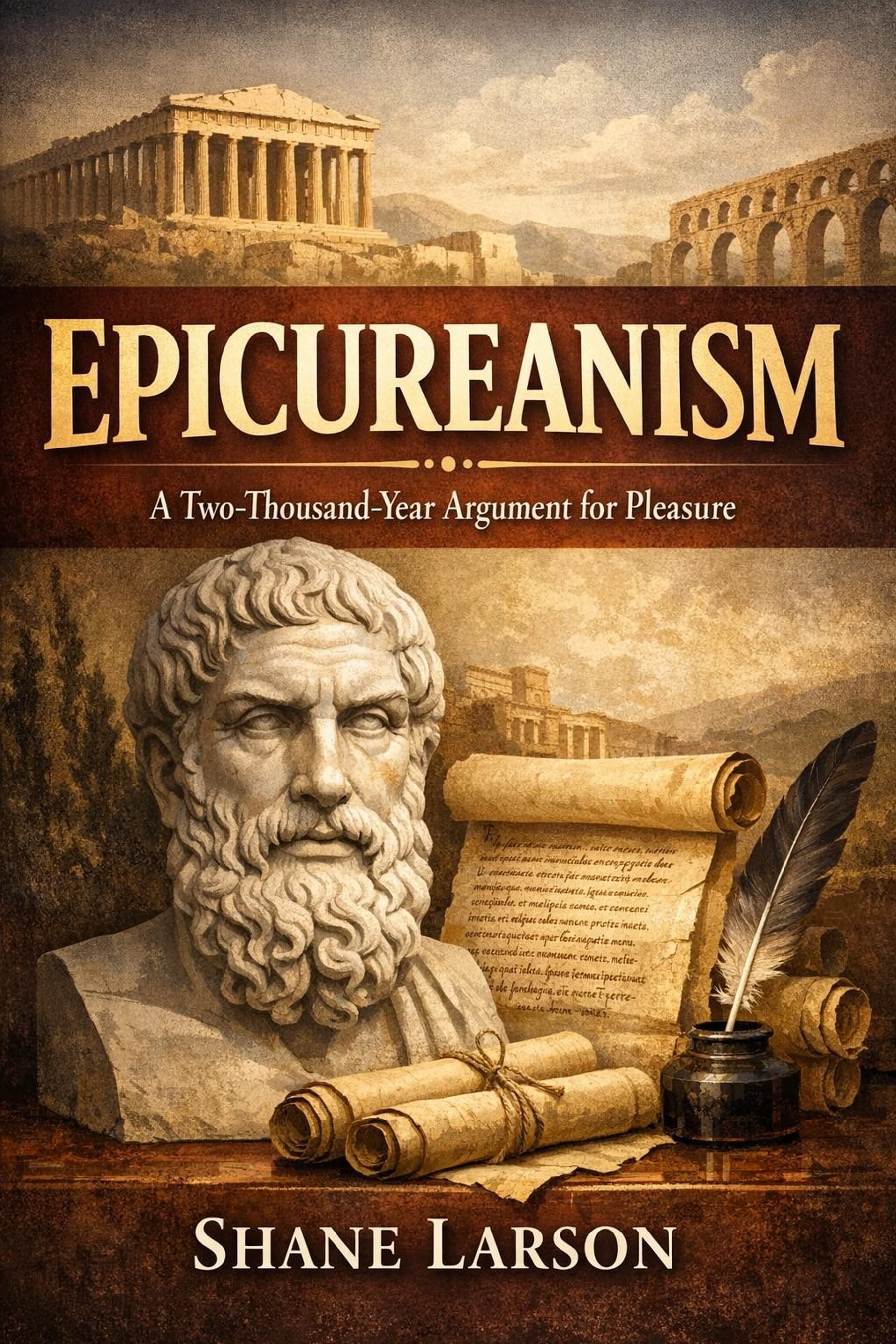
Epicureanism
A Two-Thousand-Year Argument for Pleasure
By Shane Larson
About This Book
On the morning of August 24, 79 CE, the eruption of Mount Vesuvius buried a Roman villa on the Bay of Naples under twenty meters of pyroclastic surge. Inside the villa was the only intact library to survive from classical antiquity — roughly eighteen hundred carbonized papyrus scrolls, fused into black logs by the heat, unopenable for the next sixteen centuries. When archaeologists finally reached them in the 1750s, every attempt to unroll the scrolls destroyed them. The library went largely unread.
The villa belonged to a Roman aristocrat. The library was almost entirely Greek philosophy. And the philosophy in question — the philosophy this man had spent a fortune collecting, copying, and curating — was Epicureanism.
In 2023, an undergraduate computer-science competition called the Vesuvius Challenge used AI-assisted X-ray tomography to read the first words from inside an unopened scroll. The word, fittingly, was Greek for purple. The text turned out to be a treatise by the Epicurean philosopher Philodemus. After two thousand years, the Garden was speaking again.
The Argument
Epicurus of Samos founded his school in Athens around 307 BCE, in a walled enclosure that gave the institution its name: ho kepos, the Garden. He taught a complete philosophical system organized into three integrated branches. Physics: the universe consists of atoms moving in void, with no gods involved in its operation and no purpose organizing it. Canonic: knowledge comes through the senses, and the senses, properly used, do not lie. Ethics: the goal of human life is eudaimonia, achieved through ataraxia — the absence of mental disturbance — which is attained by limiting desire to what is natural and necessary, by cultivating philosophical friendship, and by removing the great fears, especially the fear of death.
The Garden's social structure was as radical as its physics. Women were admitted as full members. Enslaved people were admitted as full members. The community organized itself around shared meals, philosophical conversation, and study of the founder's writings — a way of life rather than a curriculum. The school survived in continuous institutional form for the better part of seven hundred years.
Its most consequential afterlife came through a Roman poet. Around 55 BCE, Titus Lucretius Carus wrote a six-book Latin verse epic called De Rerum Natura — On the Nature of Things — that set the entire Epicurean system to poetry of astonishing power. The poem nearly disappeared in the Middle Ages, surviving only in a handful of monastic manuscripts, until 1417, when an Italian humanist named Poggio Bracciolini, hunting for lost classical texts in a German monastery, found a copy. He had it transcribed. Within a century, De Rerum Natura was reshaping European intellectual life — and through it, the atomic theory of matter, the materialist account of mind, the empirical theory of knowledge, and a particular conception of human happiness as the absence of unnecessary disturbance would feed forward through Pierre Gassendi, Isaac Newton, John Locke, David Hume, Adam Smith, and ultimately into Thomas Jefferson's draft of the Declaration of Independence, which guarantees not life and liberty alone but "the pursuit of happiness."
The modern world is, in substantial part, an Epicurean world that has forgotten its lineage. This book recovers that lineage.
What's Inside
- The actual life of Epicurus — the Samian schoolteacher who walked to Athens, founded the Garden, lived on bread and water, and wrote three hundred volumes that almost entirely failed to survive
- The Garden as institution — how it functioned socially, who it admitted, what daily life looked like inside it, and why those choices were themselves philosophical positions
- The full Epicurean atomism — atoms, void, the clinamen (the famous "swerve" Epicurus added to Democritus to make room for free will), and why the physics matters to the ethics
- The canonic — the Epicurean theory of how we know what we know, and its quiet anticipation of modern empiricism
- The argument that "death is nothing to us" — what the argument actually says, why it depends on the materialist physics, and why it has refused to go away
- Lucretius and De Rerum Natura — the Roman poet who carried the philosophy across the centuries, and the strangest, most beautiful didactic poem ever written
- Philodemus and the Herculaneum library — the Roman Epicurean circle, the buried villa, and the AI-driven recovery now decoding the only surviving library of the ancient world
- The Roman political context — Atticus, Cassius, Cicero's hostile but invaluable transmission, and the Augustan reception
- The Christian centuries — why Epicurus became the philosopher Christianity hated most, and how that hatred nearly buried him
- 1417 and the recovery — Poggio Bracciolini's manuscript hunt and the Renaissance reawakening of materialist thought
- The seventeenth-century reconstruction — Pierre Gassendi reassembling Epicurean physics for a Christian Europe, and Newton inheriting the result
- The Enlightenment line — Locke's empiricism, Hume's analysis of the passions, Smith's moral philosophy, and the genealogy that ends at Jefferson's "pursuit of happiness"
- Karl Marx's doctoral dissertation — on the difference between the natural philosophies of Democritus and Epicurus, and what the young Marx took from the Garden
- The contemporary scene — Stephen Greenblatt's The Swerve, Catherine Wilson's work on Epicurean ethics, the Vesuvius Challenge, and a philosophy that is, against the odds, finding new readers
Why I Wrote This
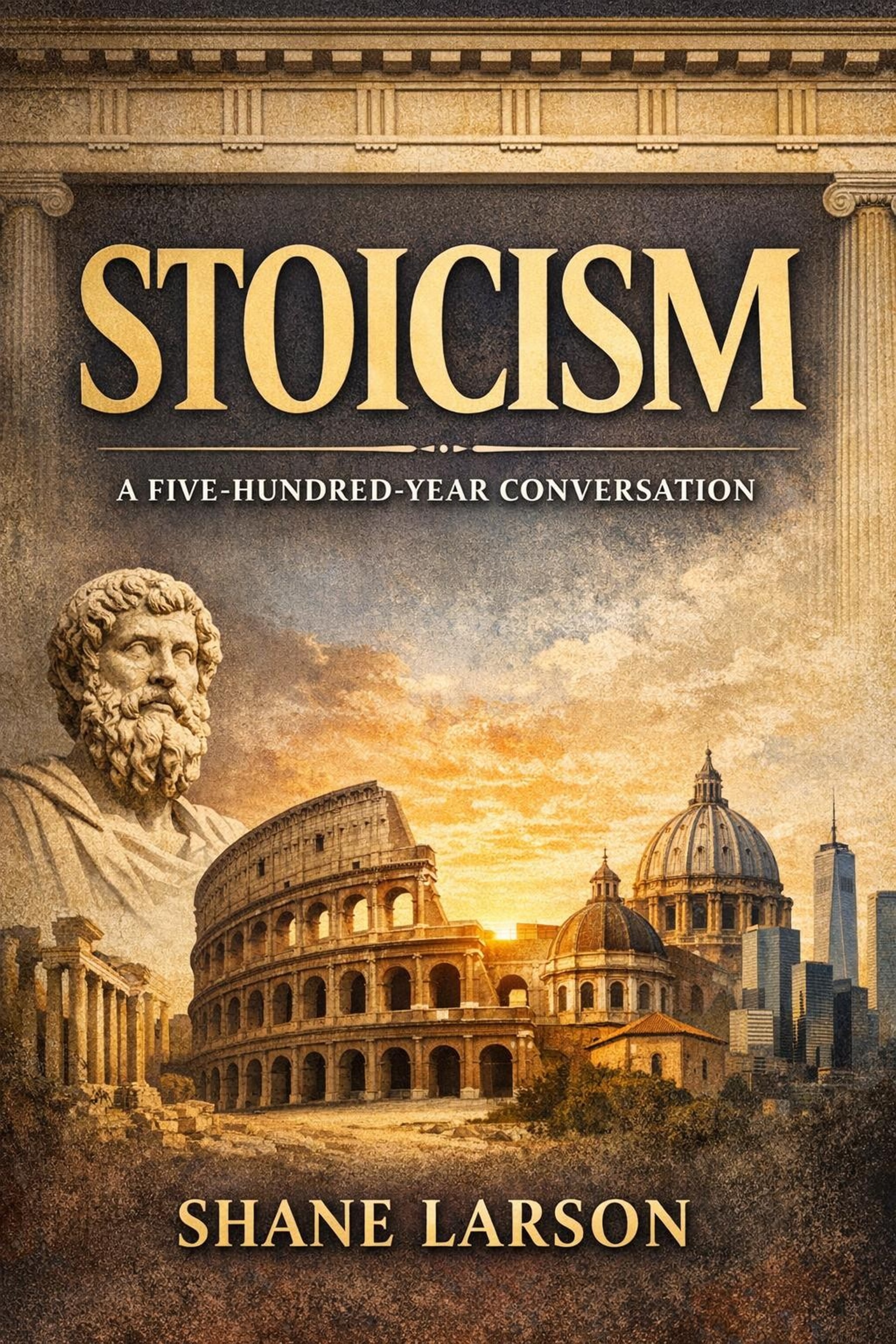
I wrote Stoicism: A Five-Hundred-Year Conversation first, and the most common question that came back from readers was some version of: what about the other one? The two great Hellenistic schools were founded in Athens within a few decades of each other, both built on integrated physics-and-ethics, both still alive in the modern conversation — and one of them has had a massive popular revival while the other has been almost entirely ceded to a misnomer about foodies.
That bothered me. Partly because the actual philosophy is so much more interesting than the cliché, but mostly because the modern intellectual world — empiricism, materialism, the secular pursuit of happiness, the atomic conception of matter — runs straight back through Epicurus, and almost nobody knows. The line through Lucretius into the Renaissance, through Gassendi into early modern science, and through Locke and Hume into the founding documents of the American republic is one of the more astonishing genealogies in Western thought. It deserved a single book that traced the whole arc, at the level of a serious general reader, without academic apparatus and without dumbing anything down. So I wrote one.
Frequently Asked Questions
Do I need to have read Stoicism: A Five-Hundred-Year Conversation first?
No. Epicureanism stands on its own. The two books are direct companions — same approach, same level, same kind of reader — but the Epicurean story is self-contained. If you read both, you'll see the two great Hellenistic schools side by side and start to notice the deep structural opposition between them, which is itself rewarding. But there's no order. Pick whichever sounds more interesting.
Is this a textbook, an introduction, or something else?
It's narrative intellectual history, written for the serious general reader rather than the specialist. The philosophy is presented in full, but in prose, not in propositions-and-numbered-arguments form. If you've enjoyed Stephen Greenblatt, Catherine Wilson's How to Be an Epicurean, or Tom Holland's ancient-history books, this is in that neighborhood.
How much of this is about the Vesuvius Challenge and the buried scrolls?
A substantial portion — the Herculaneum library is one of the most extraordinary stories in the history of philosophy, and the AI-assisted decoding now underway is changing what we know about Epicureanism in real time. But the book is not primarily about the scrolls. It is about the philosophy. The scrolls are one strand in a longer story that starts in Athens in 307 BCE and runs all the way to Jefferson.
Does the book actually argue that Epicureanism shaped the Declaration of Independence?
Yes — and it traces the genealogy in detail. The line runs from Lucretius through Gassendi's seventeenth-century reconstruction of atomism, into Locke and Hume, into the Scottish moral philosophers Jefferson was reading, and ultimately into the language of "the pursuit of happiness," which is a specifically Epicurean phrase. The argument isn't original to me; it's been made by Catherine Wilson and others. The book lays out the case.
Is this available on Kindle Unlimited?
Yes. The Kindle edition is enrolled in Kindle Unlimited, so it's free to read for KU members. Paperback editions are available where listed.
What's the relationship between this book and the rest of the catalog?
It's the direct companion to Stoicism: A Five-Hundred-Year Conversation. It also sits alongside the Library of Alexandria / Hypatia titles in the ancient-thought line of the catalog, and pairs naturally with the books on Marcus Aurelius and Epictetus, which give you the Stoic counterweight from the Roman period.
If You Liked This, You Might Like
- Stoicism: A Five-Hundred-Year Conversation — The direct companion volume. The other great Hellenistic school, treated at the same depth. Read them as a pair.
- Marcus Aurelius — The Stoic emperor at his most personal. A useful contrast: what the rival school looked like in practice, in a Roman aristocrat's private notebook.
- Library of Alexandria — The institutional setting for so much of the philosophy in this book. The library where many of the texts now lost to us were copied, catalogued, and read.
- Hypatia of Alexandria — Ancient philosophy in its final twilight, in a city about to lose it. The closing of one world that the recovery of Epicurus would partly reopen a millennium later.
A Two-Thousand-Three-Hundred-Year Argument
The Garden is gone. The villa is buried. The school's books are mostly lost, the founder's name has become a misnomer for the opposite of what he taught, and the philosophy itself was nearly erased by a thousand years of polemic. And yet here it is — read by an undergraduate AI competition, quoted in the founding document of a republic, embedded in the physics every modern child learns in school. Epicureanism is the story of how that happened, and what the philosophy actually says when you let it speak for itself.
Part of the Peak Grizzly ancient-thought line. Companion to Stoicism: A Five-Hundred-Year Conversation.
Included with Kindle Unlimited — read it free if you're a member.
New Philosophy releases and free chapters — no spam, unsubscribe anytime.
More in This Genre
View all →