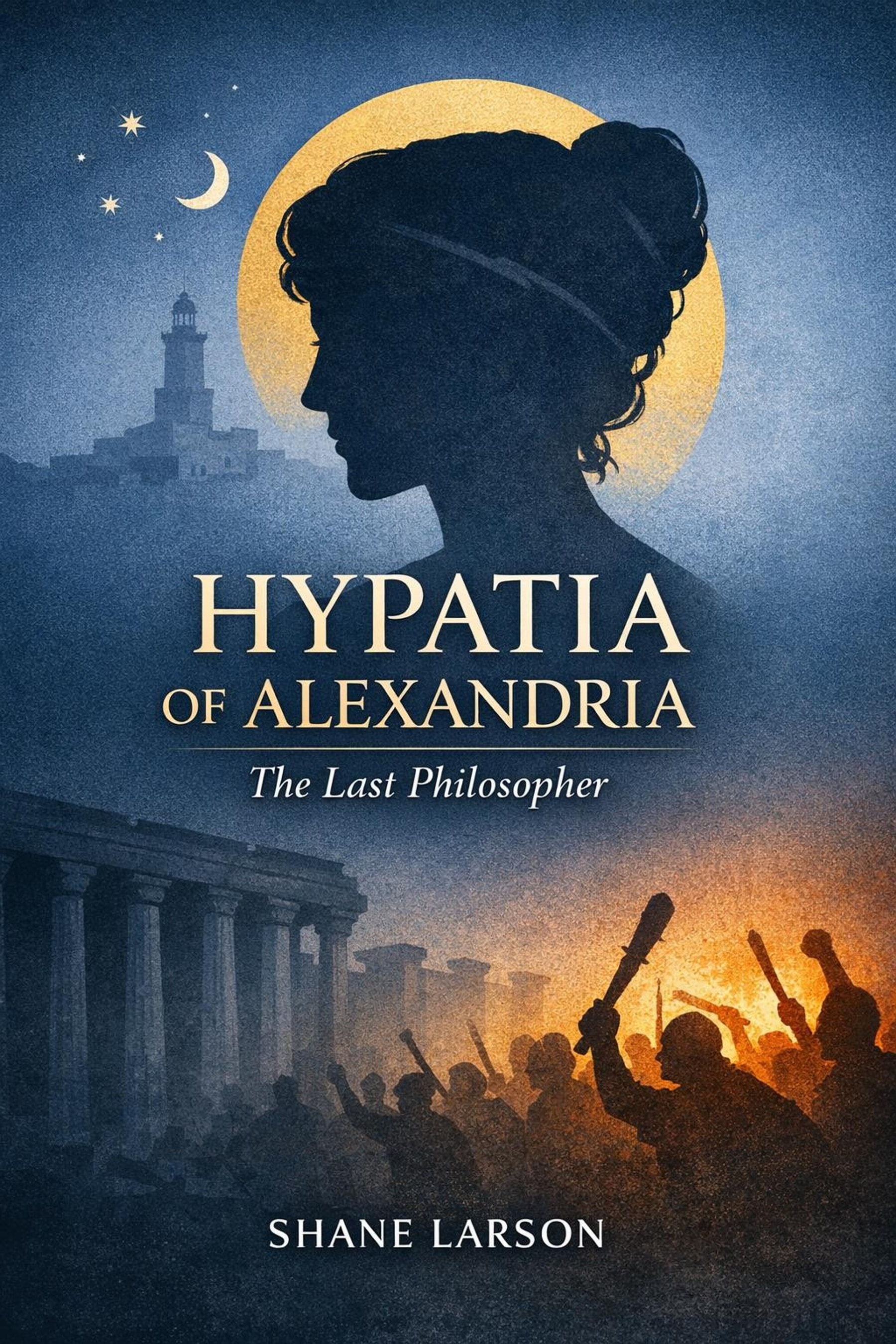
Hypatia of Alexandria
The Last Philosopher
By Shane Larson
About This Book
In the spring of 415, the most accomplished scholar in Alexandria climbed into her chariot to ride home through streets she had crossed ten thousand times. She did not arrive. By nightfall the imperial machinery of Roman Egypt had a problem it could not solve: a famous woman was dead, the whole city knew who had done it, and no one would ever be charged.
That woman was Hypatia — mathematician, astronomer, head of the Neoplatonic school, and the closest thing the late antique world had to a public intellectual. She had spent her life inside the life of the mind: refining the astrolabe, writing commentaries on Apollonius of Perga and Diophantus that scholars copied across the Mediterranean, teaching pagan and Christian students side by side in a city that was rapidly forgetting how to tolerate that combination. Her murder was not the act of a lone fanatic. It was the visible end of a political collision she had been pulled into against her will — and the people who orchestrated it walked away untouched, and in one case sainted.
The Story
Hypatia of Alexandria: The Last Philosopher reconstructs both the life and the death, and refuses to let one swallow the other. Too many accounts reduce Hypatia to the manner of her killing; this book insists on the decades of work that made her worth killing.
It begins with the city itself — fourth-century Alexandria, its libraries and lecture halls already in long decline, its streets a powder keg of pagan, Christian, and Jewish communities living in uneasy proximity. It moves to the scholarly household of her father Theon, the education that produced her, and the substance of what she actually taught: Neoplatonic philosophy, mathematics, astronomy, the design of scientific instruments. Through the surviving letters of her student Synesius of Cyrene — later a Christian bishop, always her devoted pupil — we get the only intimate glimpse of her that history allows.
Then the walls close in. The Theodosian decrees strip legal protection from pagan public life. The Serapeum is destroyed in 391 and its books scattered. In 412 the contested election of Cyril installs a patriarch willing to use the parabalani — a corps of attendants turned street enforcers — as muscle. The Jewish community is expelled in 414. The civil prefect Orestes and the patriarch Cyril square off, and Hypatia, respected by Orestes and resented by Cyril's faction as the pagan influence behind him, becomes the softest target in the hardest fight. The book reconstructs the attack from the ancient sources, weighs what each one claims, traces the imperial inquiry that named no one, and follows Cyril's uninterrupted rise to theological dominance and eventual canonization.
It closes with the sixteen centuries since — the medieval silence, Gibbon's Enlightenment martyr, Charles Kingsley's Victorian heroine, the twentieth-century feminist reclamation, and the 2009 film Agora — asking why every age has needed to reinvent her, and what the reinventions reveal about us rather than about her.
What You'll Discover
- The real content of her scholarship — the commentaries, the astronomical work, the instruments — recovered from a tradition that prefers to remember how she died rather than what she did.
- Why Alexandria was primed to combust, from the collapse of its institutions of learning to the volatile coexistence of its religious communities.
- The Serapeum's destruction in 391 and what was actually lost when one of antiquity's great libraries was emptied.
- Synesius of Cyrene, the student-turned-bishop whose letters are the most personal record of Hypatia that survives.
- The machinery of the murder — the rise of Cyril, the role of the parabalani, the expulsion of the Jewish community, the Ammonius affair, and the breaking point between prefect and patriarch.
- A source-by-source reconstruction of the attack, separating what the ancient writers assert from what the evidence can actually support.
- The cover-up — an imperial investigation that produced no defendant and no consequence.
- The afterlife of a name, from Gibbon to Agora, and why "the last philosopher" is a label that is partly true and largely invented.
Why I Wrote This
I came to Hypatia the way most people do — through the death. The dramatic, terrible end is what everyone remembers, and it's also what flattens her into a symbol you can hang whatever you want on. Enlightenment writers made her a victim of religious bigotry. Victorians made her a tragic heroine. Modern readers, fairly enough, made her an icon of women shut out of intellectual life. All of those have some truth in them, and all of them use her.
What kept nagging at me was the part underneath the symbol: an actual working scholar, with actual students and actual books, who was very good at a very hard subject and who got caught in a fight she didn't pick. I wanted to write the life with the same care as the death — to let her be a mathematician first and a martyr second. This is the closing arc of a thread I've followed through several books about Alexandria, and it felt right to end it where the city's intellectual story effectively ended: with the woman who carried it as far as it could go.
Frequently Asked Questions
Do I need to read The Library of Alexandria first?
No — this book stands fully on its own. That said, it's written as a direct sequel, and reading The Library of Alexandria first gives you the institutional backdrop that makes Hypatia's world click into place. The two together form the complete Alexandrian arc.
Is this a narrative history or an academic study?
It's narrative nonfiction — built to be read straight through, with the stakes kept present and the pacing closer to a story than a textbook. The scholarship is serious and the ancient sources are weighed carefully, but you don't need a classics background to follow it.
How much of the book is about her death versus her life?
Deliberately more about her life. The murder is reconstructed in detail, but the book spends most of its length on the city, her education, her teaching, her scholarship, and the political crisis — because the death only means something once you know what was lost.
Did Hypatia really refine the astrolabe?
She worked on and improved scientific instruments, including the astrolabe, and the book lays out exactly what the evidence supports and where later tradition has embroidered the record. Separating the documented Hypatia from the legendary one is part of the project.
What's the deal with the film Agora?
The 2009 film introduced Hypatia to a wide modern audience and took significant dramatic liberties. The book closes by examining what Agora got right, what it invented, and why its version of her resonated.
Is this part of a series?
It belongs to the catalog's Alexandrian thread rather than a numbered series, and serves as that thread's closing volume. The related reading below shows where it connects.
If You Liked This, You Might Like
- The Library of Alexandria — the direct predecessor; the rise and ruin of the institution whose intellectual life Hypatia inherited and outlived.
- Cleopatra's Egypt — the same city centuries earlier, when Alexandria still set the terms for the Mediterranean world.
- Zenobia of Palmyra — another formidable woman caught in the gears of Roman imperial politics, with a very different ending.
- The Fall of Rome — the wider transformation of the late antique world that turned Hypatia's Alexandria into something unrecognizable.
The prefect, the patriarch, and the mob all left the stage. What survived was a body of work, a handful of letters, and a name that every century since has tried to make its own.
New Ancient History releases and free chapters — no spam, unsubscribe anytime.