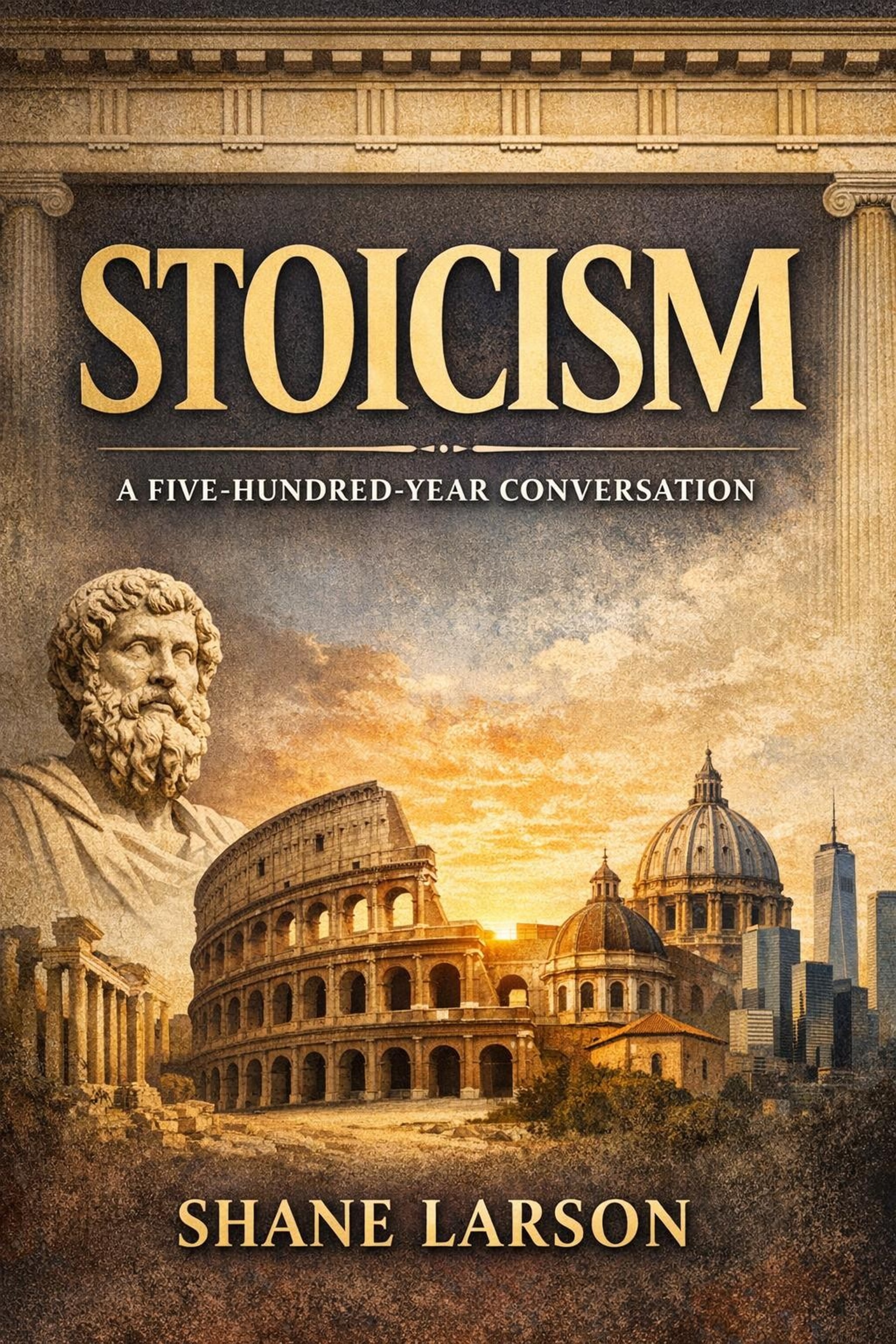
Stoicism
A Five-Hundred-Year Conversation
By Shane Larson
About This Book
In the spring of 301 BCE, a forty-something Phoenician merchant from Cyprus was shipwrecked off the coast of Athens. He had been carrying a cargo of Tyrian purple — the most expensive dye in the ancient world, the color reserved for kings. He lost the cargo and very nearly lost his life. He stayed in Athens, walked into a bookseller's stall, read a chapter of Xenophon's Memorabilia, and asked the bookseller where he could find men like Socrates. The bookseller pointed at a passing philosopher and said, "Follow him."
Zeno of Citium followed. Twenty years later he was teaching his own philosophy in a public colonnade on the north side of the Athenian agora — the Stoa Poikile, the Painted Porch — and his students were calling themselves Stoics after the building. The school he founded ran for five hundred years through a continuous chain of named teachers. By the time Marcus Aurelius was writing his private notebook in a military camp on the Danube in 180 CE, Stoicism had already been a working philosophical tradition for nearly half a millennium.
You probably haven't met most of those teachers. The popular Stoic revival has done a great deal of good, but it draws on three Roman writers — Seneca, Epictetus, and Marcus Aurelius — and treats them as if they were the school. They were not. They were the late inheritors of a system that had been built and debated and refined by a dozen earlier generations, almost all of whom wrote in Greek and almost all of whose books are now lost.
What This Book Recovers
Stoicism was not a self-help program. It was a complete intellectual system organized into three integrated branches: logic, physics, and ethics. The Stoics insisted that the three could not be separated. The ethical advice that survives in Seneca's letters and Marcus's notebook — focus on what is in your control, treat externals with equanimity, the obstacle becomes the path — was the visible end of a system that depended on a particular theory of language and proposition, a particular materialist cosmology, and a particular account of how the rational mind related to the rational order of the universe.
The logic was extraordinary. Chrysippus, the third head of the school, worked out a system of propositional inference — if-then reasoning over whole statements rather than over terms — that anticipated Frege and Russell by eighteen centuries. Almost nothing of it survives intact, and what we have was reconstructed by modern scholars from quotations and references in later authors who were often hostile.
The physics was strange and beautiful. The Stoic cosmos was a single living rational organism, made of a continuous fiery breath called pneuma, fated to undergo periodic conflagration and rebirth in eternally recurring cycles. Every human mind was a fragment of the same rational fire that animated the whole. The ethics flowed directly from the physics: to live according to nature meant living according to the rational order one was a fragment of.
This book walks through the whole arc. It opens with Zeno and the founding Greek generations. It treats the middle Stoa under Panaetius and Posidonius. It covers the transmission to Rome through Cicero and Cato. It reads the Roman imperial generation — Seneca, Musonius Rufus, Epictetus, Marcus Aurelius — as the late inheritors they were. It follows the tradition through the medieval centuries in which the original Greek texts nearly vanished, into the Renaissance Neostoic moment under Justus Lipsius, into the nineteenth-century German philological recovery, into the mid-twentieth-century academic revival under Hadot and Long and Foucault, and finally into the contemporary popular revival the reader already knows.
It is honest about that contemporary revival. The popularizers have done useful work. They have also, in the process of making the philosophy accessible, flattened it. This book is the longer version.
What You'll Discover
- The Phoenician origins of the school and what Zeno's foreign birth meant for how the Athenians received him
- Cleanthes the water-carrier, who succeeded Zeno and held the school together on what he could earn drawing water at night
- Chrysippus, whose seven hundred books made the system rigorous and almost none of which survive
- Stoic propositional logic — what it was, what survived, why it took eighteen centuries to redevelop
- The materialist cosmology in which the universe is one rational living body, fated to recur eternally
- The middle Stoa and how the school adapted as it moved from Athens to Rhodes to Rome
- Roman political Stoicism through Cicero, Cato, and the late republican aristocracy
- The Roman imperial generation read in context — not as founders but as inheritors of a four-century tradition
- The Stoic-Christian negotiation in late antiquity: what early Christianity absorbed, what it rejected, why
- The medieval near-disappearance of the original Greek Stoic corpus
- Justus Lipsius and the Renaissance Neostoic revival in the era of religious war
- Hans von Arnim's Stoicorum Veterum Fragmenta and the modern reconstruction of what was lost
- The twentieth-century academic Stoa: Pierre Hadot, A. A. Long, Michel Foucault, John Sellars
- The Stoicism-CBT pipeline through Albert Ellis and Aaron Beck and what the clinical version kept
- What the popular revival has done well and what it has trimmed off
Why I Wrote This
I came at Stoicism the way most modern readers do. I read Ryan Holiday. I read Massimo Pigliucci. I read Marcus Aurelius's Meditations in the Hays translation, then in the Hammond. I found it useful and I kept reading. Then I tried to read Seneca's letters straight through, and somewhere around the fortieth letter I started noticing that Seneca kept referring to earlier Stoic doctrines that the introductory books had never mentioned. Then I tried to read Cicero's De Finibus, in which a Stoic spokesman lays out the school's full system, and I realized that the philosophy I had been reading was a Roman remainder. The founders were elsewhere.
The founders are mostly lost. That's part of the story. Zeno, Cleanthes, and Chrysippus wrote enormously and almost nothing survives intact — what we have is fragments, quotations in later authors, and second-hand summaries. The popular Stoicism books rarely mention this because the loss is uncomfortable. It is also the reason the surviving Roman writers got promoted to founders in the popular imagination: they are who survives.
I wrote this book because I think the longer tradition is more interesting than the Roman remainder, and because I think readers who have already done the work of getting through Marcus and Epictetus are ready for the bigger picture. I wrote the previous books on Marcus Aurelius and Epictetus as standalone introductions to those two figures. This one is the frame they belong inside.
Frequently Asked Questions
Do I need to have read your other Stoicism books first?
No. Stoicism: The Long Tradition is designed as a standalone history of the school. If you have read the Marcus Aurelius or Epictetus volumes, you will recognize some of the Roman material in fuller context, but nothing in this book assumes you have. If anything, the reading order can be reversed — readers who start here may want to come back to the single-figure volumes afterward for closer treatment of Marcus and Epictetus specifically.
Is this a technical philosophy book or a narrative history?
Closer to a narrative intellectual history than a technical text. The book takes the philosophical content seriously — including the logic and the physics, which most popular books skip — but it presents the material as a story unfolding across centuries, with named teachers and historical context. No prior philosophy background is assumed. If you can follow a serious history book, you can follow this one.
How does this differ from Ryan Holiday's books or Massimo Pigliucci's How to Be a Stoic?
Those are practical-philosophy books — they extract Stoic doctrines and apply them to modern life. This book is intellectual history. It tells the story of how the philosophy was built, by whom, over how long, with what internal disagreements, and how it has traveled from Athens to the present. The popular books and this book are not in competition. They are doing different jobs. If you have read the popular books and want the underlying tradition, this is the next step.
Does the book cover the women associated with Stoicism?
The book treats the women who appear in the historical record — Porcia Catonis, the Roman matron Marcia to whom Seneca addressed his Consolation, the women whose presence in Musonius Rufus's classroom is documented — and is honest about the limits of what we know. Stoicism was theoretically committed to the rational equality of women in a way unusual for ancient philosophy, and the book treats this seriously without overclaiming.
What's the relationship between ancient Stoicism and modern Cognitive Behavioral Therapy?
The book traces the lineage in some depth. Albert Ellis, who developed Rational Emotive Behavior Therapy in the 1950s, cited Epictetus directly. Aaron Beck, who developed CBT, drew on the same tradition. The cognitive premise — that judgments about events, not events themselves, are what produce emotional response — is straight Stoicism. The book covers what the clinical tradition kept, what it adapted, and what it left behind.
Is this book available on Kindle Unlimited?
Yes. The ebook is enrolled in Kindle Unlimited and available to read at no additional cost for subscribers. The print edition is sold separately.
If You Liked This, You Might Like
- Marcus Aurelius — the standalone treatment of the philosopher-emperor whose Meditations are the most-read Stoic text in the modern revival.
- Epictetus — the freed slave whose Discourses and Enchiridion shaped the Roman imperial Stoa and the modern CBT tradition.
- Library of Alexandria — the intellectual institution where Stoic and other Hellenistic philosophical texts were collected, copied, and eventually lost.
- Hypatia of Alexandria — the late-antique philosopher and mathematician who taught in Alexandria as the Christian-pagan negotiation that absorbed Stoicism was reaching its conclusion.
Stoicism has been a working philosophical tradition for twenty-three centuries. The version on your shelf is a useful entry point. This book is what comes after the entry point.
Included with Kindle Unlimited — read it free if you're a member.
New Philosophy releases and free chapters — no spam, unsubscribe anytime.
More in This Genre
View all →