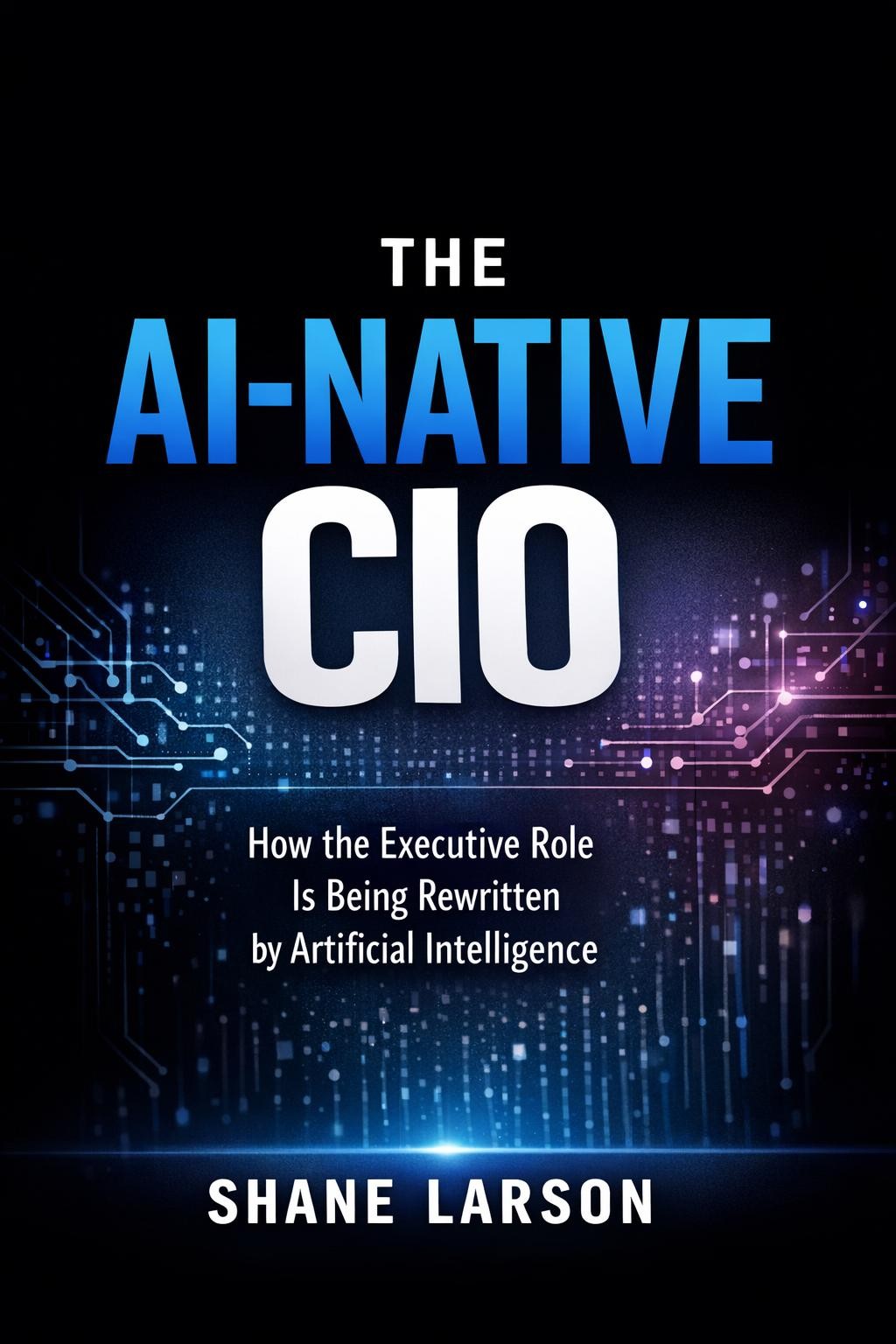
The AI-Native CIO
How the Executive Role Is Being Rewritten by Artificial Intelligence
By Shane Larson
About This Book
Picture the annual IT planning meeting. Twelve months of roadmap on the screen, locked in a spreadsheet, defended line by line in budget review. For a long time this was the most important document a technology organization produced — proof that IT had a plan and could be trusted to execute it.
Now, by the time that plan clears approval, the assumptions underneath it have already moved. The systems it governs are learning, adapting, and making decisions on a timescale the meeting can't even see. The roadmap isn't wrong because someone planned badly. It's wrong because the act of planning twelve months out, in a world where machines respond in milliseconds, has stopped making sense.
That gap — between the speed of the technology and the speed of the executive accountable for it — is what The AI-Native CIO is about.
The Argument
For three decades the CIO role rested on a stable foundation. Technology was a support function. The business set direction; IT delivered against it. Work arrived as projects, got funded once a year, and was measured by whether it shipped on time and on budget. Humans made the decisions; software executed them. Every assumption was internally consistent, and the job was built to fit.
Artificial intelligence has quietly pulled each of those assumptions out from under the role. When systems make and act on decisions continuously, an annual planning cycle becomes a liability instead of a discipline. When AI is a participant in the work rather than a tool that waits for instructions, the org chart designed to route human tasks becomes the bottleneck. When value comes from outcomes that compound, the project-and-budget model that measures activity starts measuring the wrong thing entirely.
This book is not an argument that CIOs should "embrace AI." Most already say they have. It's an argument that the role itself — its planning rhythm, its structure, its metrics, its relationship to the board — needs to be rebuilt rather than upgraded, and a practical account of what the AI-native version of the job looks like once that rebuild is done. The goal is not to make the existing role faster. It's to replace the assumptions the role was built on with ones that survive contact with AI.
What You'll Discover
- A Decision Speed Framework that categorizes decisions along a spectrum — from choices fast and repetitive enough for autonomous AI, to slow, high-context calls that have to stay with a human — and gives you a defensible way to place each one
- A method for separating what genuinely belongs to machines from the smaller, more important set of decisions that must remain human, and why getting this line wrong in either direction is costly
- Why the org chart is the real constraint on AI-era speed, and how to restructure an IT organization so the structure stops fighting the technology
- How to build human-AI teams in practice, treating the AI as a collaborator that contributes to outcomes rather than a system someone has to operate
- A new measurement model — adoption velocity, collaboration effectiveness, outcome acceleration — built to track results instead of cataloguing effort
- How to fund technology in a consumption-priced world, replacing fixed annual capex thinking with outcome-based budgeting
- A playbook for educating a board on AI honestly, holding the line between hype and fear so the conversation produces decisions instead of anxiety
- A 180-day roadmap for transforming the role from within, written for the person who has to do it without stepping out of the job to do it
Why I Wrote This
I spend my working life on the technology side of this shift — building enterprise AI systems, leading integration engineering teams, and advising organizations through Cortex Agent. What I kept running into wasn't a technology gap. The tools work. The gap was at the top of the org chart, where leaders who understood AI conceptually were still running the role exactly as they always had: planning annually, funding by project, measuring activity, keeping every meaningful decision human by default.
I wrote this because the conversation about AI in the enterprise is almost entirely about the technology and almost never about the executive accountable for it. There are endless books on models, agents, and platforms, and very few that take the CIO role itself as the thing that has to change. This is the book I wanted to hand the leaders I work with — not another tour of what AI can do, but a direct account of what the job becomes when you take that seriously.
Frequently Asked Questions
Do I need to read Digital Transformation at Machine Speed first?
No. The two are designed to stand alone. Digital Transformation at Machine Speed is the broader playbook for moving an organization at AI-era pace; The AI-Native CIO narrows in on the executive role itself. If you've read the first, this is the leadership companion; if you haven't, this still works on its own.
Is this a technical book?
No. There's no code, no model architecture, no vendor comparison. It assumes you already grasp what AI can do and focuses entirely on the executive role — how it needs to change, and what the AI-native version looks like in practice. The technical knowledge it assumes is the kind any senior IT leader already has.
Who is this actually for?
Sitting CIOs and senior IT leaders are the core audience. It's also written to be useful to CEOs and board members trying to define what technology leadership should mean in an AI era, and to aspiring CIOs who want to build the right competencies before they're in the chair.
How long is it, and is it practical?
Fourteen chapters plus three working appendices, including a 30-question self-assessment and a decision-delegation framework you can apply to your own organization. It's built to be actionable from the first chapter rather than front-loaded with theory.
Is this part of a series?
Yes. It's part of the Machine-Speed series, alongside Digital Transformation at Machine Speed, The 90-Day AI Transformation, and Governing at Machine Speed. Each stands alone, but together they cover the transformation from strategy through execution, governance, and the leadership role itself.
If You Liked This, You Might Like
- Digital Transformation at Machine Speed — the broader companion volume: how to move an entire organization at AI-era pace, where this book focuses on the leader.
- The 90-Day AI Transformation — a week-by-week execution playbook for CIOs who need visible results fast, pairing the role-level thinking here with a concrete near-term plan.
- Governing at Machine Speed — the governance side of the same shift, for when autonomous decisions need oversight that moves as fast as they do.
- AI and the Leadership Illusion — a sharper, more contrarian take on how AI is reshaping who actually holds power inside technology organizations.
The CIO role wasn't designed for a world where technology decides. This is the field guide for rebuilding it for one that does.
Part of the Machine-Speed series.
New AI & Technology releases and free chapters — no spam, unsubscribe anytime.
More in This Genre
View all →