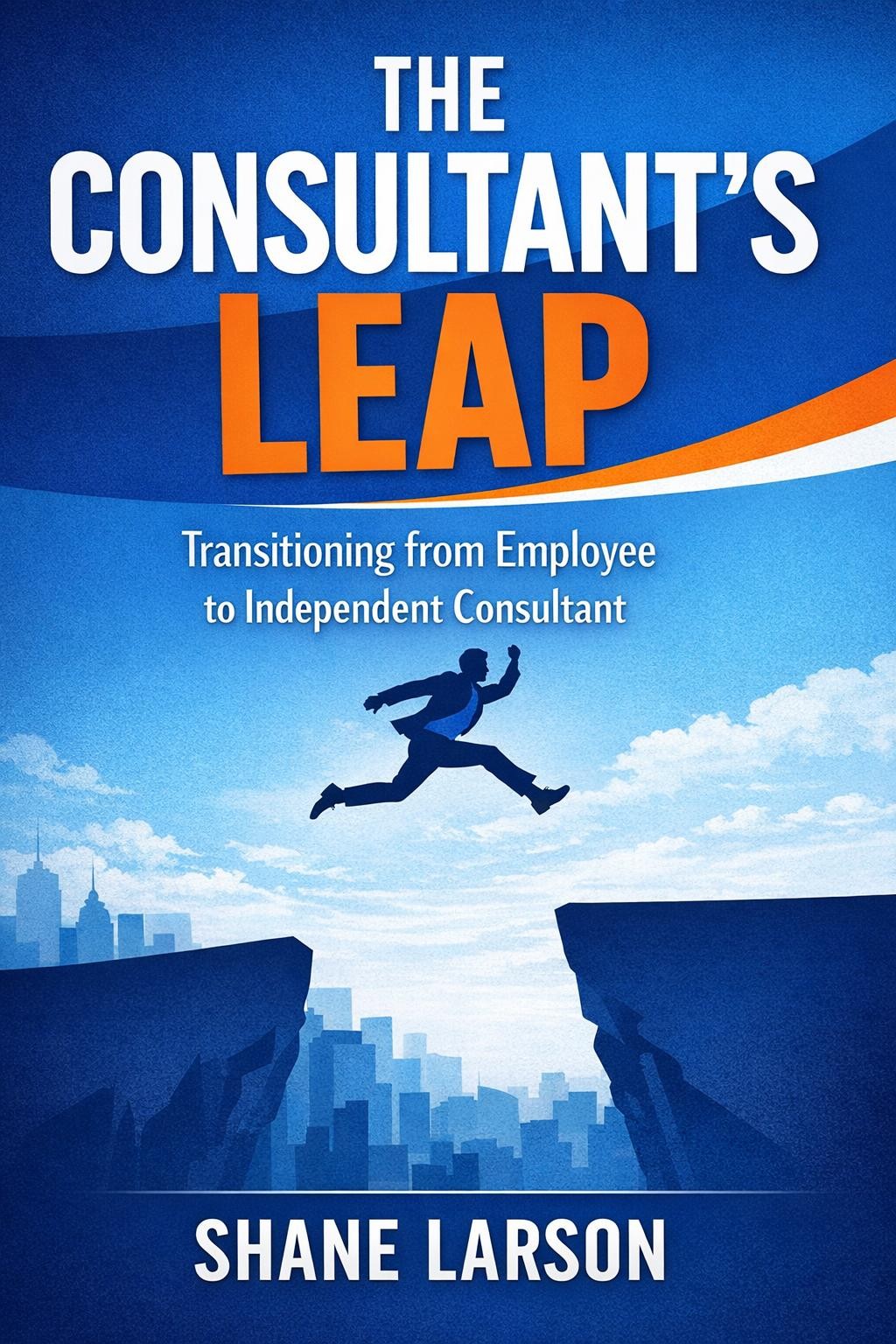
The Consultant's Leap
Transitioning from Employee to Independent Consultant
By Shane Larson
About This Book
It's a Tuesday night and you're staring at a spreadsheet you built in secret. One column is your salary. The next is your employer's billing rate for your time. The third is what you'd keep if those checks came to you instead. The number at the bottom is large enough that you've started rehearsing your resignation in the shower.
You are not the first engineer to build that spreadsheet. Thousands build it every year, and a meaningful fraction of them act on it — quitting stable jobs to become independent consultants on the strength of a single multiplication. Some of them thrive. Many of them don't, and the ones who don't rarely fail because they weren't good at the work. They fail because the spreadsheet left out every column that actually matters: sales cycles, dry months, self-employment tax, unbillable hours, and the strange loneliness of being your own employer.
The Consultant's Leap: Transitioning from Employee to Independent Consultant is about those missing columns. It's a book for the engineer who is seriously considering independence and wants the full picture before making a decision that's expensive to reverse.
The Argument
The central claim of this book is simple: independent consulting is a business, and most engineers who fail at it fail at the business, not the engineering. The technical skill that makes you valuable as an employee is table stakes as a consultant. What determines whether you survive year one is everything wrapped around it — how you find clients, how you price engagements, how you structure contracts, and how you manage the financial and emotional volatility of income that arrives in lumps instead of paychecks.
The book walks that territory in order. It starts with the decision itself: a framework for honestly evaluating whether consulting fits your skills, finances, and temperament while you still have the safety of employment. From there it covers the operational foundation — business entities, taxes, insurance, and the contract clauses that protect you when engagements go sideways. Then the part most engineers dread: building a client pipeline from zero, without a famous name or a warm network, and pricing your work in a way that reflects value rather than anxiety.
The final chapters deal with what happens after you've landed clients: the delivery and communication habits that turn a first engagement into a second, the decision points around scaling versus staying solo, and the scenario the motivational content never mentions — recognizing when returning to employment is the smart move, and doing it from a position of strength rather than desperation.
This isn't a book that assumes leaping is the right answer. It treats staying employed as a perfectly rational outcome of reading it. What it argues against is deciding either way on incomplete information.
What's Inside
- A pre-leap assessment framework covering runway, risk tolerance, marketable positioning, and the personality traits that consulting rewards and punishes
- Plain-language coverage of the legal and financial foundation: LLC versus S-corp considerations, quarterly taxes, liability insurance, and the contract terms that matter most
- Client acquisition strategies that work without an existing referral network, and how to build a pipeline before you need it
- A pricing chapter that addresses the two most common failure modes — undercharging out of fear and overcharging without positioning to back it up
- Communication and delivery practices that make clients want to extend engagements rather than end them
- The economics of repeat business, and why your second project with a client is worth far more than your first with a stranger
- Decision frameworks for the crossroads moments: hiring subcontractors, staying solo, raising rates, or winding down and returning to employment
- The psychological terrain of independence — irregular income, isolation, and identity — treated as a real operational concern rather than an afterthought
Why I Wrote This
I spent fifteen years as an employee in enterprise software before going independent, and I made the transition with far less preparation than I'd recommend to anyone else. Most of what I know about the business side of consulting I learned by getting it wrong first — contracts I shouldn't have signed, engagements I priced badly, months where the pipeline was empty because I'd been too busy delivering to sell.
When I looked for the book I needed back then, I mostly found two things: motivational content selling the lifestyle, and dense professional-services literature written for people running firms of fifty. Nothing spoke to the individual engineer sitting on that spreadsheet, trying to decide. So I wrote the version I wish someone had handed me — including the chapters about failure, because pretending it doesn't happen is how it happens.
Frequently Asked Questions
Do I need to quit my job before this book is useful?
No — the opposite. The book is most valuable while you're still employed, because the first section is a decision framework designed to be worked through before you resign. Several chapters, like building a pipeline and establishing your legal foundation, describe work you can start months before giving notice.
Is this only for software engineers?
The examples and framing come from software and enterprise technology, because that's the author's background and the most common path into technical consulting. But the core material — entity formation, pricing, contracts, client acquisition, engagement management — applies to any technical specialist considering independence, including architects, data professionals, and security practitioners.
Does it cover the tax and legal details?
Yes, at the level of a working orientation: entity types, self-employment and quarterly taxes, insurance categories, and the contract clauses that most often burn new consultants. It's written for a U.S. context and is not a substitute for a CPA or attorney — the goal is to make you an informed client of those professionals rather than a confused one.
What if I read it and decide not to go independent?
That's treated as a success, not a failure. The book's position is that the only bad outcome is leaping unprepared. A reader who works through the assessment framework and concludes that employment is the better fit has gotten full value from it.
Is this part of a series?
Yes — it belongs to the Builder's Career Series, a set of books for technologists navigating career structure, transitions, and sustainability. Each book stands alone; there's no required reading order.
If You Liked This, You Might Like
- The Second Act — career pivots for developers over 40, a natural companion for readers weighing consulting as a mid-career move.
- Refactoring Your Career — redesigning work, health, and freedom in tech, for readers drawn to independence as much for the lifestyle as the income.
- The Systems Thinker's Advantage — the skill that makes consultants worth their rates, and why AI can't replace it.
The leap from employee to independent consultant is one of the highest-stakes career decisions a technologist can make. This book exists so you make it with the whole spreadsheet in front of you — not just the column with the big number.
Part of the Builder's Career Series.
Included with Kindle Unlimited — read it free if you're a member.
New Technology Careers releases and free chapters — no spam, unsubscribe anytime.
More in This Genre
View all →