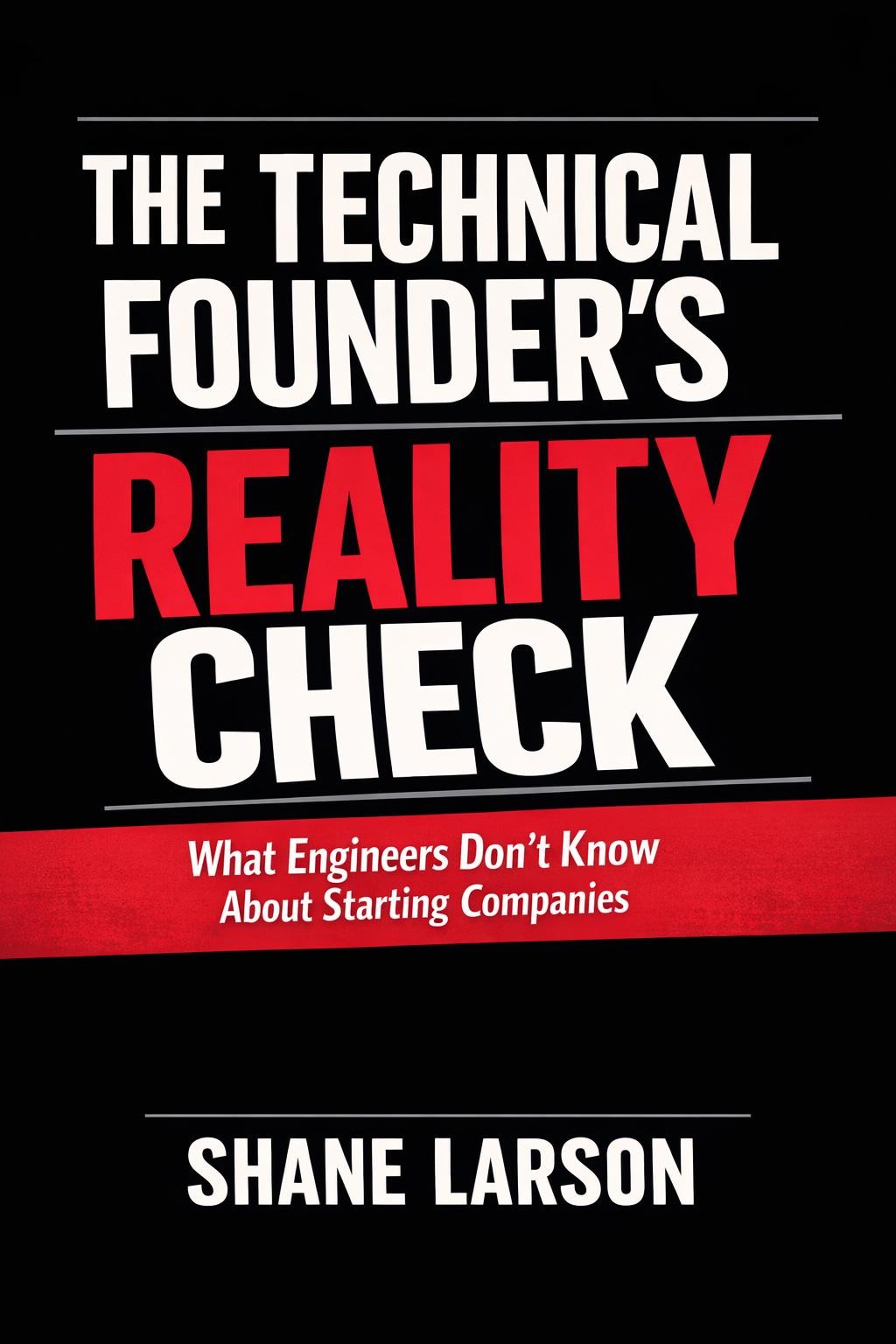
The Technical Founder's Reality Check
What Engineers Don't Know About Starting Companies
By Shane Larson
About This Book
The product is genuinely good. You've spent nine months building it, and it shows — the architecture is clean, the demo is smooth, the few people who've used it say nice things. Your bank balance, meanwhile, has been dropping in a straight line since the day you quit your job. You have maybe seven months of runway left. You have four paying customers, three of whom are friends. And you're starting to understand, in a way no blog post prepared you for, that building the thing was never the hard part. Selling it, funding it, and surviving the loneliness of it — those are the parts that decide whether you have a company or an expensive hobby.
Here's what makes this trap so effective: everyone who could warn you has a reason not to. The founders who speak at conferences are the ones it worked out for. You never hear from the far larger number who burned through their savings, strained their marriages, and quietly went back to a salaried job with nothing to show for the gamble. And the advice that does reach engineers is filtered through people whose incentives don't match yours — venture capital does very well on a portfolio of failures as long as one company hits, which is a fine deal for the fund and a terrible frame for the individual human deciding whether to risk everything.
This is a book for that human, written before the decision instead of after it.
The Argument
The central claim is simple and a little uncomfortable: your technical excellence, the thing that makes you feel ready to found a company, is largely irrelevant to whether the company works. You can out-engineer every competitor and still fail, because companies don't die of bad code. They die of running out of money, of co-founder relationships that curdle, of a founder who couldn't bring themselves to do sales, of a good idea that no one actually wanted to pay for. The skills that got you here are not the skills that keep you alive, and the gap between them is where most technical founders get lost.
So this book spends its time on the parts of founding that engineers systematically underweight. The money, in real terms — runway, burn, the honest math of bootstrapping versus raising, the preference stack that decides who actually gets paid when the company sells, and the quiet financial decisions that kill companies slowly enough that nobody notices until it's too late. The human parts — choosing a co-founder, which is the most consequential and least reversible decision you'll make, and the conversations you have to force before you start rather than after it breaks. And the psychological cost, which almost no one talks about: the identity fusion that makes every product setback feel like a personal verdict, the decision fatigue, the isolation, the toll on your body and the people who love you.
It also insists on something the ecosystem never mentions: the alternatives. Founding a venture-track startup is one option among several, not the only respectable path for an ambitious engineer. Side projects, consulting, indie hacking, lifestyle businesses — ways to build something of your own without betting your entire life on a single binary outcome. Sometimes the reality check leads you to a smaller, sturdier version of the dream, and that's a win, not a consolation prize.
What it does not do is tell you the answer. The last chapter hands you a framework and asks you to fill it in with your own savings, your own market, and your own household, and the Conclusion refuses to supply the verdict the framework withheld. An informed no and an informed yes are treated as equally good results. The only outcome the book is trying to stop is the one where you find out the price after you've paid it.
Why I Wrote This
I'm a software engineer, and I founded a company. You will not find that company anywhere in this book, and leaving it out was the hardest editorial decision in it.
The obvious way to write a book like this is from experience: here is what I learned, here is what I would do differently. I started down that road and stopped, because the first chapter makes an argument that applies to me exactly as much as it applies to anyone on a conference stage. The person telling a founding story is the person who survived long enough to tell it. One outcome is an anecdote, however honestly it's reported, and an honest anecdote is still the raw material the founder-content industry runs on. If I put my own company in, I'd be asking you to trust me because I was there, which is precisely the form of authority the book tells you to stop accepting.
So I took myself out. Every illustration in the book is a documented public case, a published study with the figure and the source named, or arithmetic shown on the page so you can redo it with your own numbers. Where I couldn't support a claim one of those ways, I cut it rather than softening it into something vague and keeping it. That made for a less flattering book to write and, I think, a more useful one to read. It also means the book passes the test it asks you to apply to everything else: if you finish it and decide not to found a company, nothing happens to me. That was the point.
Frequently Asked Questions
Is this an anti-startup book?
No — it's an anti-mythology book. The goal isn't to talk you out of founding a company; it's to strip away the survivorship bias and the borrowed optimism so you can decide with clear eyes. If the reality check changes your mind, it saved you years and a lot of money. If you read it and still want to go, you'll go better prepared.
Is it based on the author's own startup?
No, and on purpose. The author has founded a company but kept it out of the book, because a single founder's experience is an anecdote no matter how honestly it's told, and the survivorship problem the book opens with applies to him too. Everything in it is a documented public case, published research with the source named, or worked arithmetic you can check. There are no composite founders and no "imagine a startup that…" scenarios.
I already have a side project. Is this relevant to me?
Very. One of the exact decisions the book is built to help with is whether a side project should become a company at all — and the honest answer is often that it shouldn't, or at least not yet, or not in the venture-backed way people assume. It treats "keep it a side project" and "go all in" as equally legitimate outcomes.
Does it cover the money side, or is it all mindset?
It covers the money in concrete terms — runway, burn rate, bootstrapping versus raising, dilution, and the financial decisions that quietly sink companies. There's a financial readiness calculator and a risk tolerance assessment among the practical tools, alongside a co-founder compatibility checklist and a quit-versus-persist decision matrix.
Do I need business experience to get anything out of it?
No. It's written specifically for engineers who can build but have never run a business, which is why it spends its time on the sales, financial, and psychological ground that technical people tend to walk into blind.
If You Liked This, You Might Like
- The Vibe Coded SaaS — a firsthand account of building a real business as a technical solo operator, the tactical companion to this book's harder questions.
- The Zero Employee Company — for the "build something of your own without betting everything" alternative this book argues you should take seriously.
- The Consultant's Leap — the lower-risk path out of employment for engineers who want ownership without the full startup gamble.
- The Builder's Bargain — an honest look at the trade-offs of building a career on your own terms.
For the earlier chapters of an engineering career, The First 1,000 Days and The Staff Engineer's Paradox — both companions in this series — cover the ground you'd be leaving behind to found something.
Founding a company is one of the few decisions in a career that's genuinely hard to reverse. This book makes sure you make it awake. Part of the Builder's Career Series.
What You'll Learn
- How the founder narrative gets manufactured, and what the actual survival and return figures look like when the losers are counted.
- The self-assessment most founders skip — real runway, the benefits that vanish with your badge, the opportunity cost that dwarfs lost salary, and the conversation with the person whose life this also changes.
- Co-founder selection — compatibility questions to answer honestly up front, equity and vesting, and why this decision outranks almost everything else you'll do.
- Where a founder's hours actually go once the product exists, and why hiring the problem away doesn't work early.
- Sales for people who instinctively hate it — finding the first customers, asking for the money, pricing without undercharging yourself, and getting attention with no audience and no budget.
- The money, with the arithmetic shown — unit economics, burn, dilution, and how a sale that sounds like a win can leave the founders with nothing.
- The psychological toll, sourced from the research on founder mental health rather than from war stories.
- Co-founder blow-ups, running out of cash, and the pivot question — plus frameworks for telling a hard phase apart from a dead end, and how to close a company without it closing you.
- The paths nobody promotes — consulting, indie hacking, and lifestyle businesses that let you own something without wagering everything on one throw.
New Technology Careers releases and free chapters — no spam, unsubscribe anytime.
More in This Genre
View all →