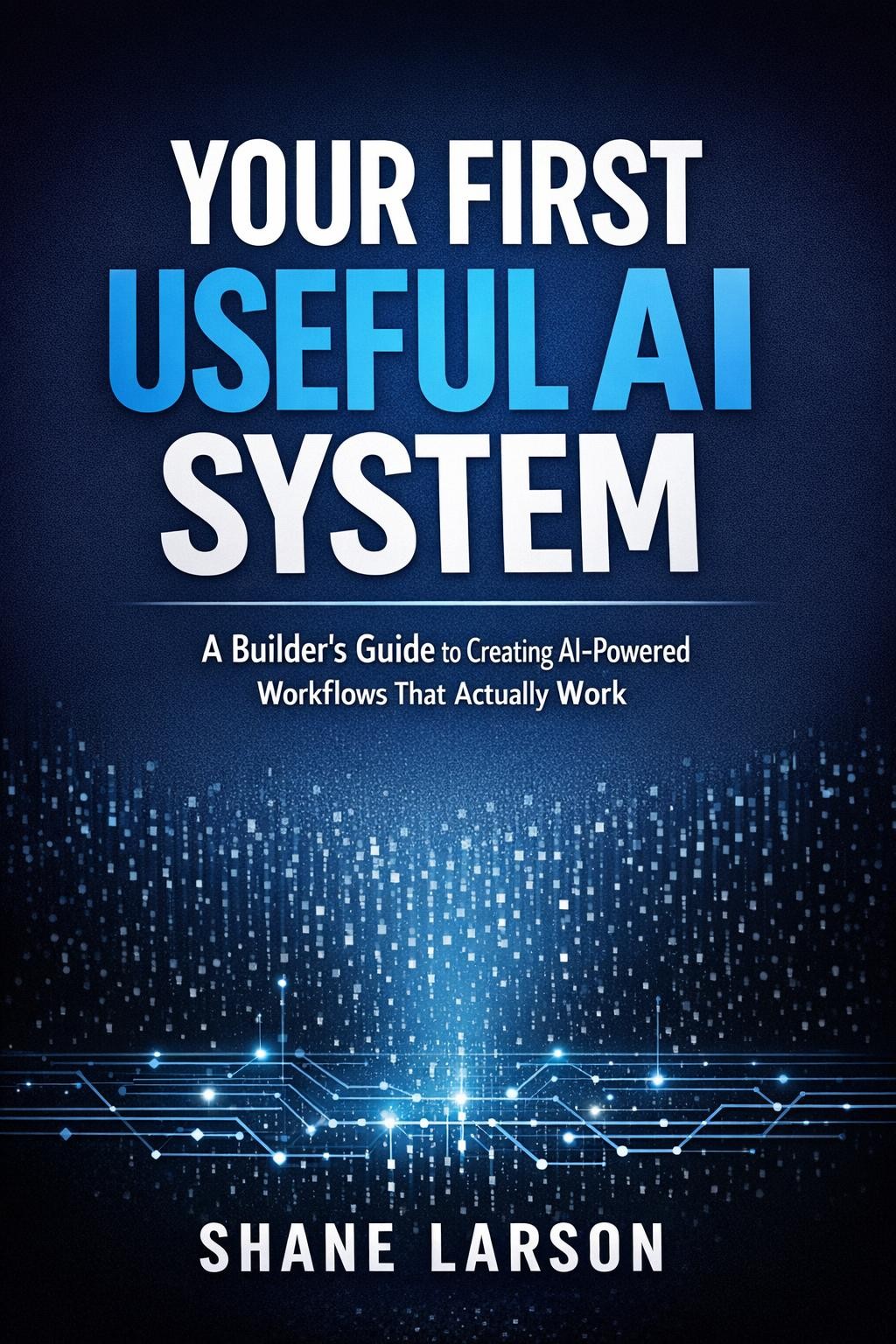
Your First Useful AI System
A Builder's Guide to Creating AI-Powered Workflows That Actually Work
By Shane Larson
About This Book
The demo worked. That's the trap. Someone wires an LLM to a prompt, feeds it three carefully chosen examples, watches it produce something impressive, and declares the problem solved. Then they point it at real data — the messy exports, the inconsistent fields, the edge cases nobody warned them about — and it hallucinates a customer that doesn't exist, silently mangles a date, and costs forty dollars in tokens to process a batch that should have cost forty cents. The demo was never the hard part. The demo is where the hard part hides.
There is a canyon between asking a model a clever question and running a system that does real work without you standing over it. On one side: prompts, playgrounds, screenshots you share because the output surprised you. On the other: a thing that ingests actual data on a schedule, produces output you can trust enough to act on, recovers when a call fails, and doesn't quietly bankrupt you on API costs. Almost everyone is stuck on the first side. Very little exists to help anyone cross to the second.
This book is the bridge across that canyon — and it is built as a bridge, not a lecture about bridges. You end with a system that runs.
The Argument
The reason most AI projects die isn't the model. Models are astonishingly capable and getting more so. Projects die in the space around the model: the wrong problem chosen, no design done before the code, no plan for the failure modes that are guaranteed rather than possible, no honest accounting of what a token actually costs at volume. The intelligence is a component. The system is everything you build around that component to make it reliable — and reliability is a design discipline, not a prompt trick.
So this is a book about that discipline, taught by building. It starts with the choice most people get wrong: which problem to point AI at in the first place. Pick a task that's poorly defined, or one where a mistake is expensive and hard to catch, and no amount of prompt engineering saves you. Pick well, and half the battle is already won. From there it moves through designing the system on paper before writing a line, connecting models to real data sources, forcing structured and usable output out of a tool that would rather ramble, and building the guardrails that catch hallucinations and errors before they reach anything that matters.
It stays framework-agnostic on purpose. This is not a tutorial welded to one vendor's API or one week's hot library — those age out in months. It's the underlying pattern: how to design, build, deploy, monitor, and improve an AI system, using skills that transfer to whatever tools you're holding a year from now. Every chapter ends with something concrete built. By the last page you own a working system and, more valuable, the judgment to build the next one without a book open beside you.
What You'll Discover
- Problem selection as the highest-leverage decision — why most people aim AI at the wrong task, and a practical way to spot the ones that will actually pay off.
- Designing before coding — how to sketch an AI system's shape, data flow, and failure points on paper before you commit to an implementation you'll have to unwind.
- Wiring models to real data — connecting an LLM to genuine sources and coaxing structured, machine-usable output from a tool that defaults to prose.
- Failure modes, handled — hallucinations, malformed responses, timeouts, and the specific errors that quietly kill AI projects, with strategies to catch them early.
- Cost as a design constraint — keeping a system from becoming more expensive than the problem it solves, and knowing where the money actually goes.
- Deploying to run unattended — scheduling, automation, monitoring, and alerts so the system does its job while you do something else.
- Improving on real performance — treating a deployed system as something you tune against actual results rather than freezing it the day it ships.
- A concrete deliverable every chapter — the book is structured so you're always building, not just reading about building.
Why I Wrote This
I've spent years as a software engineer and solutions architect, and I kept watching capable people bounce off the same wall. They'd read the tutorials, get a clever prompt working, and then stall completely when it came to turning that spark into something dependable — because everything they'd read stopped at the demo. The skills that make a demo and the skills that make a system are different skills, and hardly anyone was teaching the second set to people who weren't already senior engineers. I wanted a book I could hand to a competent developer or a technical professional and say: this is how you get from "look what it did" to "it did that again, correctly, at 6 a.m., without me." That gap is where the real value is, and it was going untaught.
Frequently Asked Questions
Do I need to be an experienced programmer?
You need to be comfortable writing and running code — this isn't a no-code book, and it isn't an absolute-beginner's introduction to AI. If you've called an LLM API, run beginner tutorials, and want to move from one-off scripts to a real system, you're squarely the reader. If you've never used an AI model at all, start somewhere more introductory first.
Is this tied to a specific model, API, or framework?
No, and that's deliberate. The patterns are framework-agnostic so they don't expire when the tooling churns. You'll see concrete examples, but the point is the reusable approach — design, data, error handling, cost, deployment, iteration — that carries over to whatever stack you use.
Is this theory or hands-on?
Hands-on throughout. It's not a survey of artificial intelligence or a conceptual overview. Every chapter produces a concrete deliverable, and the chapters accumulate into one complete, working system rather than a pile of disconnected snippets.
What kind of system will I actually build?
A real workflow-automation system — something that processes real data, runs on a schedule without supervision, and returns results you can rely on. The specific domain is flexible; the architecture and the skills transfer to whatever you want to point them at next.
I'm a small business owner, not a developer — is this for me?
If you can write basic code, yes, especially if you're weighing building a custom solution against paying for yet another SaaS subscription. If you don't code at all, this book will move faster than is comfortable.
If You Liked This, You Might Like
- Build Your Own AI Agent From Scratch — the next step up: giving your system tools, memory, and autonomous reasoning in Python.
- Retrieval Augmented Generation with Node.js — a deeper build on connecting models to your own data reliably.
- Prompt Engineering For Real Work — sharpening the model-facing half of the craft once your system architecture is solid.
- Ship It With AI — the same build-something-real ethos applied to shipping whole products faster.
The distance between playing with AI and running something that quietly earns its keep is a set of skills, not a secret. Build the first useful system, and the second one stops feeling like magic and starts feeling like work you know how to do.
New AI & Technology releases and free chapters — no spam, unsubscribe anytime.
More in This Genre
View all →