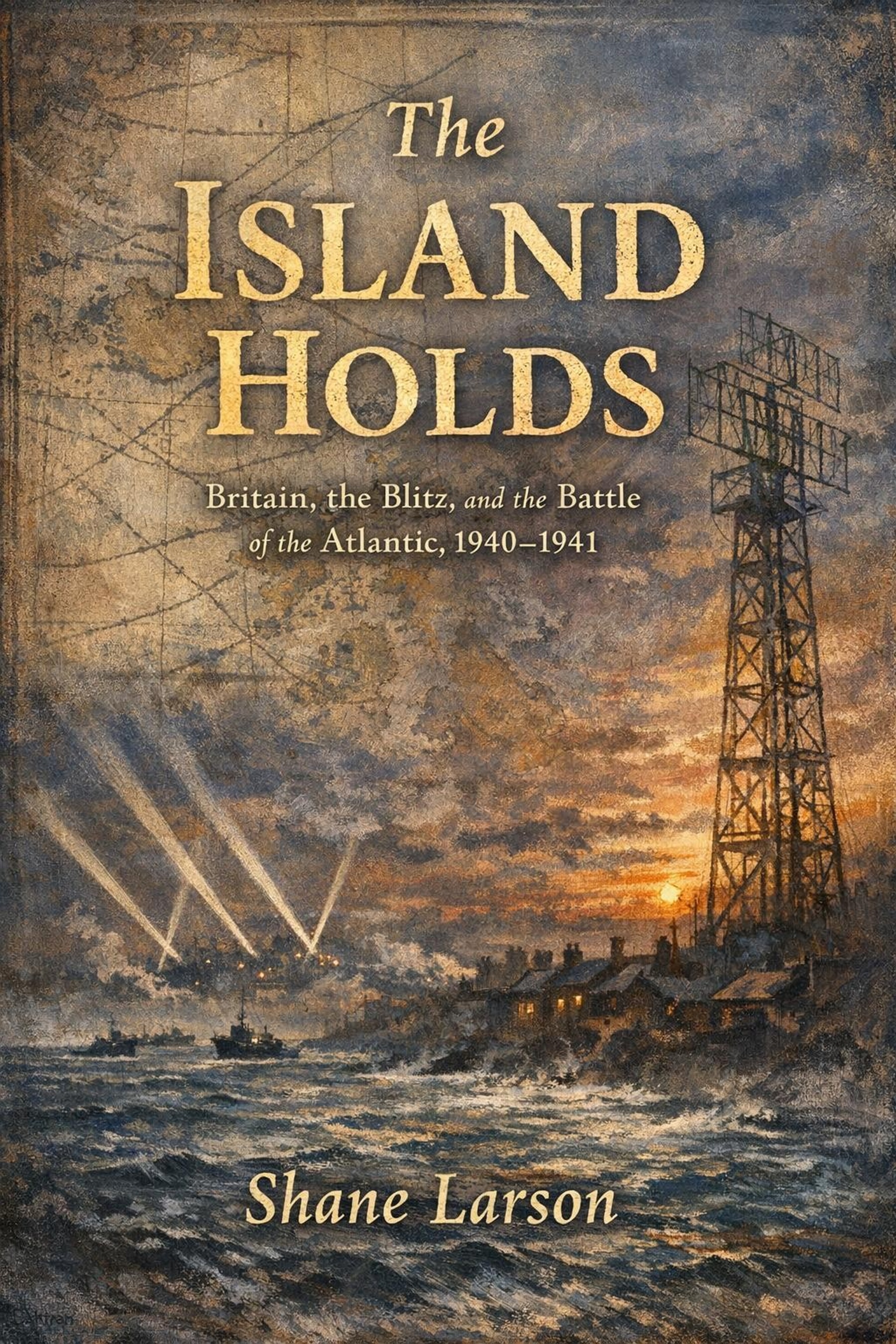
The Island Holds
Britain, the Blitz, and the Battle of the Atlantic, 1940-1941
By Shane Larson
About This Book
Somewhere over the Channel there is a raid, and three radar stations disagree about it. One reports forty aircraft at twelve thousand feet. A second says sixty, and higher. A third, with older aerials, offers a bearing and not much else. The reports arrive by dedicated telephone line at a filter room, where a filterer — quite possibly a woman in her early twenties, doing a job that had not existed four years earlier — reconciles the contradictions into a single counter on a map table: one raid, one strength, one height, one track. Controllers read the table, and somewhere in Kent a squadron climbs to be where the bombers are going to be rather than where they were.
That act of reconciliation, repeated hundreds of times a day through the summer of 1940, is what won the Battle of Britain. Not the radar aerials — the Germans had radar too, in some respects better radar. Not the Spitfire — the Hurricane shot down more aircraft. The scarce thing was the network: the world's first integrated air defence system, rehearsed in two peacetime exercises and finished with about four months to spare. The Luftwaffe never fully understood it was fighting one. It bombed the radar stations for a fortnight, concluded they were not worth the effort, and turned away.
The Argument
The first two volumes of this series were studies in failure under time pressure: a security system that would not bear a cost, then an army that could not decide inside the tempo of an attack. This volume is the control case — what it looks like when the machinery is ready before the demand arrives, built by committees and unpopular air marshals in years when nobody could prove it would be needed.
But the same country, in the same year, supplies the counter-example, and it is the strongest evidence in the series. When the bombers came at night, the machinery that won the daylight battle could not see them, and nothing equivalent had been built for the dark. For eight months the night defences shot down almost nothing — figures kept from the public — while London was bombed on fifty-seven consecutive nights and the fires moved on to Coventry, Bristol, Plymouth, Clydebank, Belfast. Same population, same government, same scientists, same courage. The only variable that changed at dusk was whether the system existed. The Blitz was endured, not defeated, and it ended for German reasons, not British ones.
Underneath both air campaigns ran the slowest and least visible struggle of the three. Britain's imports arrived by ship or did not arrive, and from mid-1940 the U-boats sank shipping roughly three times faster than British yards replaced it. The air battle, counted honestly, was never as close as it looked. The Atlantic was being lost, in fact, continuously, for every month this book covers — and Churchill's later judgement that the U-boat peril was the only thing that ever really frightened him survives the arithmetic.
What's Inside
- Mers-el-Kébir, 3 July 1940 — the morning Britain fired on the fleet of an ally of six weeks earlier, and the audience across the Atlantic the guns were really aimed at
- The Dowding System from aerial to filter room to sector controller, plus a technical appendix that leaves you able to explain it to someone else
- Sea Lion as the German navy saw it: a river crossing against the largest fleet on earth, planned with requisitioned canal barges after half its destroyers were already lost
- The daylight battle with the arithmetic in the open — claim inflation on both sides, and a German intelligence estimate wrong by a factor of seven at the decisive moment
- The Big Wing controversy stated fairly, and how the battle's two winning commanders lost their careers
- The beam war: bombing by intersecting radio signals, and the intelligence effort that deduced, bent and jammed them
- The Coventry–Ultra story taken apart properly — what was known before the raid, when, and from which source
- The Happy Time, the surfaced night attack sonar could not detect, and the merchant seamen whose proportional death rate exceeded any armed service's
- What the naval Enigma break actually did — routing convoys around wolfpacks, a victory of evasion won by battles that never happened
- Hood and Bismarck, Taranto and Crete, and the bridge to the war's eastern turn
Why I Wrote This
The first two books in this series were about machinery failing under pressure — a peace that would not pay to defend itself, an army that could not decide fast enough for the decision to matter. Writing them, I kept wanting the control case: what does it look like when the machinery was built in time? This volume is that case. What made it irresistible is that Britain in 1940 contains its own counter-example. The same country, in the same year, under the same bombs, succeeded completely by day and failed almost absolutely by night — and the difference was that one system had been finished four years early and the other had not been built at all. That is as close to a controlled experiment as history ever runs, and I have not found a cleaner one. The courage was constant. The machinery was the variable. That seemed worth a book.
Frequently Asked Questions
Do I need to read Volumes 1 and 2 first?
No. The Introduction opens with a compressed recap that carries a new reader from Versailles to the French armistice in a few pages. If you have read Volume 2, Chapter 1 begins eight days after it ends. Every volume in the series stands alone.
Is this just another Battle of Britain book?
No — the daylight battle is four chapters of fourteen. The Blitz gets three, the Atlantic and the naval war get four, and the framing argument is about the system rather than the dogfights. If anything, the book argues the air battle was less of a near-run thing than memory insists, and the Atlantic more.
Did Churchill really let Coventry burn to protect Ultra?
No, and Chapter 9 takes the story apart in detail rather than in a footnote: what was actually known before the raid, when, from which source, and why the myth has proved so durable. It is one of the most persistent false stories of the war.
Why does the Atlantic get so much of the book?
Because on the numbers it was the closer campaign. The air battle was decided in about four months; the tonnage war ran the whole span of this volume and years beyond it, and in its worst stretches the margin was measured in weeks of imports.
Does it cover Pearl Harbor and America's entry into the war?
No. This volume closes in June 1941, as the bombing of London stops and three million men stand on the Soviet frontier. The invasion of the Soviet Union is Volume 4; Pearl Harbor and the war's globalisation belong to Volume 5.
If You Liked This, You Might Like
- The Institutional Collapse Pattern — the general theory of what this book studies in a single year: how institutions keep or lose the capacity to function under load.
- The Empire Collapse Pattern — Britain survived 1940 by spending its empire to keep its island; this is the longer story of how great powers come apart.
- The Technology Collapse Pattern — why inventing a technology, as Germany did radar, matters less than organising it.
The twelve months in this book did not decide the war's outcome — they decided that there would be an outcome to fight for. Volume 3 of The Second World War Chronicles, a ten-volume history of the Second World War.
What You'll Learn
- Mers-el-Kébir, 3 July 1940 — the morning Britain fired on the fleet of an ally of six weeks earlier, and the audience across the Atlantic the guns were really aimed at
- The Dowding System from aerial to filter room to sector controller, plus a technical appendix that leaves you able to explain it to someone else
- Sea Lion as the German navy saw it: a river crossing against the largest fleet on earth, planned with requisitioned canal barges after half its destroyers were already lost
- The daylight battle with the arithmetic in the open — claim inflation on both sides, and a German intelligence estimate wrong by a factor of seven at the decisive moment
- The Big Wing controversy stated fairly, and how the battle's two winning commanders lost their careers
- The beam war: bombing by intersecting radio signals, and the intelligence effort that deduced, bent and jammed them
- The Coventry–Ultra story taken apart properly — what was known before the raid, when, and from which source
- The Happy Time, the surfaced night attack sonar could not detect, and the merchant seamen whose proportional death rate exceeded any armed service's
- What the naval Enigma break actually did — routing convoys around wolfpacks, a victory of evasion won by battles that never happened
- Hood and Bismarck, Taranto and Crete, and the bridge to the war's eastern turn
Included with Kindle Unlimited — read it free if you're a member.
New Military History releases and free chapters — no spam, unsubscribe anytime.