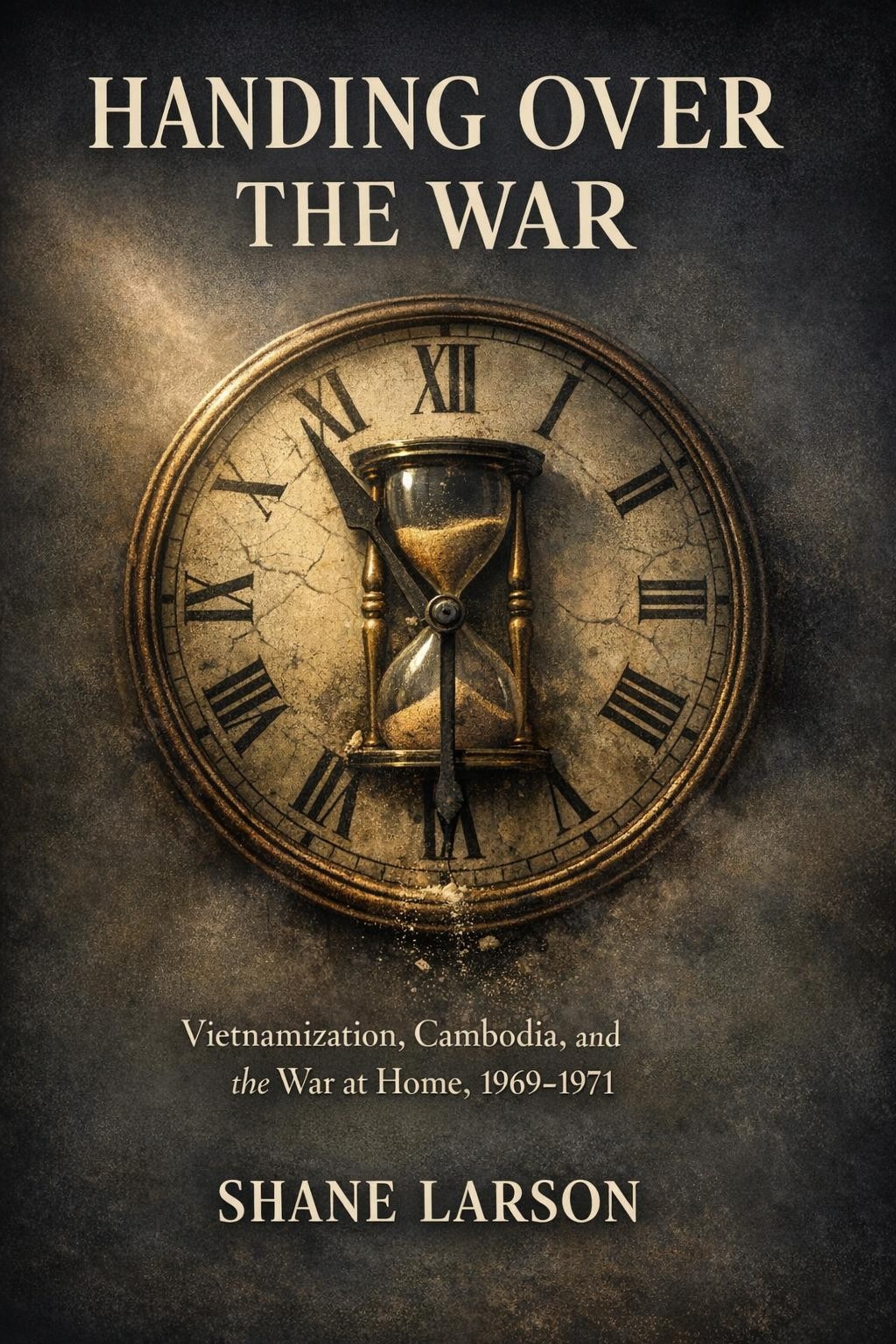
Handing Over the War
Vietnamization, Cambodia, and the War at Home, 1969-1971
By Shane Larson · The Vietnam War Chronicles (Book 6)
About This Book
On 20 April 1970 the President of the United States went on television and announced the largest single troop withdrawal of the war: 150,000 Americans home within a year. Nine days later, American ground forces crossed the border into Cambodia, and the country was told that a war it had been promised was ending had just been widened into a second country.
Nine days. The same president, the same policy, the same fortnight. Most histories treat the announcement and the invasion as a contradiction, or as evidence of bad faith. This book argues they were neither — that they were the same strategy, operating exactly as designed, and that the design is the tragedy. The withdrawal kept the war politically alive at home. The operation tried to buy time for the handover the withdrawal was making more fragile. An administration was trying to purchase time with operations while spending it with withdrawals, and that fortnight in the spring of 1970 is the whole argument compressed into fourteen days.
The sixth volume of The Vietnam War Chronicles covers 1969 to 1971: the years of the war's most serious attempt at a coherent strategy, run by the most capable American command team of the war, and the years in which the fighting in Southeast Asia and the argument in America stopped being a war and its background and became one system — a system in which a Senate amendment written in Washington determined the shape of a battle in Laos, and a battle on a mountain in the A Shau Valley rewrote the standing orders of an army. The book runs both halves as a single story, because after 1968 that is what they were.
Why I Wrote This
This series opened with a volume about the French handing over a war they could not win to an America that believed it could. Five volumes later, the story arrived at the Americans handing the same war back — and I did not plan that symmetry, but once it appeared it organised everything. The men running Hanoi's war in 1971 had been at Geneva in 1954. They had watched a great power hand this problem over once before, and they read the second handover through the first. That is the kind of structural fact that only a series can earn, and this volume is where it pays.
The other reason is the three arguments. Whether Abrams was winning a war Washington threw away, whether Cambodia bought decisive time, and what Lam Son 719 actually proved are among the most fiercely partisan questions in the war's literature — each has a camp, and each camp has a shelf. I wanted to write the book that gives both cases at full strength, says which way the evidence leans, and states exactly where it runs out. Refusing to settle them is not fence-sitting; it is the finding. The evidence genuinely does not permit settlement, and a book that pretended otherwise would be tidier and less honest than its reader deserves.
What surprised me most in the writing was how completely the domestic clock reached into the field. I expected the big collisions — the campuses after Cambodia, the Congress after Kent State. I did not expect to find the connection running all the way down to tactics: standing orders rewritten because of a Senate speech about a hill, an offensive in Laos shaped by an amendment, an army's ground war liquidated in step with a casualty list that had become a political instrument. By 1970 there was no line where the war ended and the argument about it began.
Frequently Asked Questions
Did Vietnamization fail?
The book declines the one-word answer, and gives its reasons. What Laos demonstrated in 1971 was that the South Vietnamese army could not run a corps-level offensive abroad, against a prepared conventional enemy, without the American coordinating apparatus — and nothing about what it could do defensively, at home, with that apparatus present. That second test came in 1972, which belongs to the next volume. What this book does establish is the structural problem: an army genuinely better than it had ever been, resting on American air power that was leaving on a published schedule.
How does the book handle Kent State?
From the official inquiries, the court records, and the published investigations, and from nothing else. This volume names more living people than any other in the series, and one rule governs all of them: a claim about a named person's conduct requires a court record, an official inquiry, or two independent published sources — otherwise the claim attaches to the unit or the event, without the name. Jackson State, ten days later, is covered in the same chapter, along with the disparity in national attention between the two, and so are the demonstrations in support of the administration, which most accounts leave out.
Is this a book about Phoenix?
One chapter covers Phoenix, and covers it plainly: what the programme was designed to do, how it was organised, what its numbers claimed and why the totals — which combined killed, captured, and defected into single figures — are not a measure of anything simple. The abuses are covered as the congressional record and official inquiries established them. Readers looking for an exposé will find something they may value more: the documented record, disaggregated, with the range of published assessments and no number laundered.
Whose side is the book on?
The evidence's. Command statistics appear as what the reporting system claimed, with the caveat attached each time. Contested figures come as ranges with a named source at each end. Where the record is closed — Cambodian civilian deaths under the bombing are the clearest case — the state of the evidence is described and no number is endorsed. And a full chapter runs from Hanoi's side of the hill, because Hanoi's own decision to lower the tempo in 1969 is the strongest alternative explanation for the improving American indicators, and the reader needs it before judging them.
Do I need to read the earlier volumes first?
No. The Introduction carries the war from the French reconquest through Tet and the 1968 election in a single compressed account, and the volume stands alone. Readers of the fourth volume will recognise the reporting-system problem returning in a new uniform — the hamlet scores had the same epistemic properties as the body count — but nothing here assumes it.
If You Liked This, You Might Like
The five earlier volumes of The Vietnam War Chronicles carry the story to this point:
- A War Inherited: France, Ho Chi Minh, and the Road to Dien Bien Phu, 1945–1954 — Volume 1, the first handover
- The Advisors' War: Diem, Kennedy, and America's Slide into Vietnam, 1954–1963 — Volume 2
- The Tonkin Decision: Johnson, Rolling Thunder, and the Ia Drang, 1964–1965 — Volume 3
- The Attrition Years: Westmoreland's War of the Big Battalions, 1966–1967 — Volume 4, the reporting system whose habits this volume finds intact
- Two Hundred Thousand More: Tet, Khe Sanh, Hue, and the Year America Stopped Believing, 1968 — Volume 5, the week the bill arrived
A programme that needed patience, funded by a policy that consumed it. Handing Over the War is the sixth volume of The Vietnam War Chronicles, an eight-volume history of America's war in Vietnam.
What You'll Learn
- **Two clocks** — one in Saigon measuring how long the handover needed, one in Washington measuring how long the public would keep paying, and a strategy that had to make the first run faster than the second while its own chosen instrument sped it up.
- **Abrams and the one war** — the change of command and concept in 1968, with the revisionist case that this was a winning war thrown away and the counter-case that the improvement owed more to an enemy who had chosen to stop fighting hard, both at full strength, from the outset.
- **The secret bombing** — Operation Menu and the dual reporting system that concealed a fourteen-month bombing campaign from the Congress that was paying for it.
- **Vietnamization audited** — what was actually delivered, the least-noticed genuine success (the territorial forces), and the places no equipment programme could reach: officer selection by patronage, logistics run by American contractors, and a structural dependence on air power that was itself scheduled to leave.
- **Phoenix, disaggregated** — what the programme was designed to do, how it actually ran, why its totals combined categories that mean entirely different things, and the abuses as the congressional record and official inquiries established them.
- **Hanoi rebuilds** — a full chapter from the northern side, sourced to the translated Vietnamese record: Resolution 9, the deliberate retreat to protracted war, the shock of the Phnom Penh coup, and the decision to build for a conventional offensive.
- **The army coming apart** — the drug, fragging, and desertion indicators with their methodology and their concentration stated honestly, refusing both the dismissal and the caricature.
- **The violent spring** — Cambodia, the campuses, Kent State and Jackson State from the commission reports and court records, and the disparity in national attention between the two, which is part of the story and usually omitted.
- **My Lai revealed and the Calley verdict** — the disclosure twenty months after the event, the Peers Inquiry, the court-martial, and a public reaction to the verdict that surprised almost everyone.
- **Lam Son 719** — an army built for a decade around the embedded American advisor, sent across a border the advisor was forbidden by statute to cross, and what each side concluded from the result.
- **The Pentagon Papers** — a study that indicted the previous administrations and damaged the sitting one anyway, with the Supreme Court opinions quoted as the public documents they are.
- **The balance at the end of 1971** — 543,000 down to 156,800, an improved army resting on departing air power, and a Politburo that had already decided.
Included with Kindle Unlimited — read it free if you're a member.
New Military History releases and free chapters — no spam, unsubscribe anytime.
More in The Vietnam War Chronicles
View series →



More in This Genre
View all →