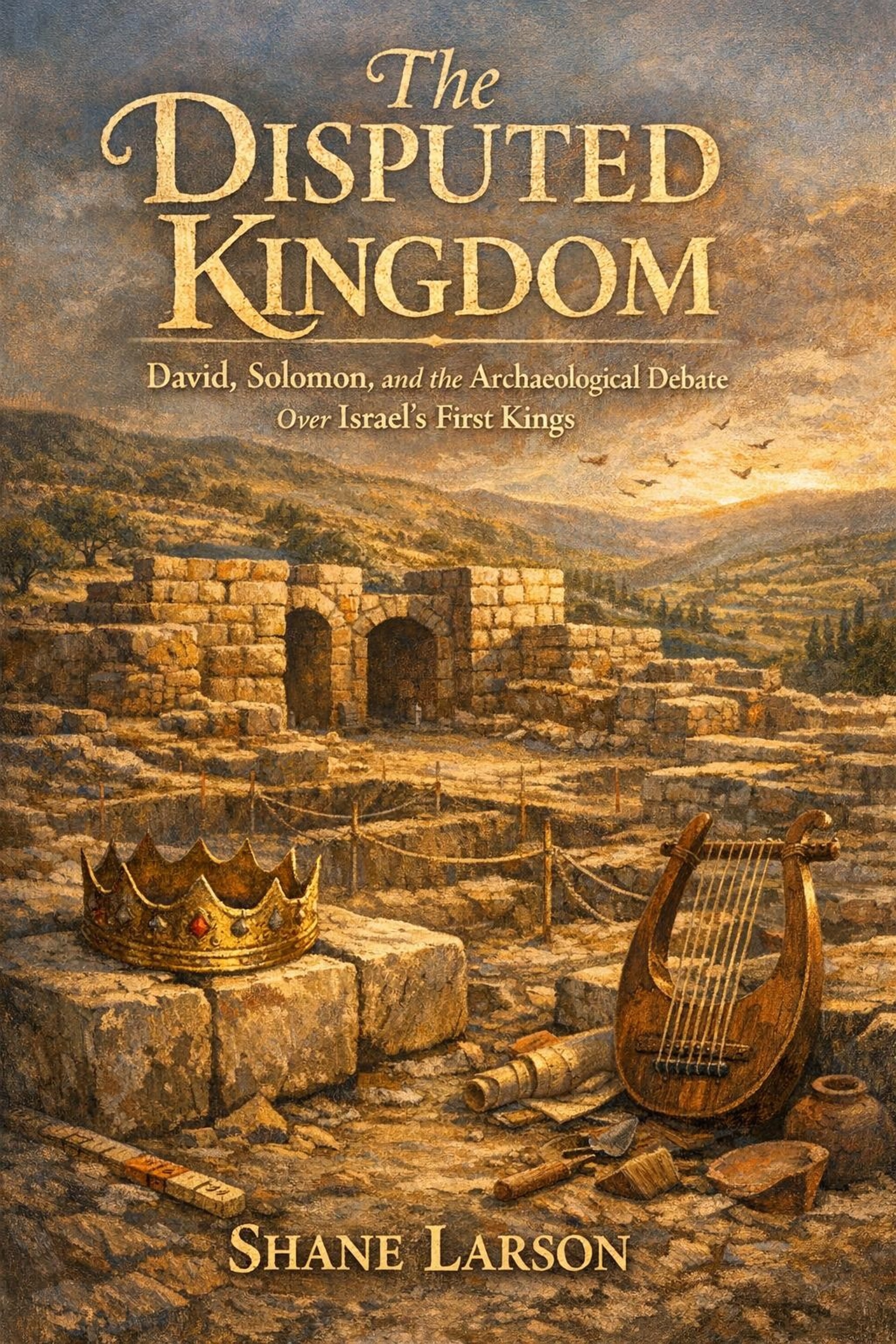
The Disputed Kingdom
David, Solomon, and the Archaeological Debate Over Israel's First Kings
By Shane Larson
About This Book
In 1958 Yigael Yadin made his most famous discovery in a library. He had just finished three seasons at Hazor, where his team had uncovered a six-chambered city gate. The books of Kings say Solomon fortified Hazor, Megiddo and Gezer (1 Kings 9:15). Megiddo had a gate of the same plan. Gezer did not, so far as anyone knew. But Yadin, reading the plans R. A. S. Macalister had published from Gezer fifty years earlier, found a structure labeled a "Maccabean castle" and recognized in it half of a six-chambered gate, drawn by a man who had not known what he was looking at. Three cities in one verse; three gates on one plan. Excavators returning to Gezer in the 1960s exposed the gate where he had said it would be.
For nearly forty years that was the cleanest match anyone had made between a line of scripture and a wall in the ground. Then, in 1996, a single journal article argued that the pottery on which the whole scheme was dated belonged about a century later than everyone had assumed. Nothing about the gates changed. Only the century moved, and with it the builder: from Solomon, king in Jerusalem, to Ahab, king in Samaria.
That is the shape of the whole argument over Israel's first kings. Nobody is fighting about what was found. They are fighting about when.
The question of King David has moved a long way in thirty years. A basalt fragment reused as building stone at Tel Dan, read in 1993, carries the phrase "House of David" in the boast of a ninth-century king of Damascus, and since then the view that David was a late literary invention has been a minority one. What that fragment cannot say is how large a kingdom the house started with. Samuel and Kings describe a realm with districts, a standing army, fortified cities and a fleet on the Red Sea; the lowest reading of the archaeology describes a chiefdom of the hill country ruled from a town of a few hundred people. The Disputed Kingdom: David, Solomon, and the Archaeological Debate Over Israel's First Kings is about the distance between those two pictures.
It is, more than anything, a book about how dates are made. A stratum has no year written on it. It is dated by its pottery, the pottery by its sequence against other sites, the sequence by the few points where a burnt layer can be tied to a named invader, and the whole chain, since about 2000, by radiocarbon on seeds and olive pits. Radiocarbon, expected to end the dispute, narrowed the gap from a century to a few decades and stopped, because the calibration curve around 900 BC flattens in a way that turns a precise measurement into a wide range. Then the book goes site by site: a wall in Jerusalem that is either David's palace or later terracing; a town above the Valley of Elah that olive pits date to about 1000 BC and that no one can assign a builder; copper camps at Timna run by people who lived in tents; and the antiquities market and its forgeries. Every position is given at full strength before the objections are heard.
Why I Wrote This
I kept picking up books about David and Solomon and realizing, somewhere around the third chapter, that the author was one of the people in the fight. The best-known accounts were written by participants, and they are good books, but they are closing arguments. I wanted the trial transcript.
What hooked me was the olive pits. A town can be dated to within a generation by burnt seeds from its floors, that date is accepted by everyone, and it changes nothing, because the argument was never about the date of the town. It was about the name of the man who built it, and no seed carries that. The whole debate looked like that. I wanted to understand how that was possible without deciding in advance who was right.
Frequently Asked Questions
Is The Disputed Kingdom a religious book, and does it try to prove or disprove the Bible?
Neither. The biblical story is told as Samuel and Kings tell it, attributed to them and treated with respect, and the archaeology is told as the excavators have published it. A reader who believes the account will find their strongest scholarly allies represented fairly; a reader who doubts it will find the same.
Did King David really exist, according to archaeology?
Most scholars now accept that a dynasty in Jerusalem traced itself to a founder named David, because a ninth-century king of Damascus used the phrase "House of David" on a victory inscription found at Tel Dan in 1993. What the evidence does not settle is how large a kingdom he ruled, and that question, not his existence, is the live dispute this book covers.
What makes it different from The Bible Unearthed or the Khirbet Qeiyafa excavators' own book?
Those were written by principals in the debate. This book reports the debate rather than joining it, and it covers material the older trade books predate: the Timna copper camps, the 2019 arguments over the Mesha Stele's line 31, and the 2024 Jerusalem radiocarbon program.
Does it cover the forged inscriptions and the Jehoash tablet trial?
Yes, in the final chapter: the ivory pomegranate and the Jehoash inscription, the committee findings of 2003 and 2004, the trial that ended in 2012 with an acquittal on the forgery charges, and the court's statement that the acquittal did not establish authenticity. It names institutions and published findings only, never individuals.
How much background does it assume, and how long is it?
None. What a stratum is, how pottery dates a layer and what a calibrated radiocarbon range means are each explained the first time they matter. It is a standalone title on the biblical archaeology shelf, about 74,000 words, thirteen chapters in four parts with three appendices, around 240 pages in paperback.
If You Liked This, You Might Like
- Elijah: The Prophet Who Defied Kings - the kingdom of Ahab and Jezebel, where one school now places the gates this book argues over, and the era of the Tel Dan stele.
- The Purple Merchants - Hiram of Tyre's cedar and craftsmen built Solomon's temple in 1 Kings; this is the Phoenician side of that partnership.
- Sea Peoples: Raiders of the Bronze Age - where the Philistines of Gath and Goliath came from.
- Aksum - the Ethiopian kingdom whose national epic made the Queen of Sheba the mother of Solomon's son.
A dynasty's name on an enemy's stone, a gate with no builder's mark, a town everyone can date and no one can name: that is close to the whole of what the ground has given up about Israel's first kings, and this book lays it out so the reader can weigh it rather than be told what it weighs.
What You'll Learn
- The story as the text tells it: David from the sheepfold at Bethlehem to the deathbed, and Solomon from Gihon to the division of the kingdom, narrated from Samuel and Kings in the King James translation.
- A century of biblical archaeology: from the confidence of Albright's generation through the skeptical Copenhagen and Sheffield schools of the 1990s to the evidence-bound middle ground that has replaced both.
- Three enemies' inscriptions: the Tel Dan stele line by line, with legible royal names kept separate from restored ones; the Mesha Stele, smashed in 1869 and rebuilt from a paper squeeze; and Shoshenq's list at Karnak, which names towns and not kings.
- How Yadin's synthesis was built and challenged: the six-chambered gates, the Megiddo "stables" that may be storehouses or barracks, and the 1996 Low Chronology that handed all of it to the house of Omri.
- Jerusalem, the hardest site in the region: Kenyon and Shiloh on the ridge, the Large Stone Structure and its 2007 rebuttal, and the 2024 radiocarbon study of about a hundred samples and how each camp has read it.
- Three appendices: every inscription paraphrased with its disputed readings; the three chronologies side by side, stratum by stratum; and a who's who of the scholars grouped by argument, with a glossary.
New Ancient History releases and free chapters — no spam, unsubscribe anytime.
More in This Genre
View all →