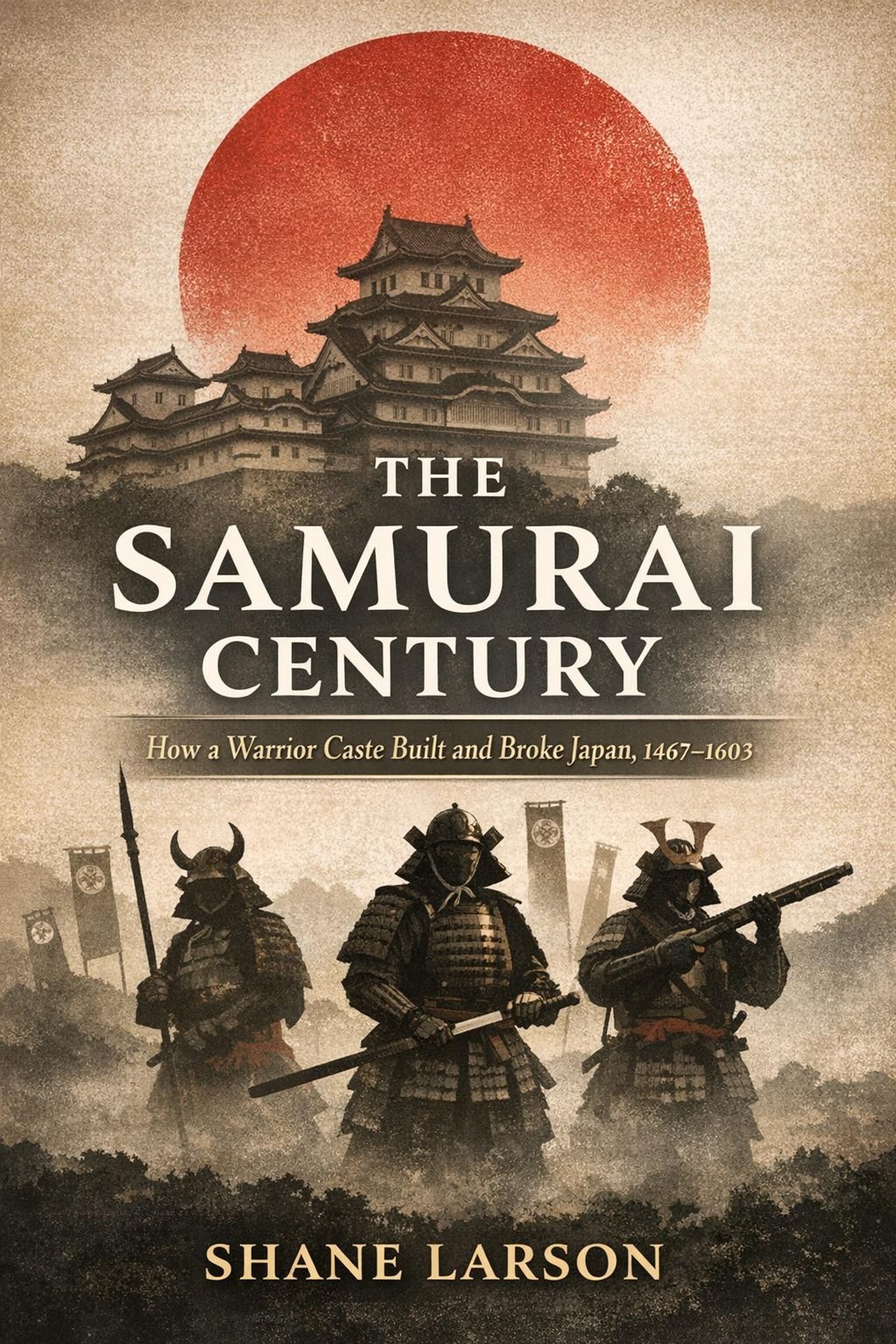
The Samurai Century
How a Warrior Caste Built and Broke Japan, 1467-1603
By Shane Larson
About This Book
Picture the samurai you've met in films: a lone swordsman bound by an unbreakable code, choosing honorable death over surrender. Now set that picture down. The warriors who actually fought their way through Japan's longest civil war switched allegiance for advantage, leaned hard on imported firearms, and answered mostly to ambition. The romance came afterward — much of the famous bushido code was written down only once the killing had stopped.
Between 1467 and 1603, Japan spent 136 years tearing itself apart. The emperor reigned over nothing. The shogun signed orders no one obeyed. Real power belonged to whichever warlord could field the most spears and hold the most rice land, and for over a century no one could hold enough of either to win. This is the Sengoku Jidai — the Age of Warring States — the brutal, gunpowder-soaked world that lies behind Shogun, told as the documentary reality rather than the legend.
Three men ended it. None of them were the heroes the stories promised.
The Story
The collapse began with a quarrel over succession. The Onin War broke out in 1467, gutted Kyoto, and exposed a truth the country couldn't un-see: the institutions everyone had deferred to were hollow. Once the center failed, every regional lord became a law unto himself, and Japan splintered into a patchwork of competing domains that fought, merged, and betrayed one another for generations.
The Samurai Century follows that long unraveling and the harder work of putting the pieces back together. Oda Nobunaga arrives first — a disruptor with no patience for the old order, willing to burn fortified monasteries and break any institution that stood between him and control. He reshaped how Japan made war, then died by betrayal before he could finish what he started. Toyotomi Hideyoshi, born a peasant foot soldier, climbed higher than anyone of his origins had any right to, unified the islands, and then squandered his armies in two ruinous invasions of Korea. Tokugawa Ieyasu simply outwaited them both. When the decisive moment came at Sekigahara in 1600, he took the gamble — and the order he built afterward held for two and a half centuries.
Running underneath the politics is a technological revolution. The matchlock arrived with Portuguese traders in 1543, and within a generation it rewrote the rules of the battlefield. At Nagashino in 1575, massed volley fire shredded a cavalry charge and quietly ended the age of the mounted samurai. The sword survived in memory and ritual; the gun decided the wars. This is narrative military history that keeps the gunpowder, the missions, the castles, and the betrayals — and leaves the mythology at the door.
What You'll Discover
- How a single disputed succession detonated the Onin War and pitched Japan into more than a century of fragmentation and civil war
- The way Portuguese matchlocks reshaped Japanese warfare, and why Nagashino in 1575 marked the real end of the mounted warrior
- Why Nobunaga's ruthlessness was the precondition for unification — and the same quality that got him killed
- Hideyoshi's improbable climb from common soldier to ruler of the islands, and the Korean campaigns that drained everything he'd built
- The discipline of Ieyasu's patience, and how the single afternoon at Sekigahara settled the fate of the country
- The great hilltop castles, the Jesuit missions, and the wide gap between the bushido of legend and the bushido of the historical record
- How a warrior caste that thrived on endless war was finally forced into a peace that would eventually make it obsolete
Why I Wrote This
I came to the Sengoku period the way a lot of people do lately — through Shogun — and then went looking for the history underneath it and kept hitting the same wall. Either the books were romanticized to the point of fairy tale, or they were so dense with names and dates that the story drowned. What I wanted was the version that respected both the drama and the facts: the betrayals and the volley fire, but also the unglamorous truth that the famous samurai code was largely a peacetime invention, codified after the wars it supposedly governed.
What hooked me most was the shape of the thing — a century of pure chaos resolving, against the odds, into a stable order, and the three very different temperaments it took to get there. A disruptor, a climber, and an institution-builder. I wanted to tell that as one continuous story, moving fast, without jargon, and without pretending the warriors were nobler than the record shows.
Frequently Asked Questions
Is this the real history behind Shogun?
Yes. Shogun is set at the close of the Sengoku period, in the rivalry that culminated at Sekigahara, and its central characters are drawn from real figures of that era. This book covers the full 136 years that produced that moment — how the civil war started, who fought it, and how Tokugawa Ieyasu's victory turned into a lasting peace.
Is this a narrative history or an academic textbook?
It's narrative history written to move. There are no footnote thickets and no assumed background — the storytelling carries you through the politics, the battles, and the personalities. Readers who enjoy Stephen Turnbull or George Sansom will find familiar territory told in a faster, more accessible register.
Do I need to know anything about Japanese history first?
No. The book introduces the emperor, the shogunate, the daimyo, and the warring-states system as it goes, so you can start here cold. If you've watched Shogun or read other narrative military history, you'll feel immediately at home, but nothing is taken for granted.
Does it cover Hideyoshi's invasions of Korea?
It does. The two Korean campaigns are treated as a turning point rather than a footnote — they show how unification could curdle into overreach, and how the wars Hideyoshi launched abroad hollowed out the power he'd assembled at home.
How much of the famous samurai code is actually true?
Less than the legend suggests, and the book is direct about it. Much of the formal bushido tradition was written down during the long Tokugawa peace, after the era of constant warfare had ended. The warriors of the Sengoku period were shaped far more by ambition, shifting alliances, and firearms than by any fixed code of honor.
Is this book available on Kindle Unlimited?
Yes. It's enrolled in Kindle Unlimited, so KU members can read it as part of their subscription.
If You Liked This, You Might Like
- The First Emperor — China's own Warring States period and the violent unification that ended it; the closest mirror in the catalog to Japan's century of consolidation.
- Charlemagne — another study in forging durable order out of fragmentation, and what it takes to build an institution that outlives its founder.
- The Empire Collapse Pattern — the flip side of this story: how the mightiest powers come apart, and why building order is so much harder than breaking it.
The samurai century made modern Japan — not through the code we remember, but through ambition, gunpowder, and the slow construction of peace out of chaos. This is how it actually happened.
Included with Kindle Unlimited — read it free if you're a member.
New Military History releases and free chapters — no spam, unsubscribe anytime.