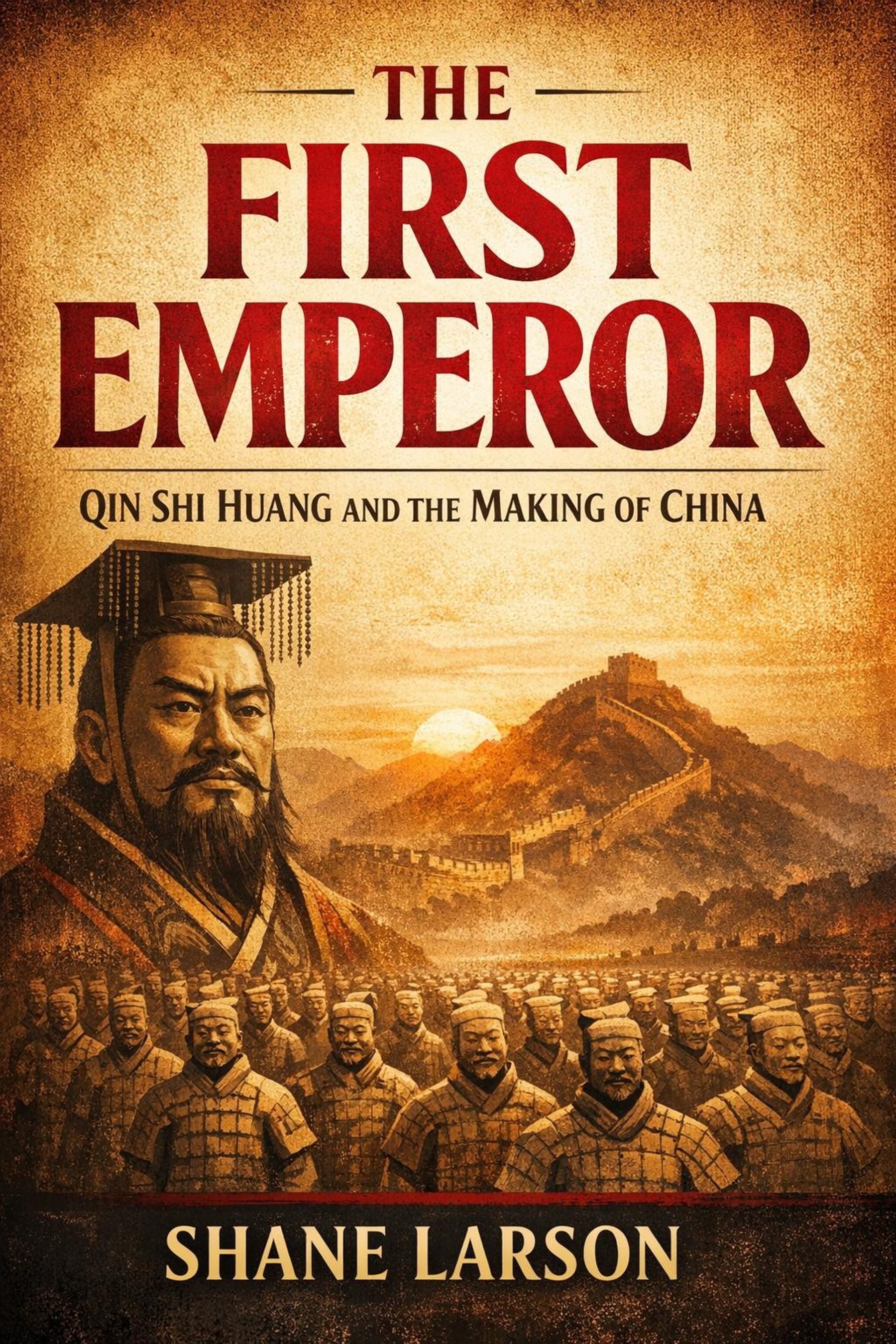
The First Emperor
Qin Shi Huang and the Making of China
By Shane Larson
About This Book
In March of 1974, a farmer named Yang Zhifa was digging a well outside Xi'an, in the dry plains of central China, when his shovel struck something that wasn't a rock. He pulled up the head of a man — life-size, hollow, made of fired clay, with a faint expression of attentiveness still visible on the face. Within months, archaeologists had drawn a perimeter around the field. Within years, the world had a name for what lay beneath it: the Terracotta Army. Eight thousand soldiers in battle formation, life-size, every face individuated, arranged in three pits aligned to the cardinal directions.
Beyond them, half a mile west, sat a wooded mound the size of a small hill. The man buried inside it had been waiting there for two thousand one hundred and eighty-four years. His name was Ying Zheng. He was the First Emperor of China, and his tomb has not been opened.
This is the story of how he got there.
The Argument
Ying Zheng was born in 259 BCE, the son of a Qin prince held hostage in a rival kingdom — a child whose own life was a piece of state collateral. He came to the throne of Qin at thirteen, when the territory we now call China was seven kingdoms locked in two and a half centuries of grinding war. By thirty-eight, he had conquered the other six. He took a new title for himself — Shi Huangdi, First Emperor — and then did something that no conqueror in the ancient world had done before: he refused to govern his new territory as a collection of subordinated kingdoms. He erased the kingdoms.
He standardized the script, so that a merchant in former Chu could read a decree issued in the new capital. He standardized the currency, the weights, the measures. He standardized the width of cart axles, so that wagons rolling across the empire would settle into the same ruts on the same imperial roads. He divided the territory into thirty-six commanderies governed by appointees rather than hereditary lords — a structural template of Chinese administration that has now persisted, with modifications, for more than two thousand years. He linked existing northern walls into a continuous defensive line, the ancestor of the Great Wall. He ordered the burning of the books of the rival schools, and according to the hostile tradition, the burying alive of four hundred and sixty Confucian scholars.
And then he became obsessed with not dying. He sent expeditions east in search of the islands of the immortals. He drank elixirs compounded from cinnabar — that is, mercury — and the consensus of modern scholarship is that those elixirs probably killed him. He died on the road in 210 BCE during an inspection tour. His chief minister and chief eunuch concealed his death so completely that the imperial procession returned to the capital with carts of rotting fish positioned beside the imperial carriage to mask the smell of the decomposing body. Within four years, the dynasty he had built to last ten thousand generations was gone. The Han who replaced him kept almost everything he had built, and then spent the next four centuries insisting that he had been a monster.
That paradox — founder and tyrant, architect and destroyer, the man whose system survived him by twenty-two centuries while his name became a byword for cruelty — is the spine of this book.
What's Inside
- The Warring States period as a lived reality: what two and a half centuries of continuous, multi-front warfare actually looked like, and why Qin in particular was positioned to end it.
- Shang Yang's Legalist reforms a hundred years before Ying Zheng's birth — the bureaucratic and military machinery that turned Qin into a state-shaped weapon.
- The decade-long campaign of conquest, kingdom by kingdom, ending with the fall of Qi in 221 BCE.
- The standardization decrees and what they actually cost the regional cultures they overwrote.
- The commandery system: how hereditary nobility was replaced by appointed officials, and why this single structural decision shaped two thousand years of Chinese governance.
- The assassination attempts on the First Emperor, including the famous failed attempt by Jing Ke, and what they reveal about the texture of his rule.
- The burning of the books, the buried scholars, and the question of whether the hostile Han account can be trusted.
- The construction of the Mount Li tomb complex, including the seventy thousand laborers Sima Qian claims worked on it.
- What modern remote sensing and soil-mercury surveys have confirmed about the unopened central mound, and why no Chinese government has authorized excavation.
- The four-year collapse of the Qin dynasty after the cover-up of the emperor's death — one of the most rapid disintegrations of a major state in the ancient record.
- The strange afterlife: how Sima Qian, writing a century later under a hostile dynasty, shaped almost everything we think we know about the man.
Why I Wrote This
I came to this book the way a lot of people probably do — through the Terracotta Army. I'd seen photographs of the figures my whole life, and the touring exhibitions when they came through, and what kept catching me was the question nobody seemed to be answering in any of the captions: who was the man they were guarding, and what was he so afraid of?
When I started reading, what I found surprised me. Most of the accessible English-language books on Qin Shi Huang are either coffee-table photo books about the army or specialist academic monographs aimed at people who already know the period. There wasn't a good middle book — narrative, source-honest, written for a reader who's curious but not a Sinologist. The other thing that surprised me was how much of the standard story comes from a single hostile source, Sima Qian's Records of the Grand Historian, written a hundred years after the fact under a dynasty that needed Qin Shi Huang to have been a tyrant. A lot of what "everybody knows" about the First Emperor is one man's account of his predecessor's enemy. That's worth flagging up front, and it's worth taking seriously throughout. This book tries to do both — tell the full arc and stay honest about what the sources can and can't actually tell us.
Frequently Asked Questions
Do I need any background in Chinese history to read this?
No. The book assumes you're starting from zero. The opening chapters cover the Warring States period — the political map, the major kingdoms, the long war that produced Qin's rise — before the First Emperor is even on the throne. If you've read general ancient history but never specifically studied China, you're the target reader.
Is this a narrative biography or an academic study?
Narrative nonfiction. It's character-driven and written in the same voice as the rest of the ancient history catalog — closer to Mary Beard or Tom Holland than to a university press monograph. Sources are discussed openly in the text where they affect the argument, but there's no apparatus of footnotes interrupting the prose.
How much of the book is about the Terracotta Army versus the emperor himself?
Most of the book is about the man, the conquest, and the administrative revolution. The Terracotta Army and the tomb complex have their own dedicated chapter near the end, treated as the physical expression of everything that came before — not as the main subject.
Has the central tomb actually been opened?
No. The outer pits containing the Terracotta Army have been excavated since 1974 and continue to be worked on. The central tomb mound itself — where the emperor is buried — has not been opened. Mercury surveys of the mound's soil show anomalously high concentrations consistent with Sima Qian's claim that the burial chamber contained simulated rivers of mercury. Chinese authorities have so far declined to authorize excavation, in part because current preservation techniques can't reliably handle what would likely emerge.
What other Peak Grizzly books pair well with this one?
If you read for ancient empire-building, Cleopatra's Egypt and the Carthage volumes are the closest tonal matches. If you read for collapse and aftermath, The Sea Peoples and The Fall of Rome sit in the same register.
Is this part of a series?
No. The First Emperor is a standalone volume in the ancient history catalog. It can be read in any order relative to the other ancient history titles.
If You Liked This, You Might Like
- Cleopatra's Egypt — another founder-figure reduced to caricature by the regime that replaced her. Same approach, different empire.
- The Sea Peoples — what the collapse of an interconnected ancient world actually looks like from the inside.
- The Fall of Rome — the long-form companion piece on imperial disintegration and what survives the empire.
- Hannibal's War — a contemporary of the late Qin period on the other side of the world, fighting his own war against a rising centralized state.
- The Silk Road — a generation after the Qin fell, Han envoys rode west out of the empire he had unified; this is the story of what grew along that road over the next fifteen centuries.
Closing
The mound at Mount Li is still closed. The mercury is still beneath it. The administrative system the man inside designed is, in its bones, still running. The story of how he built it — and what it cost — is one of the strangest and most consequential reigns in the ancient world, and it deserves to be told straight.
Included with Kindle Unlimited — read it free if you're a member.
New Ancient History releases and free chapters — no spam, unsubscribe anytime.