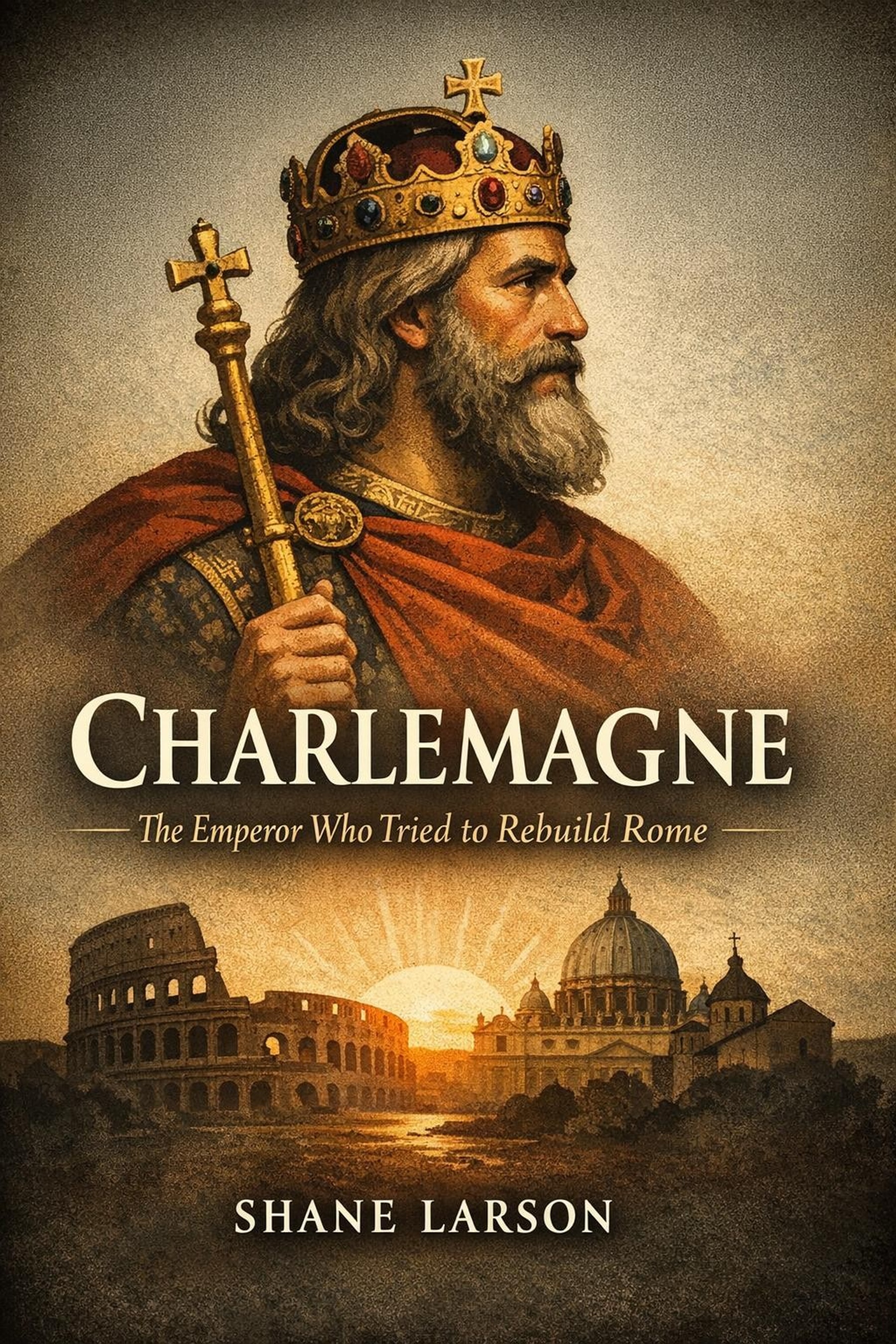
Charlemagne
The Emperor Who Tried to Rebuild Rome
By Shane Larson
About This Book
When the Western Roman Empire collapsed in 476, the title of emperor in the West simply stopped existing. For three hundred years there was no one to hold it — no apparatus, no claim, no living memory of what it had meant to govern from Rome. The throne wasn't contested. It was empty, and most of Europe had stopped looking at it.
Then a Frankish king who could barely sign his own name decided the chair was his.
Charlemagne ruled from horseback for most of his life. He spent thirty years grinding down the Saxons in a war so brutal it produced the mass execution at Verden. He outlived several of his sons, lost a rearguard in the Pyrenees at Roncesvalles, and held together an enormous, sprawling realm with almost no bureaucracy, no fixed capital, and no real money economy. By any practical measure, he should have been one more warlord whose kingdom died with him. Instead, on Christmas Day in the year 800, he walked into a Roman church and walked out an emperor — and the idea he revived that day outlasted him by a thousand years.
The Argument
This is a clear, fast-moving biography of Charlemagne that takes the man seriously without dressing him up. He did not rebuild Rome; the Rome of the Caesars was gone and not coming back. What he built was stranger and far more durable: the idea that imperial authority in the West could be made legitimate again — blessed by the Church, anchored in law, and carried forward by learning rather than legions.
That idea turned out to be one of the most consequential inventions in European history. It drew the political map of the continent. It survived the Treaty of Verdun in 843, which split Charlemagne's empire among his grandsons and planted the seeds of what would become France and Germany. It was still being invoked a thousand years later, when Napoleon dissolved the Holy Roman Empire in 1806 — the last institutional heir of the crown a Frankish king claimed in a borrowed church.
The book follows the whole arc: how a minor royal house clawed its way from palace officials to kings to emperors in three generations; how Charlemagne conquered the Lombards and waged the long Saxon wars; what actually happened at Roncesvalles before the legend rewrote it; and how the court at Aachen became the center of a cultural revival — the Carolingian Renaissance — that physically saved much of classical Latin literature from disappearing. It is told in plain, direct prose, with no romance, no hero-worship, and no hype. Charlemagne is interesting enough without the embroidery.
What's Inside
- The rise of the Carolingians — how a family of palace administrators maneuvered, married, and fought its way from royal servants to a new imperial dynasty in three generations.
- The Lombard and Saxon campaigns — the conquests that built the empire, including the decades-long Saxon war and the killing at Verden that still shadows Charlemagne's reputation.
- Roncesvalles, fact versus legend — the real ambush in the Pyrenees and how it became the Song of Roland, one of the foundational myths of medieval Europe.
- The coronation of 800 — the gamble that resurrected a Western emperor after three centuries, and what Charlemagne, the pope, and the Eastern empire each thought they were getting out of it.
- Aachen and the Carolingian Renaissance — how a barely literate king built a court that became the intellectual engine of the early medieval West.
- Alcuin and the scriptoria — the scholars and copyists who preserved classical texts, and the clean new script, Carolingian minuscule, that shaped the letters we still read today.
- Governing without institutions — how one man ran an empire through messengers, sworn oaths, and personal loyalty instead of a standing bureaucracy.
- The fracture and the Treaty of Verdun — how the empire split in 843 and drew the first faint borders of France and Germany.
- The thousand-year afterlife — the long career of the "idea of Rome" Charlemagne created, from the Ottonians through the Holy Roman Empire to its final dissolution in 1806.
Why I Wrote This
Charlemagne usually arrives in two forms: as a cardboard "Father of Europe" on a school timeline, or as a figure so buried in academic apparatus that you need a graduate seminar to reach him. Neither version explains the thing I actually find remarkable — that a man who couldn't comfortably write revived a dead political idea and made it stick for a millennium. That's not a footnote. That's one of the most successful acts of imagination in the history of power.
What hooked me was the gap between his limitations and his reach. No capital. No treasury worth the name. No bureaucracy. He held it all together with loyalty, motion, and the calculated theater of a single church ceremony. I wanted to write the version I'd want to read: short enough to finish, honest about what we know and don't, and clear about why this one ruler still defines how Europeans argue about who gets to call themselves an empire.
Frequently Asked Questions
Is this a narrative biography or an academic history?
It's a narrative biography written for general readers. It moves quickly, tells the story in plain prose, and skips the scholarly machinery — but it doesn't dumb the subject down or invent scenes that didn't happen. Where the evidence is thin or contested, the book says so.
Do I need to know anything about the early medieval period first?
No. The book assumes no background. It sets up the fall of the Western Roman Empire and the world Charlemagne was born into before getting to his reign, so you can come in cold and follow the whole arc.
How long is the book?
It's a focused, fast-moving read — built to be finished in a few sittings rather than used as a reference shelf. The goal is a complete picture of the man and his legacy without padding.
What's the difference between Charlemagne's empire and the Holy Roman Empire?
Charlemagne's empire was the original Frankish creation of 800. The Holy Roman Empire was its later institutional descendant — a separate, longer-lived structure that traced its legitimacy back to his coronation. The book explains how one became the other and why the connection mattered all the way to 1806.
Does it cover the cultural side, or just the wars?
Both. The military campaigns are here, but so is the Carolingian Renaissance — Aachen, Alcuin, the scriptoria, and the preservation of classical literature. The argument of the book is that the cultural revival, not the conquests, is what actually made the empire last.
If You Liked This, You Might Like
- The Fall of Rome — the collapse of the Western empire that left the imperial throne empty for the three centuries before Charlemagne claimed it.
- The First Dark Age — what happens to a world when its central order disappears, the long aftermath Charlemagne was trying to reverse.
- Collapse Proof — the synthesis volume of the Collapse Pattern series, for readers drawn to the deeper question of why some institutions endure for a thousand years and others vanish in a generation.
The man is gone, and every kingdom he ruled is centuries dead. The idea he built in a single afternoon outlived all of them. This is the story of the emperor who set out to rebuild Rome and ended up inventing Europe instead.
Included with Kindle Unlimited — read it free if you're a member.
New Medieval History releases and free chapters — no spam, unsubscribe anytime.