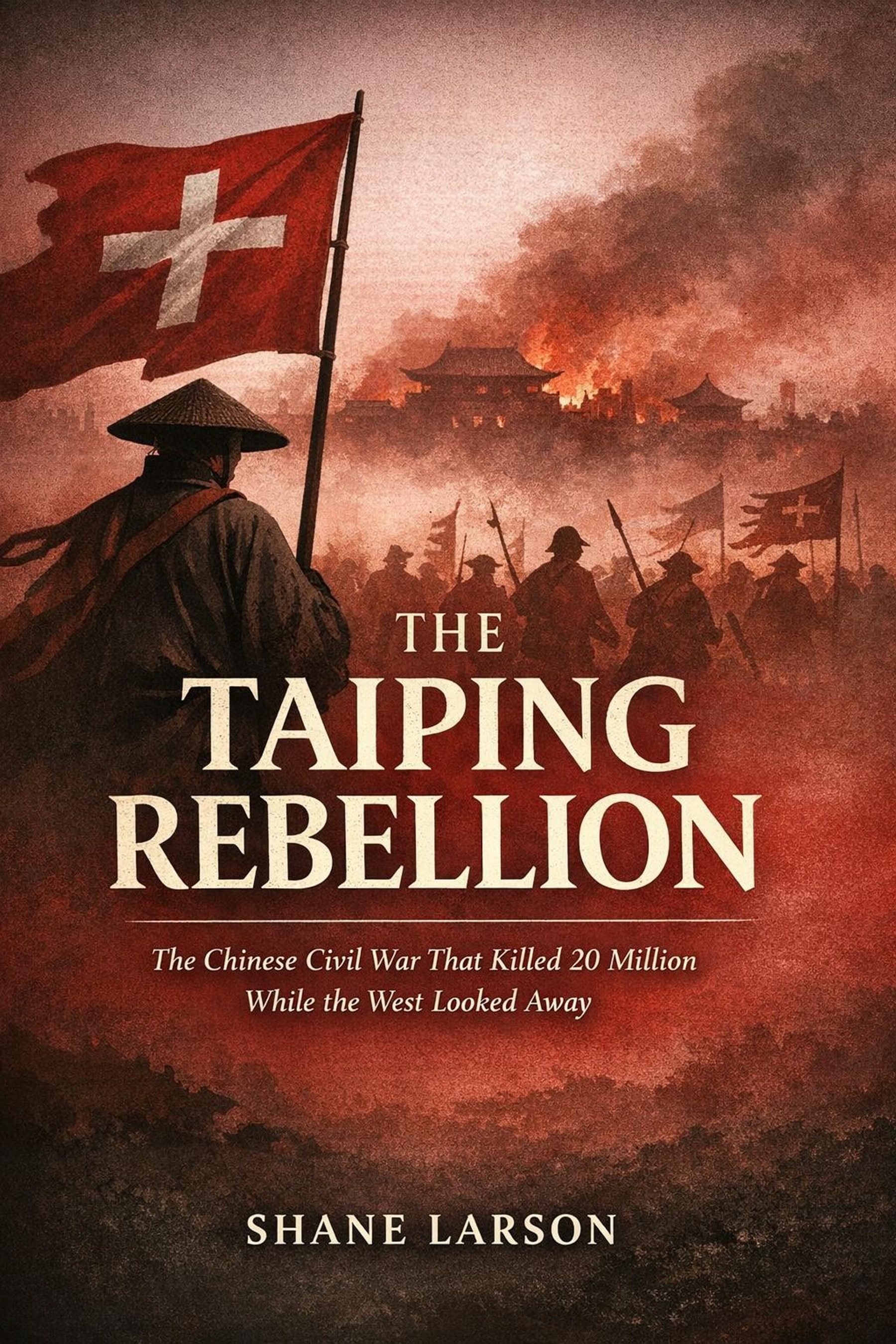
The Taiping Rebellion
The Chinese Civil War That Killed 20 Million While the West Looked Away
By Shane Larson
About This Book
In 1837, a young man named Hong Xiuquan collapsed into a fever in a village in southern China. He had just failed the imperial civil service examinations for the third time — the test that decided whether a man rose into the empire's ruling class or stayed nothing. For days he burned. When he woke, he was certain of one thing: he had been carried into heaven, met an old man with a golden beard, and learned his true identity. He was the younger brother of Jesus Christ. And he had been sent to destroy the demons ruling China.
The demons, he decided, were the Qing dynasty itself.
What grew out of one schoolteacher's breakdown became the deadliest war of the entire nineteenth century — deadlier than anything in Europe, deadlier than the American Civil War by a factor of twenty or more. Between 1850 and 1864, the Taiping Rebellion killed somewhere between twenty and thirty million people. Most of the West has never heard its name.
The War the West Looked Away From
The Taiping Rebellion tells the full story of that catastrophe, from a failed exam candidate's visions to the smoking ruin of his Heavenly Kingdom fourteen years later. It is a narrative history built for readers who want the events laid out clearly and fast — not buried under academic hedging — but who don't want the strangeness sanded off either. And the Taiping story is genuinely strange.
This was not a peasant uprising in the ordinary sense. Hong Xiuquan built a theocratic state. His movement, the Heavenly Kingdom of Great Peace, seized the great city of Nanjing in 1853 and declared it a new capital. From there the Taiping banned foot-binding and opium, held land in common, separated men and women into segregated camps, and rewrote the moral order of the territory they controlled. For a few years they ran something that looked like a revolution centuries ahead of its time — and at the same time something monstrous, paranoid, and self-devouring.
Because the Heavenly Kingdom turned on itself. The book traces the palace coups and internal massacres that gutted the Taiping leadership from the inside, even as the Qing recovered. The empire's salvation came not from its own rotting Manchu armies but from a new kind of force: the regional gentry armies raised by men like Zeng Guofan and Li Hongzhang, who rewrote the rules of Chinese warfare to do it. They were aided, in the final years, by foreign soldiers and gunboats — including the mercenary Charles "Chinese" Gordon and his Ever Victorious Army — as the Western powers belatedly decided which side they wanted to win.
What You'll Discover
- How a single man's fever-dream — and a botched exam — lit the fuse on the bloodiest civil war in recorded human history
- The Taiping march out of the southern hills and the campaign that ended in the conquest of Nanjing
- What the Heavenly Kingdom actually was: its radical reforms, its theocratic law, its terror, and the internal bloodbath that hollowed it out
- How Zeng Guofan's gentry armies broke with centuries of Qing military practice and, in doing so, quietly shifted power away from the throne
- The role of foreign mercenaries, gunboats, and shifting Western interests in the rebellion's final years
- Why the Taiping war left the Qing dynasty permanently crippled — and set a course that ran straight to the empire's collapse in 1911
Why I Wrote This
I kept running into the same number and not believing it. Twenty million dead, sometimes thirty — in a war I'd never been taught and couldn't have placed on a timeline. We all learn about the American Civil War and its three-quarters of a million dead. Almost nobody outside of China learns about the war that was happening on the other side of the world at the same time and killed dozens of times more people.
What pulled me in wasn't just the scale, though. It was Hong Xiuquan himself — a man who failed a test, had a breakdown, and ended up declaring himself the brother of Christ and very nearly toppling one of history's largest empires. That's not a footnote. That's one of the strangest and most consequential stories of the modern era, and it explains more about why China is the way it is than most things that get taught instead. I wanted a version a normal reader could pick up and actually finish — fast, clear, and honest about how weird and terrible the whole thing was.
Frequently Asked Questions
Do I need to know anything about Chinese history to read this?
No. The book assumes you're coming in cold. It explains who the Qing were, why the dynasty was vulnerable by 1850, and how the imperial system worked, before the rebellion gets going. If your knowledge of nineteenth-century China is close to zero, this is written for you.
Is this a dense academic study or a narrative?
It's a narrative. The goal is to read like a thriller while staying accurate — clear chronology, real people, real stakes, no fog. If you want a heavily footnoted monograph, this isn't it; if you want the story told well, it is.
How does the death toll compare to other wars?
Estimates for the Taiping Rebellion run from twenty to thirty million dead over fourteen years. That makes it the deadliest conflict of the nineteenth century anywhere on earth, and one of the deadliest in all of human history — far beyond the American Civil War, and on a scale that rivals the world wars of the next century.
Does it cover the foreign involvement, or just the Chinese side?
Both. The book follows the internal Chinese story — Hong Xiuquan, the Taiping state, Zeng Guofan and Li Hongzhang — and the foreign dimension, including the European powers' shifting position and figures like Charles "Chinese" Gordon and the Ever Victorious Army in the war's closing phase.
If I liked Stephen Platt, Jonathan Spence, or Julia Lovell, will I like this?
Most likely yes. Those writers shaped how this era gets told for general readers, and this book is aimed at the same audience — people who want serious history delivered as a gripping story rather than a textbook.
If You Liked This, You Might Like
- The First Emperor — How China was forged into a single empire in the first place, two thousand years before the Taiping nearly tore it apart.
- The Empire Collapse Pattern — The Taiping war is a case study in how the mightiest powers begin to fall from the inside; this book maps the pattern across history.
- The Fall of Rome — Another empire undone less by outside enemies than by its own internal fractures.
The most lethal war you've never heard of, the visionary who started it, and the dynasty it doomed — told as the story the West looked away from.
Included with Kindle Unlimited — read it free if you're a member.
New Asian History releases and free chapters — no spam, unsubscribe anytime.