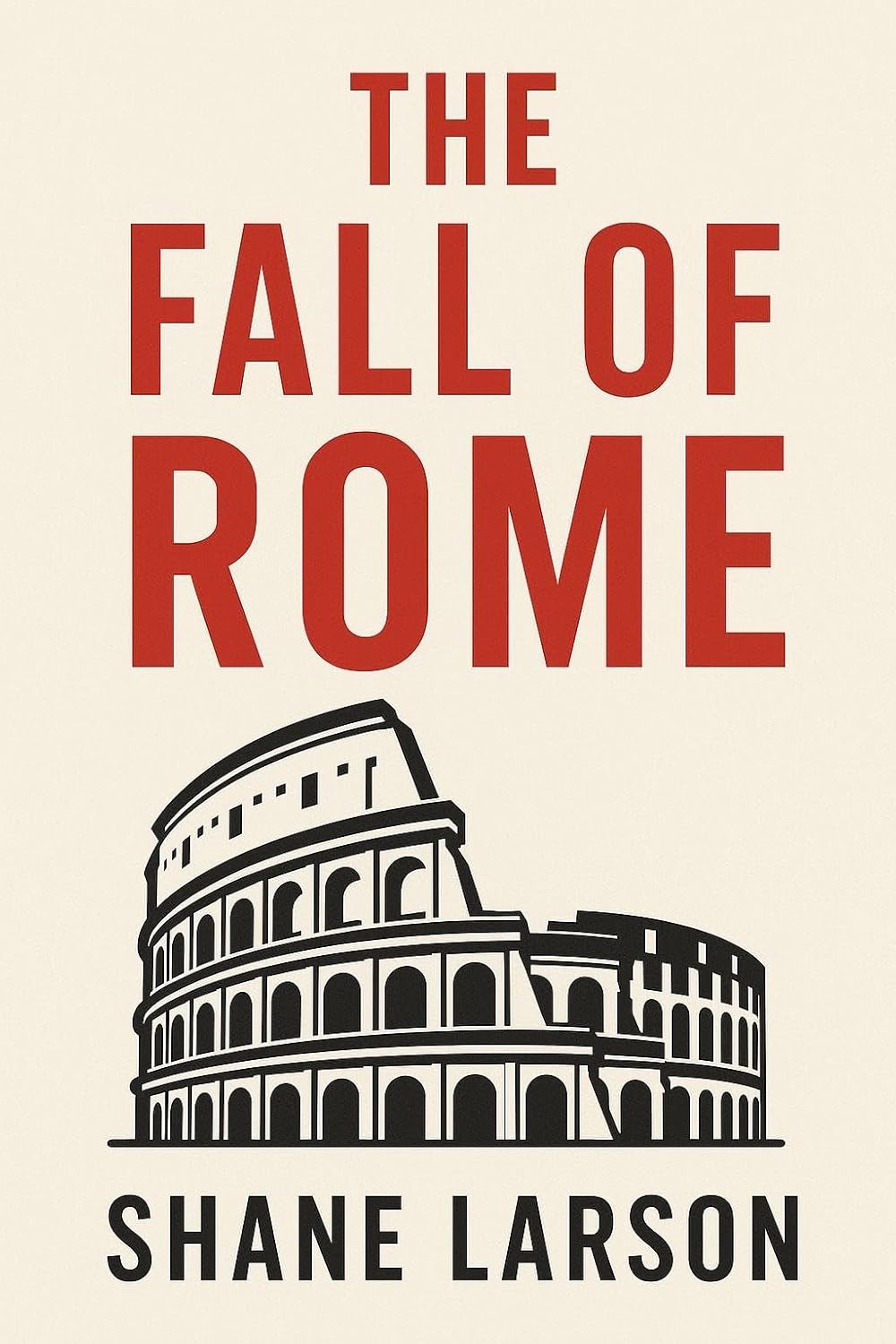
The Fall of Rome
Decline and Transformation - How the Ancient World Became the Medieval
By Shane Larson
About This Book
The greatest civilization the world had ever seen didn't fall in a day. It took three centuries — and the story is more complex, more human, and more relevant than you've been told.
Rome ruled the Mediterranean for centuries. Sixty million people lived under its laws. Its roads, aqueducts, and cities represented a level of infrastructure that wouldn't be matched for a thousand years. At its peak, it was so dominant, so deeply embedded in the fabric of the ancient world, that its disappearance seemed unthinkable.
And then it was gone — replaced by a patchwork of barbarian kingdoms, shrinking cities, and a world that had lost the ability to make decent pottery.
What happened?
The Fall of Rome traces the full arc of Rome's decline and transformation — not as a sudden catastrophe with a single cause, but as a centuries-long process driven by plague, civil war, economic collapse, religious transformation, and the slow unraveling of the systems that held an empire together.
What you'll discover:
- How the Antonine Plague and the Crisis of the Third Century nearly destroyed Rome two centuries before it actually fell — and what survival cost
- Why Diocletian's radical reforms saved the empire in the short term and fundamentally changed what Rome was in the process
- How Constantine's embrace of Christianity transformed Roman civilization from the inside out — culturally, politically, and institutionally
- The real story of the barbarian invasions — far more complex than savages at the gates, and far more interesting
- Why the loss of North Africa to the Vandals mattered more than the famous sack of Rome itself
- How the eastern empire survived for another thousand years while the West collapsed — and what that tells us about what Rome actually was
- What was genuinely lost when the Western empire fell — and what survived in transformed, medieval forms
- Why there is no single answer to why Rome fell — and why that ambiguity is the most important lesson the history offers
This isn't a 600-page academic treatise or a breathless popular history that turns everything into a thriller. It's a clear, direct account of one of history's most consequential events — written for intelligent readers who want to understand what actually happened, why it mattered, and what it means.
No jargon. No padding. No forced modern parallels. Just honest history, honestly told.
1,500 years later, Rome's fall still shapes the world we live in. This is how it happened.
Included with Kindle Unlimited — read it free if you're a member.
New Ancient History releases and free chapters — no spam, unsubscribe anytime.