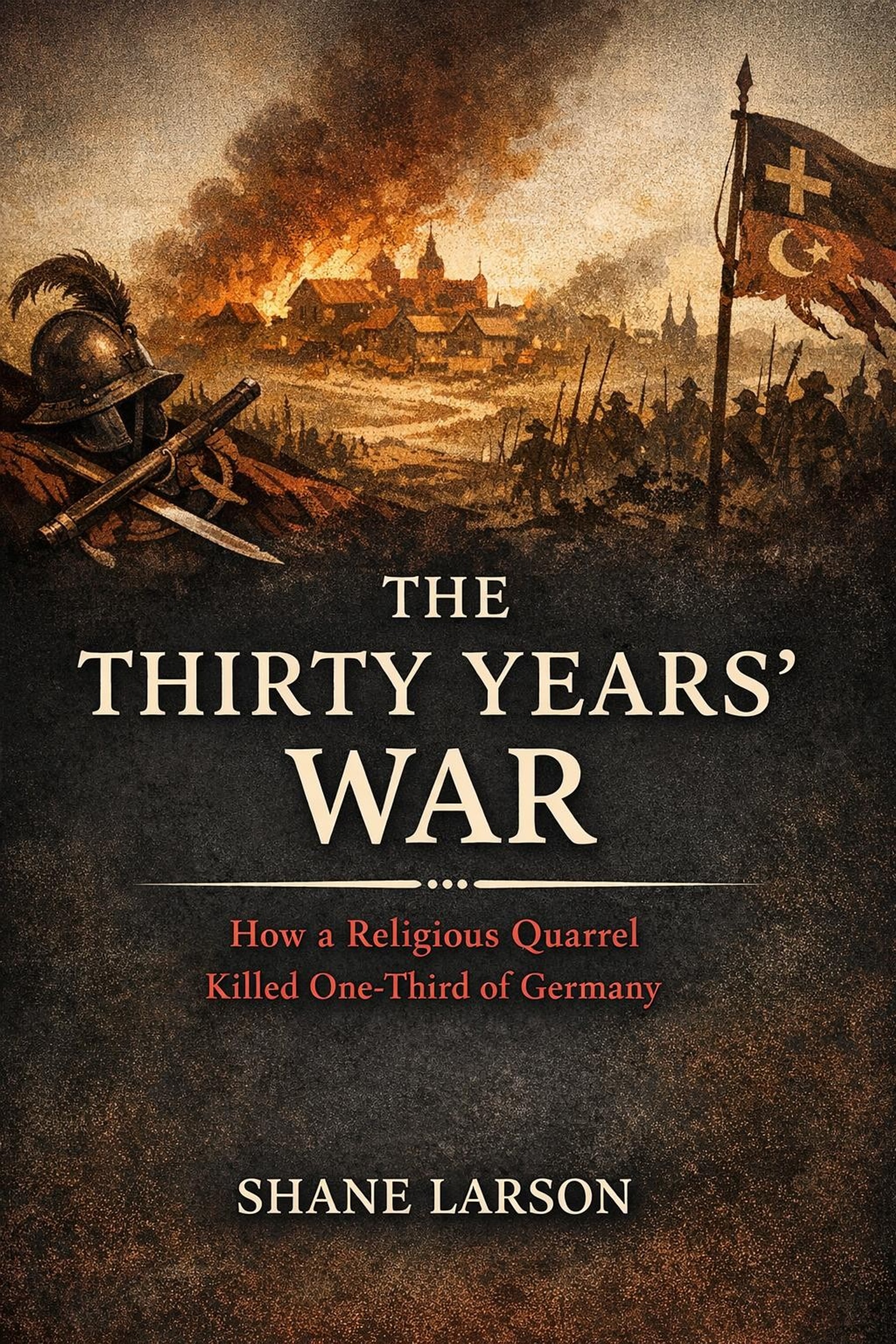
The Thirty Years' War
How a Religious Quarrel Killed One-Third of Germany
By Shane Larson
About This Book
Walk through central Germany in the years after 1648 and you would have passed through villages where no one answered the door. Fields had gone back to forest. Towns that once held ten thousand people were reduced to a few hundred. In some districts more than half the population was simply gone — killed by soldiers, carried off by plague, or starved in the ruin left behind by armies that had long since stopped caring which side they fought for.
This is the wreckage the Thirty Years War left behind, and by the time it ended it had become the deadliest European conflict before the twentieth century. Somewhere between four and eight million people died across three decades of fighting, famine, and disease. Whole regions of the Holy Roman Empire emptied out and would not recover for generations.
It did not begin as a catastrophe. It began as an argument about God.
The Quarrel That Ate a Continent
In 1618, in Prague, a crowd of Protestant nobles threw two royal officials and their secretary out of a castle window. The men survived the fall. The empire did not. That single act of defiance lit a fuse that ran from a local Bohemian dispute into a continental war between Protestant and Catholic, prince and emperor, that would burn for thirty years and pull in nearly every power in Europe.
What makes the Thirty Years War so hard to grasp — and so rarely explained well — is that it kept changing what it was about. It started as religion. It ended as raw power politics, fought by mercenary armies that answered to whoever could pay them and to no faith at all. The clearest proof is Cardinal Richelieu, a prince of the Catholic Church, pouring French money into Protestant armies for the sole purpose of breaking the Catholic Habsburgs. By then the war had stopped being about heaven and started being about who would dominate Europe.
Shane Larson tells this story the way it deserves to be told: as narrative, driven by character and consequence rather than by treaties and troop counts. The cast is unforgettable. Gustavus Adolphus, the Lion of the North, who turned an impoverished Sweden into a great power, reinvented how armies fought, and died in the fog at Lützen at the height of his triumph. Wallenstein, the warlord who raised a private army out of nothing, made himself indispensable, and was assassinated for becoming too dangerous to live. Tilly, the iron Catholic general whose men turned Magdeburg into the war's defining atrocity. And behind them all, the slow unmaking of an entire political order.
That is the deeper subject of this book. The same forces that brought down Rome — institutional decay, religious fracture, mercenary armies that outgrew the masters who hired them — tore through seventeenth-century Germany. And out of that ruin came something genuinely new. The Peace of Westphalia, signed in 1648, drew the borders of the sovereign nation-state and gave the world the system of independent powers we still live inside today. The war that began with a quarrel ended by inventing the modern map.
What You'll Discover
- How a contained religious dispute in Bohemia metastasized into a thirty-year war that swallowed the entire Holy Roman Empire and dragged in Sweden, Spain, France, and Denmark.
- The military revolution of Gustavus Adolphus — the tactics and discipline that made Sweden briefly unstoppable, and the gamble at Lützen that cost him his life.
- The full arc of Wallenstein: how a minor Bohemian noble built the era's most powerful private army, and why the emperor he served had him murdered.
- What actually happened at the sack of Magdeburg, where as many as twenty thousand people died, and why it became the moral nadir of the entire conflict.
- The paradox of Cardinal Richelieu and Catholic France funding Protestant armies — and what it reveals about how the war shed its religious skin.
- How institutional decay, mercenary warfare, and religious collapse combined into a pattern of state failure that echoes far beyond the seventeenth century.
- Why the Peace of Westphalia is remembered as the birth certificate of the modern sovereign state, and what it actually settled.
Why I Wrote This
Almost everyone has heard of the Thirty Years War. Almost no one can tell you what it was about. It gets named in a sentence and then skipped — too tangled, too many princes, too many shifting alliances to bother explaining. That always bothered me, because underneath the tangle is one of the most consequential and most human stories in European history.
What pulled me in was the scale of the dying set against how little it's discussed. A third of Germany gone, and most people couldn't place the war on a timeline. I also kept seeing the same shape I'd traced in the fall of Rome: an old order rotting from inside while armies its leaders could no longer control roamed the countryside. I wanted to write the version I wished existed — one that follows the people, keeps the thread visible through three chaotic decades, and treats the reader as someone capable of holding a complicated story in their head. No textbook fog. Just the war, told straight.
Frequently Asked Questions
Do I need to know European history to follow this book?
No. The book assumes no prior knowledge of the period, the Holy Roman Empire, or the religious politics of the era. Everything you need is built in as the story moves, so a reader coming in cold can follow it as easily as someone who already knows the broad outline.
Is this a narrative history or an academic textbook?
It's narrative history. The structure follows people and events rather than themes and statistics, and it reads like a story with a beginning, a middle, and an end. The research is serious, but the telling is built for someone who wants to actually enjoy the read.
Why did Catholic France fight against the Catholic Habsburgs?
Because by the later phase of the war, religion had become a pretext rather than the point. France under Cardinal Richelieu cared more about preventing Habsburg domination of Europe than about Catholic solidarity, so it bankrolled and eventually joined the Protestant side. The book traces exactly how and why that shift happened.
How reliable is the figure of four to eight million dead?
It's a genuine range rather than a guess, reflecting how historians estimate deaths from combat, plague, and famine across regions with incomplete records. The book explains where the numbers come from, why the spread is so wide, and why some areas lost more than half their population.
Is this part of a series, and is it on Kindle Unlimited?
It's a standalone history that stands entirely on its own. It's available on Kindle and enrolled in Kindle Unlimited, so KU members can read it as part of their subscription.
If You Liked This, You Might Like
- The Fall of Rome — the original case study in how an empire decays from the inside, and the historical parallel this book keeps returning to.
- The Empire Collapse Pattern — pulls the structural logic out of the wreckage: the recurring forces that bring the mightiest powers down, with the Thirty Years War as one of its starkest examples.
- The Black Death — the other great demographic catastrophe of pre-modern Europe, where plague rather than armies emptied the map, and a useful companion for understanding mass death and social collapse.
The Thirty Years War began as a fight over heaven and ended by drawing the borders of the modern world. This is the story of how a single quarrel became a continental catastrophe — and what was built out of the ruins.
Included with Kindle Unlimited — read it free if you're a member.
New European History releases and free chapters — no spam, unsubscribe anytime.