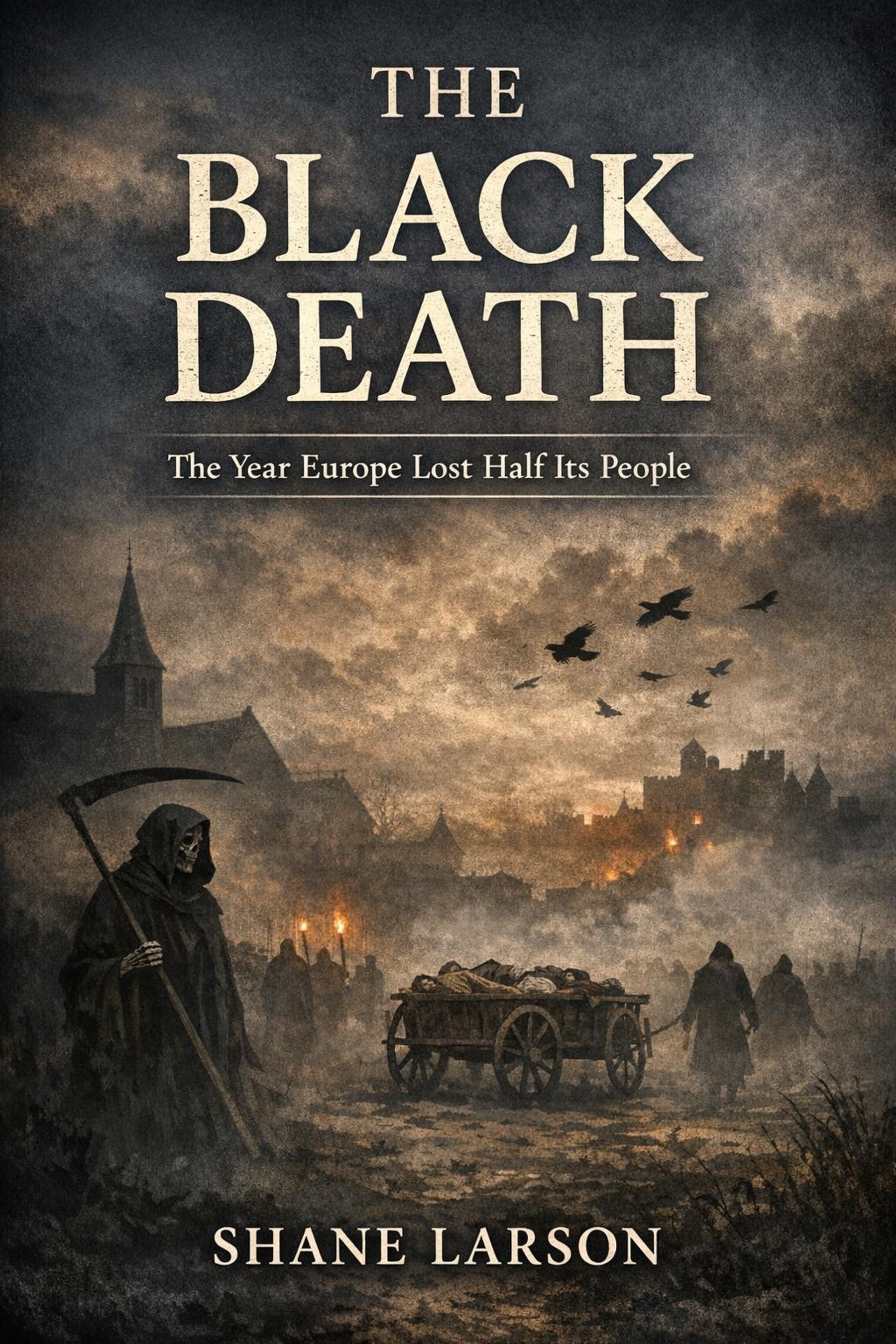
The Black Death
The Year Europe Lost Half Its People
By Shane Larson
About This Book
By the time the plague reached Siena, the dead outpaced the living. A chronicler there buried his own children in a pit with his own hands, body over body and earth between, because no grave could be dug fast enough and no one was left to mourn them properly. He wrote that he believed he was watching the end of the world. Across a continent, ordinary people reached the same conclusion at roughly the same moment, for the same reason.
In the space of about five years, a single disease erased somewhere between a third and a half of Europe's population — a loss on a scale the West has never matched before or since. Out of perhaps seventy-five million people, twenty-five to forty-five million died, and they died fast, often within days of the first black swelling in the groin or under the arm. No one understood what it was. No one could stop it.
This is the story of the Black Death from its origins to its long aftermath: where the plague came from, how it crossed half the world to reach a Sicilian harbor, what it did to the people in its path, and why the world that climbed out of the catastrophe was permanently changed by it.
The Story
For more than a century, historians argued over what the Black Death actually was. That argument is over. The recovery of ancient DNA from plague burial pits has confirmed the killer beyond reasonable doubt: Yersinia pestis, the same bacterium behind plague outbreaks before and since. This book is built on that current evidence and uses it as the foundation for a narrative history written for the general reader, not the specialist.
The story begins far from Europe, on the Central Asian steppe, and follows the disease west along the arteries of medieval commerce — the Silk Road caravans, the Black Sea ports, the Genoese galleys that finally carried it into the Mediterranean. The same trade network that made the medieval world rich is the one that killed it. From Messina the plague spread outward in a matter of months, and the book traces it city by city and season by season — Florence, Avignon, Paris, London, north as far as Bergen — each arrival marked by the same collapse of everyday life.
But the dying is only half the story. The Black Death broke things that had seemed permanent. The Church, which had neither an explanation nor a cure, watched its authority crack, and the Flagellant movement that rose to fill the vacuum frightened the hierarchy enough that it was condemned outright. The hunt for someone to blame turned murderous; the book confronts the anti-Jewish massacres driven by a vicious and baseless accusation. And the sheer scarcity of survivors handed the people at the bottom something they had never possessed: leverage. Wages rose, serfdom strained, and within a generation the revolts arrived.
Out of the wreckage came institutions we still recognize. Quarantine, boards of health, and the first crude machinery of state-run disease control were all born of desperation in these years. The book follows those innovations too, and closes on the hard question a modern reader brings to any pandemic history: what does the medieval catastrophe actually tell us about our own — and where does the comparison fall apart?
What's Inside
- The DNA breakthrough that finally ended the debate over what the Black Death really was, and how genetic material pulled from plague pits identified Yersinia pestis as the agent
- The plague's route west from the Central Asian steppe, traced along the Silk Road and the Genoese shipping lanes that carried it into Europe
- A city-by-city, season-by-season account of the spread — Messina, Florence, Avignon, Paris, London, Bergen — as the map of trade became the map of death
- The collapse of religious authority, and the Flagellant movement that rose in its place and could not be controlled
- The anti-Jewish persecutions of 1348–1349, and the deadly libel that drove them
- The birth of quarantine and organized public health out of sheer necessity
- The labor shortage that pried feudalism open, and its connection to the revolts of 1358 and 1381
- What the medieval pandemic can — and cannot — tell us about the pandemics of our own age
Why I Wrote This
I came to the Black Death the way a lot of people did recently: through a more modern pandemic, and the urge to know whether anything like it had happened before. It had, of course — on a scale that makes almost everything since look small. But what surprised me wasn't the death toll. It was how much of the modern world traces back to those five years: the idea that a state should isolate the sick, the slow death of serfdom, the first deep cracks in an institution that had seemed eternal.
Most of the popular accounts were written before the DNA evidence settled the basic question of what the disease even was. I wanted one that started from the current science and still read like a story — something that respects a reader who wants the real history without a textbook's distance. The people who lived through this deserved at least that.
Frequently Asked Questions
Do I need any background in medieval history to follow this book?
No. It's written for the general reader and assumes no prior knowledge of the period. The names, places, and workings of medieval society are explained as they come up, so you can pick it up cold.
Is this a textbook or a narrative history?
It's narrative history. The book is meant to be read straight through as a story, not consulted as a reference. It's grounded in current scholarship and the recent DNA findings, but it keeps the people and the unfolding crisis at the center throughout.
What makes this different from older books on the Black Death?
Most of the well-known accounts were written before ancient-DNA research confirmed Yersinia pestis as the cause. This book starts from that settled science rather than rehearsing a debate that's now closed, and it gives the aftermath — the social and economic upheaval — as much weight as the dying itself.
Does it cover what happened after the plague, or just the outbreak?
Both, in roughly equal measure. The breakdown of feudalism, the labor revolts, the religious crisis, the persecutions, and the birth of public health all get full treatment. The book's central argument is that the aftermath is where the Black Death truly reshaped the world.
How does it compare to The Great Mortality or A Distant Mirror?
If you enjoyed John Kelly's The Great Mortality or Barbara Tuchman's A Distant Mirror, this belongs on the same shelf — accessible, narrative, human-centered — but it's tighter than either and built on more recent scientific evidence.
Is this book available on Kindle Unlimited?
Yes. You can read it free with a Kindle Unlimited subscription, or purchase it on its own.
If You Liked This, You Might Like
- The Silk Road — the upstream story: the trade network that carried the plague out of Central Asia, and the 2022 discovery that pinned the pandemic's origin to a mountain cemetery sitting directly on the road.
- The Fall of Rome — another account of a vast, seemingly permanent order coming apart, and the long question of what replaced it.
- The Bronze Age Collapse — a systems failure three thousand years earlier, when an interconnected world unraveled almost overnight.
- Collapse Proof — the synthesis volume of the Collapse Pattern series, on the recurring structure beneath civilizational breakdowns like this one.
A third of a continent died in five years, and the survivors inherited a world remade — freer in some ways, more fearful in others, and permanently marked by what it had endured. This is how it happened, and what it left behind.
Included with Kindle Unlimited — read it free if you're a member.
New Medieval History releases and free chapters — no spam, unsubscribe anytime.