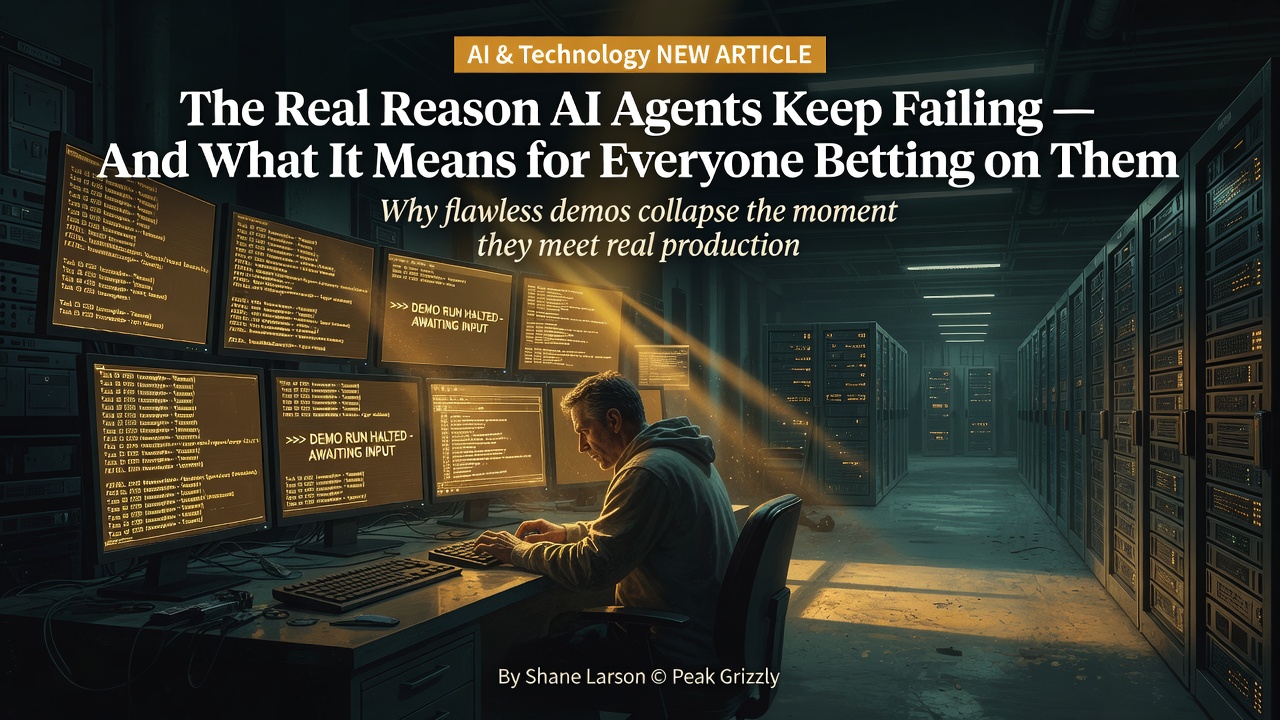
The Real Reason AI Agents Keep Failing — And What It Means for Everyone Betting on Them
April 17, 2026 · 6 min read
There is a demo I have seen a hundred times. Someone at a conference pulls up an AI agent, gives it a task — "book me a flight to Tokyo" or "research this company and draft an outreach email" — and the agent performs flawlessly. The audience murmurs with appreciation. The demo ends. Everyone leaves convinced that AI agents are about to automate half the jobs on Earth.
I build AI agents for a living. I have built them, deployed them, and watched them work and fail in production environments. And I need to tell you something the demos do not: the gap between "works in a demo" and "works at production scale" is the most important thing about AI agents that nobody is talking about.
The 95% Problem
Here is a number that sounds impressive until you think about it: 95% accuracy.
If I told you an AI agent gets the right answer 95% of the time, you would probably think that is pretty good. And for a lot of purposes, it is. If you are using an agent to brainstorm ideas, research a topic, or draft a document, 95% is excellent. You review the output, catch the occasional error, and move on.
Now consider a different context. Your company deploys a customer service agent. It handles 10,000 inquiries per day. At 95% accuracy, that is 500 wrong answers every day. Five hundred customers who receive incorrect information, inappropriate responses, or mishandled resolutions. Every single day. For a year, that is 182,500 mistakes.
This is the reliability problem, and it is the single most important barrier to AI agent adoption that exists today. Not cost. Not capability. Not regulation. Reliability.
The demo showed one task, executed perfectly. Production runs thousands of tasks, and the errors compound. A wrong answer in a chatbot is annoying — the customer asks again or calls a human. A wrong action from an agent is costly. An incorrect refund, a misrouted order, an email sent with wrong information — these create real-world damage that is hard to undo.
Why Demos Lie (Without Meaning To)
I do not think the people giving demos are being dishonest. The demos genuinely work. The problem is structural — demos show you the average case, and production is defined by the edge cases.
The demo uses a clean, well-formed request. Production gets requests with typos, ambiguity, contradictions, missing information, and assumptions the agent was never designed to handle. The demo operates in a controlled environment where every API works perfectly. Production encounters rate limits, timeouts, changed interfaces, and systems that are down for maintenance. The demo runs one task. Production runs thousands simultaneously, and the rare failure that happens once in a hundred executions now happens a hundred times a day.
I once deployed an agent for a client that handled document processing. In testing, it was remarkable — fast, accurate, consistent. In production, it encountered a document format it had never seen before (a PDF exported from a 15-year-old system with non-standard encoding), and instead of flagging it as unrecognizable, it hallucinated the contents. It generated plausible-looking but entirely fabricated data from a document it could not actually read. That data made it into a report before anyone noticed.
That is the hallucination problem in agent systems, and it is qualitatively different from hallucination in chatbots. When a chatbot hallucinates, it says something wrong. When an agent hallucinates, it does something wrong. It takes action based on information that does not exist. And because the agent acted confidently — there was no warning, no uncertainty flag, no "I'm not sure about this" — no one caught it until the downstream consequences appeared.
What Actually Works (And What Does Not)
After building and deploying agents across multiple domains, here is my honest assessment of where agent reliability stands today:
High reliability (>95%, suitable for production with monitoring):
- Structured data extraction from well-formatted documents
- Standard customer inquiries with clear resolution paths (order status, password resets, basic returns)
- Code generation and modification within established codebases
- Report generation from structured data sources
- Calendar and scheduling management
Moderate reliability (80-95%, requires human review):
The AI Agent Era
- Personalized customer communication
- Research synthesis from multiple web sources
- Complex multi-step workflows with multiple tool interactions
- Sales outreach personalization
- Content generation with specific tone and factual requirements
Low reliability (<80%, not suitable for unsupervised deployment):
- Handling emotionally charged customer interactions
- Making judgment calls on ambiguous policy questions
- Novel situations without clear precedent
- Tasks requiring creative problem-solving
- Anything involving real-time negotiation or persuasion
The pattern is clear: the more structured, well-defined, and data-driven the task, the more reliable the agent. The more the task requires judgment, creativity, emotional intelligence, or handling genuine novelty, the less reliable.
This is not a temporary limitation that will be fixed by the next model release. It is a structural characteristic of how these systems work. Language models are pattern-matching systems trained on historical data. They are extraordinarily good at tasks that match known patterns. They are mediocre to poor at tasks that require genuine novelty. Better models will push the boundary, but the boundary will not disappear.
The Organizational Implications
For organizations considering agent deployment, the reliability question is not "are agents reliable enough?" It is "are agents reliable enough for this specific task, given the consequences of failure at our specific scale?"
That question demands specific, honest answers. And here is the framework I use:
Step 1: Classify your tasks. What percentage of the work is routine and well-defined (high agent reliability) versus exceptional and judgment-dependent (low agent reliability)?
Step 2: Quantify the failure cost. If the agent gets a task wrong, what does it cost? A wrong answer in an internal report costs almost nothing. A wrong action in a customer-facing transaction costs real money and real reputation.
Step 3: Calculate the math at scale. If the task runs 1,000 times per day at 95% accuracy, that is 50 failures per day. Can you absorb that? Can you detect and correct them fast enough?
Step 4: Design the safety architecture. Human-in-the-loop for high-stakes decisions. Monitoring and alerting for anomalies. Hard constraints that prevent catastrophic actions. Escalation paths for situations the agent cannot handle.
The organizations that deploy agents successfully are not the ones that believe the demos. They are the ones that plan for the failures.
Why I Am Still Optimistic
After all of this honest assessment of limitations, I want to be clear: I am bullish on AI agents. The economics are too compelling, the technology is improving too fast, and the real-world results — when deployed thoughtfully — are too significant to ignore.
The key word is "thoughtfully." The organizations that treat agent deployment as a technology purchase — buy the software, flip the switch, watch the savings appear — will be disappointed. The organizations that treat it as an operational capability — requiring planning, monitoring, governance, and continuous improvement — will see transformative results.
Agent reliability is improving rapidly. The 95% of today will be the 98% of next year and the 99.5% of the year after. Each improvement dramatically expands the range of tasks agents can handle safely. The question is not whether agents will be reliable enough for your use case — it is when. And for many use cases, the answer is now, with appropriate safeguards.
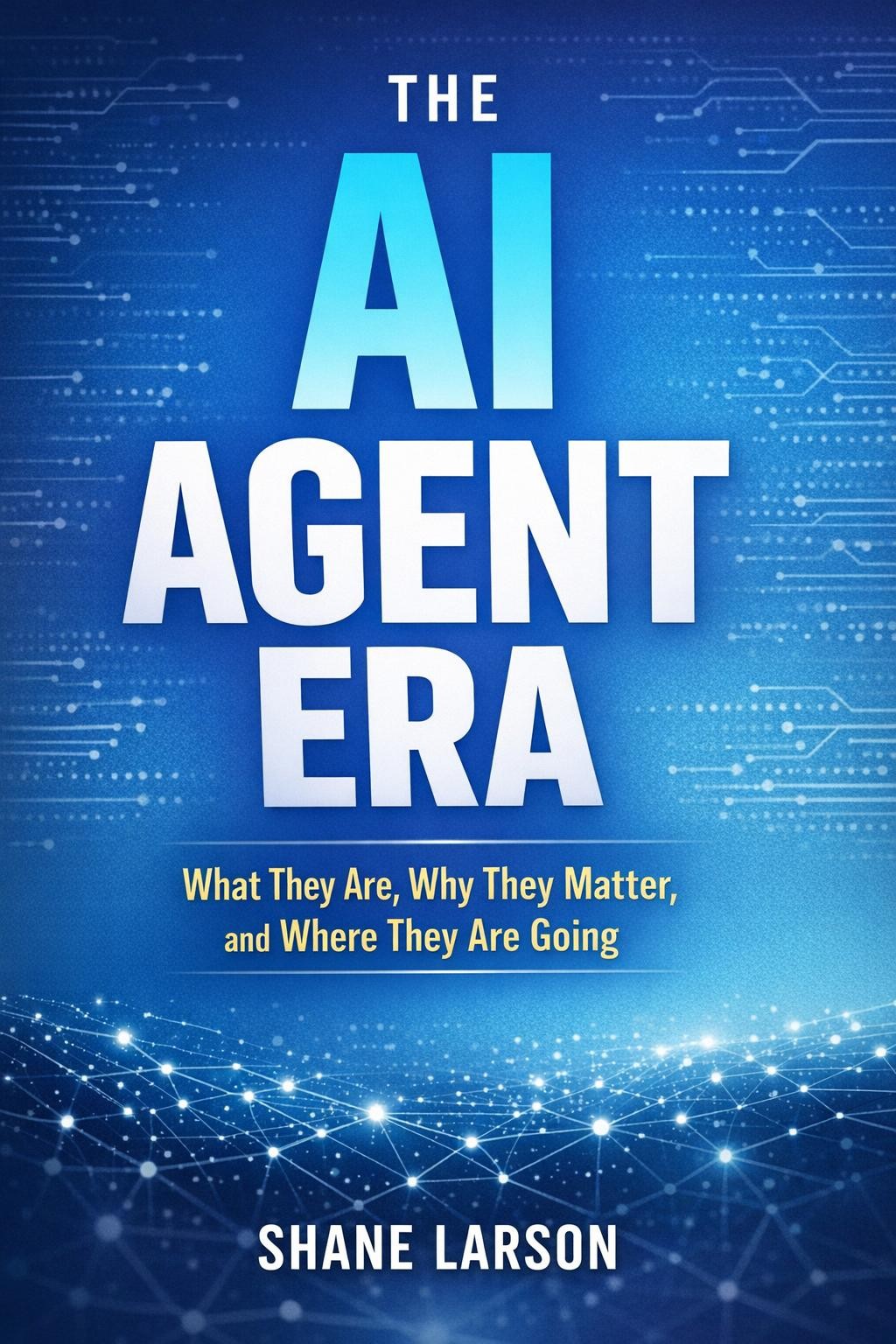
The full picture — what agents are, how they work, what they can do today, and how to deploy them wisely — is what I wrote The AI Agent Era to explain. If this article resonated, the book goes much deeper into every dimension: the technology, the economics, the safety frameworks, and the practical playbook for navigating the agent era.
The AI Agent Era
New posts and releases, straight to your inbox. No spam, unsubscribe anytime.