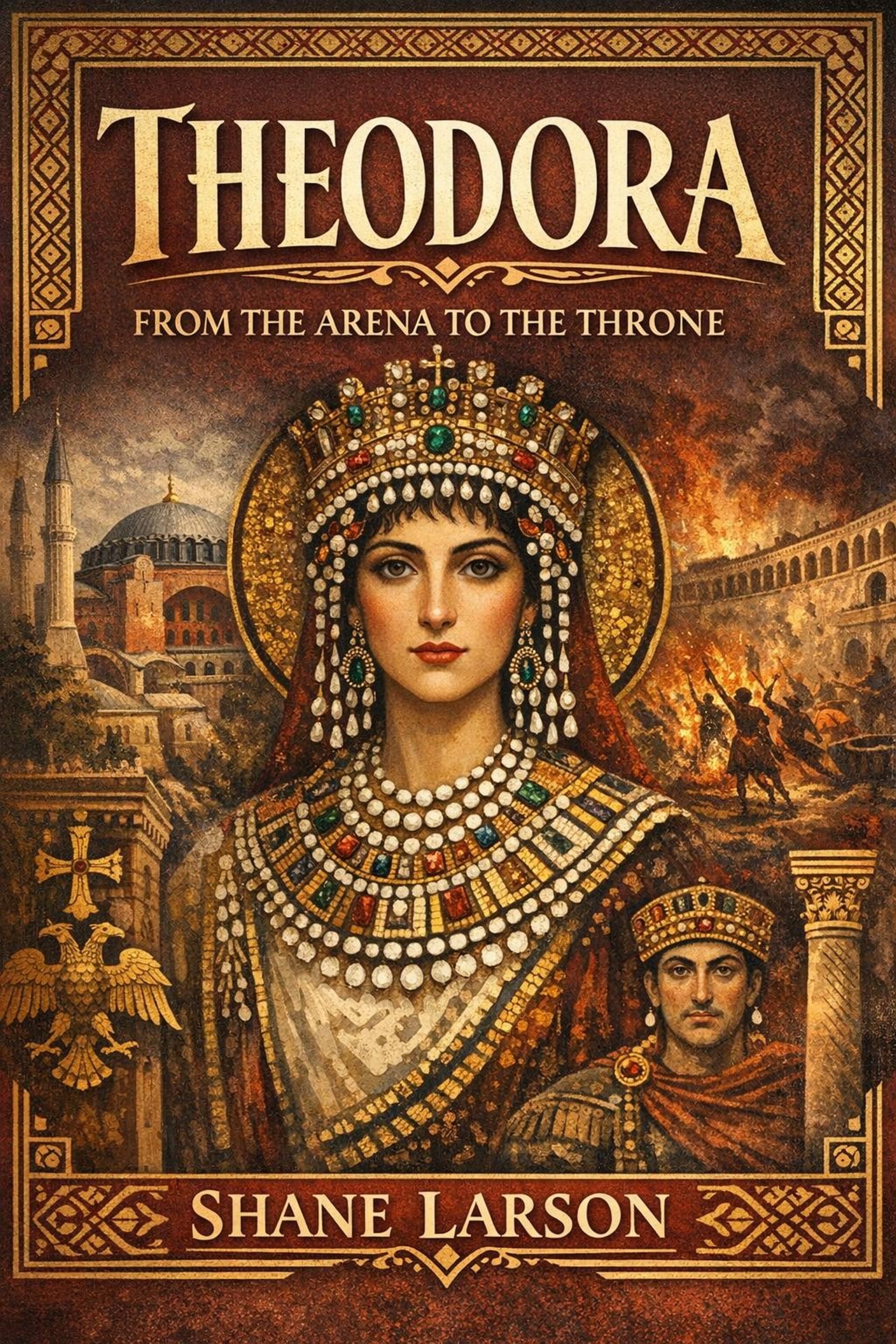
Theodora
From the Arena to the Throne
By Shane Larson
About This Book
Sometime after the empress was safely dead, a respected court historian sat down and wrote a book he would never dare publish in his lifetime. In public, Procopius of Caesarea had praised Theodora as pious, brilliant, and devoted. In private, in the manuscript we now call the Secret History, the same pen turned her into a demon in human form — insatiable, cruel, risen from the gutter to poison an empire. Two portraits, one author, and fifteen centuries of readers left to decide which mask, if either, showed the real face underneath.
That contradiction is where any honest account of Theodora has to begin, because it is nearly all we have. She did not leave letters or a memoir. What survives is a war between an official version and a poison-pen version, both written by a man with reasons to lie in both directions. And yet through that noise a figure emerges who is impossible to explain away — a woman who started with nothing the ancient world valued and ended holding one half of the most powerful throne on earth.
She was not born to any of it. Her father kept bears for one of the circus factions in Constantinople; when he died, his little girls were paraded before a roaring crowd to beg for a new protector. Theodora grew up on the stage, in a profession the law treated as barely distinguishable from prostitution. There was no ladder from there to the imperial palace. She built one anyway.
The Argument
This book takes the source problem seriously instead of choosing a side and running with it. The praise and the venom are both weighed, cross-examined, and set against everything else we can reconstruct — the laws that actually got passed, the buildings that actually got raised, the crises the throne actually survived. The point is not to crown Theodora a saint or convict her as a monster, but to ask what a careful reader can genuinely know about a woman whose entire record was written by people determined to distort her.
What comes through the distortion is a political operator of the first rank. When she married Justinian and rose beside him, she did not settle into the decorative role empresses were expected to occupy. She shaped legislation, particularly law touching the lives of women — protections for wives, penalties for those who trafficked girls into the trade she had escaped, a hard line against the forced prostitution she knew from the inside. She ran her own diplomatic and religious networks, quietly shielding Monophysite Christians whom her husband's official church was persecuting, playing a longer and more dangerous game than a compliant consort ever could.
And in 532 she saved the reign outright. When the Nika riots turned Constantinople into a burning battlefield and Justinian's council was urging him onto a ship, it was Theodora who refused to run — who reportedly told the room that the imperial purple made a worthy burial shroud, and that she for one had no intention of living to see herself called anything but empress. The emperor stayed. The revolt was crushed. Whatever else the sources disagree about, the throne survived that day because a bear-keeper's daughter had more nerve than the men around her.
What's Inside
- From the margins to the purple: How a stage performer from the lowest tier of Roman society climbed to the highest position a woman could occupy in the ancient world — and what that ascent cost.
- The day the empire almost ended: The full anatomy of the Nika riots, the panic in the palace, and the speech that reportedly stiffened a wavering emperor's spine.
- Laws ahead of their time: Theodora's reforms on marriage, divorce, and the treatment of women — measures that read as startlingly modern against their sixth-century backdrop.
- A private religious policy: Her risky protection of the Monophysites, running counter to her own husband's church, and what it reveals about how independently she operated.
- Reading a hostile source: A working method for handling Procopius — how to use a witness who alternately worshipped and despised his subject without being played by either version.
- Plague, fire, and reconstruction: What the great pestilence, the riots, and the rebuilding of Constantinople expose about the partnership at the center of the throne.
- The erased and the remembered: Why the men who tried to write Theodora out or drag her down failed, and why we're still arguing about her long after their names faded.
Why I Wrote This
I came to Theodora sideways, through the Secret History, and I couldn't get past how strange the whole situation was. Here is a historian who wrote official praise and secret venom about the same woman, and for centuries people have just picked the version that suited their argument — saint for the admirers, harlot for the cynics — as if the contradiction weren't the most interesting thing in the room.
What hooked me was the detective problem underneath the biography. You cannot take a single word about Theodora at face value, and that forces you to actually think about how we know anything about the ancient world at all. I wanted to write the book that neither flatters her nor slanders her, but does the harder work of asking what survives the cross-examination. What survives is a genuinely formidable person — and a case study in how the record gets shaped by whoever holds the pen.
Frequently Asked Questions
Do I need to know Byzantine history to follow this?
Not at all. The book sets up the world of sixth-century Constantinople, the reign of Justinian, and the political machinery from scratch. If your knowledge of Byzantium is a blank, you'll be brought up to speed as the story moves.
Is this a straight biography or an argument about the sources?
It's both, braided together. You get Theodora's life told as a narrative, but the book never pretends the sources are neutral — it keeps showing you how the account is built, and where it has to hedge, so you're never just handed a tidy legend.
How does it handle Procopius and the Secret History?
Carefully and skeptically, from both directions. The book uses Procopius extensively because there's no avoiding him, but it treats his praise and his slander as evidence to be weighed rather than facts to be repeated — and it's candid about what that leaves genuinely uncertain.
Is there a lot about Justinian too?
He's necessarily present — they ruled as a partnership — but the book keeps its center of gravity on Theodora. Justinian's reign is the stage; she's the subject.
If You Liked This, You Might Like
- Zenobia of Palmyra — Another woman who seized real imperial power against the grain of Rome, and whose story survives only through the hostile pens of her enemies.
- Hypatia of Alexandria — A brilliant woman navigating the same late-antique eastern Mediterranean world of faction, faith, and violence that shaped Theodora's Constantinople.
- The Fall of Rome — The long transformation of the Roman world that produced Justinian's empire; essential background for the throne Theodora helped hold together.
- The Empire Collapse Pattern — Justinian and Theodora fought to reverse an empire's decline; this is the wider framework for why the mightiest powers fall, and why holding them together is so rare.
Weigh the praise against the poison, and a real person steps out of the argument — not the saint, not the monster, but the bear-keeper's daughter who out-thought the men who wanted her gone.
Included with Kindle Unlimited — read it free if you're a member.
New Ancient History releases and free chapters — no spam, unsubscribe anytime.