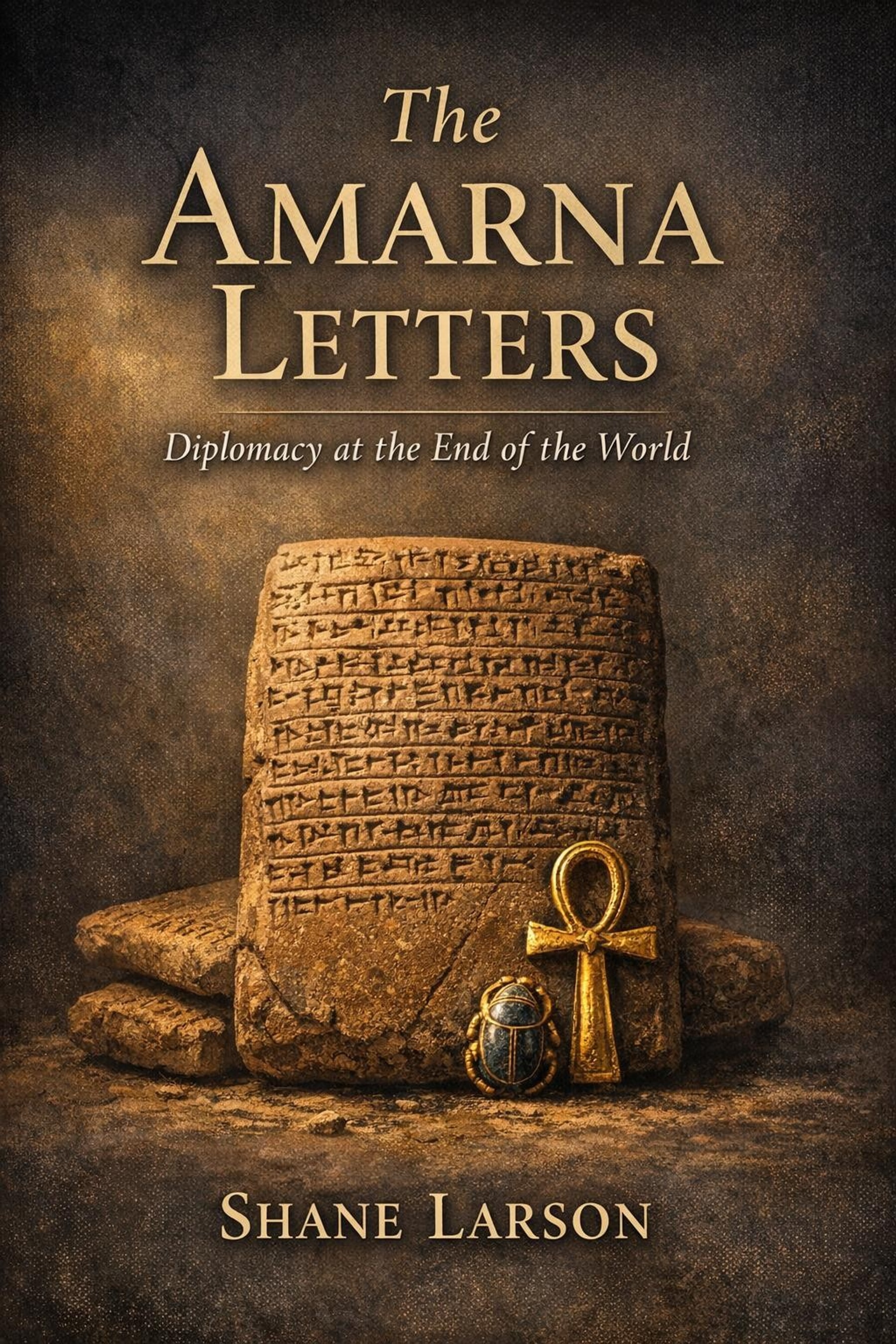
The Amarna Letters
Diplomacy at the End of the World
By Shane Larson
About This Book
When the Egyptian court abandoned the city of Akhetaten around 1330 BC, the clerks took what mattered and left the rest. Among the things that did not make the cut was the foreign-correspondence file: hundreds of clay tablets in Babylonian cuneiform, the accumulated mail of two pharaohs, left in a records office as the desert closed over the town. It sat there for three thousand years. Then a village woman, digging decayed mud-brick out of the ruins to spread on her fields, put her hoe through the most extraordinary cache of documents to survive from the ancient world — and nobody believed a word of it, because cuneiform tablets had no business being in Egypt.
What she had found, and what dealers scattered and partly destroyed before scholars caught on, was the working diplomatic archive of a superpower at the height of the Late Bronze Age. Not the version of foreign relations that got carved on temple walls, where Pharaoh is a god and every neighbor grovels — the real version. The inbox.
The Amarna letters are the only place in the ancient world where you can watch an international system operate in its own words, in real time, with nobody performing for posterity. And the shock of them is not their formality. It is how little of it there is.
The Story
The archive holds two worlds. In the first, the great kings of Egypt, Babylon, Mitanni, Hatti, Assyria, and Cyprus write to each other as equals — "my brother," they insist, a legal fiction that let strangers a thousand miles apart exchange gold, brides, and grievances as if international order were a family matter. They bicker about the weight of gold shipments and the lateness of wedding gifts. They send daughters to seal alliances and then demand proof the women are still alive. They apologize for shorted copper deliveries by explaining, reasonably, that plague has killed the coppersmiths. One king spends decades pursuing a single grievance about statues he was promised in solid gold and received in gilded wood.
In the second world — the other half of the archive, and the darker one — the small kings of Canaan and Syria write up the chain to a pharaoh who rarely answers. Their letters are inventories of a frontier coming apart: neighbors seizing towns, populations slipping away to join the stateless bands the letters call Apiru, garrisons of ten men asked to hold cities. One governor, Rib-Hadda of Byblos, sent more than sixty letters begging for troops — a correspondence that ends with his own brother handing the city to his enemies while he was abroad. The empire's answer, over and over, amounted to: stop writing so much.
Read together, the two halves make a portrait no chronicle could: a functioning international order, complete with protocol, finance, marriage politics, intelligence problems, and imperial neglect — caught at full confidence, a century and a half before nearly every kingdom in the correspondence was destroyed. The correspondents cannot see the end coming. The reader can. That is what makes an archive of complaints about gold one of the most quietly devastating documents in ancient history.
What's Inside
- A detective story before the history: how tablets sold as fakes for pennies were authenticated, numbered, and reassembled into a coherent archive across a century of scholarship — and how much was lost in grain sacks on the way to Cairo.
- A tour of the great powers of 1350 BC — Egypt, Babylon, Mitanni, the Hittites, upstart Assyria, and copper-rich Cyprus — and why this one century produced a genuinely multipolar world, a rarity in ancient history.
- The strange machinery of Akkadian diplomacy: why every court wrote in a language none of them spoke natively, and what the Canaanite scribes' grammatical fingerprints accidentally preserved.
- Gift exchange decoded as international finance — obligation, credit, exchange rates, and insult — through the gold disputes that dominate the royal letters.
- Marriage as foreign policy, including the one rule Egypt never broke: princesses come in, princesses never go out — and the Hittite prince who died answering an Egyptian queen's astonishing proposal.
- Character studies of the archive's unforgettable voices: wheedling Tushratta of Mitanni, doomed Rib-Hadda of Byblos, and Aziru of Amurru, the minor vassal who outplayed two empires.
- The Apiru question handled honestly: who the stateless people of the letters actually were, and what the evidence does — and does not — support about their connection to the Hebrews.
- The long view: what happened to every correspondent's kingdom in the century and a half after the archive went silent, and what the letters reveal about how interconnected systems fail.
Why I Wrote This
I have been writing about the Bronze Age for years — its empires, its palaces, and above all its ending, which I have now covered from more angles than I care to admit. Every one of those books leaned on the Amarna letters as evidence. Cite the archive, quote the argument, move on. At some point I noticed I had never actually sat down with the whole correspondence and just read it as what it is: mail. When I finally did, what struck me was not the geopolitics. It was the tone — kings sulking, needling, apologizing, and lying in ways I recognized instantly from three thousand years away. Everything else I have written about this world was reconstructed from ruins. This is the one place its people talk. They deserved their own book.
Frequently Asked Questions
Do I need to read Akhenaten or other Bronze Age books first?
No. The book explains the world of the letters from the ground up — the powers, the geography, the chronology. If you have read Akhenaten, this is the natural sequel, since the archive was dug out of his capital and half of it was addressed to his court. But it stands entirely on its own.
Does the book quote the actual letters?
It paraphrases them, deliberately. The Amarna corpus survives in English only in copyrighted scholarly translations, so every letter's content is rendered fresh in the book's own voice and cited by its standard EA number. You get what each letter says, who sent it, and why it matters — and the paraphrase keeps the prose consistent from first page to last.
Is this a narrative history or an academic reference?
Narrative. The chapters are built around people — a gold-obsessed Babylonian king, a Mitannian royal in decline, a doomed city governor — with the archive's mechanics explained as the stories need them. Three appendices (a who's-who, an anatomy of a tablet, and a field guide to Bronze Age diplomatic practice) carry the reference load.
What does this book say about the Apiru and the Hebrews?
It presents the evidence and the state of the scholarly argument, and it does not pretend to more certainty than the sources allow. The simple equation — Amarna's Apiru are the Bible's Hebrews — does not survive scrutiny, and the book explains why. A subtler relationship remains possible, and the book lays out exactly what would have to be true for it.
How does this connect to the Bronze Age collapse?
This is the "before" picture. The letters show the interconnected palace world — gold, copper, grain, and royal brides moving on the same thin channels — roughly a century and a half before that world burned. The final chapter follows the correspondents' kingdoms to their ends.
If You Liked This, You Might Like
- Akhenaten — the pharaoh whose city held the archive; the religious revolution in this book's background is that book's foreground.
- When the World Burned — the complete story of the collapse that destroyed nearly every kingdom in the correspondence; the "after" to this book's "before."
- The Hittite Empire — Suppiluliuma, the predator on the archive's northern edge, gets his empire's full story.
- Sea Peoples: Raiders of the Bronze Age — the raiders who appear at the end of this story, and the oldest unsolved mystery of the era.
Three hundred and fifty tablets of complaint, flattery, and fear — the private correspondence of an international order that did not know it was mortal. This is the Bronze Age speaking for itself.
What You'll Learn
- How tablets sold as fakes for pennies were authenticated and reassembled into a coherent archive — and how much was lost in grain sacks on the way to Cairo
- The great powers of 1350 BC — Egypt, Babylon, Mitanni, the Hittites, upstart Assyria, and copper-rich Cyprus — and why this one century produced a genuinely multipolar world
- Why every court wrote in Akkadian, a language none of them spoke natively, and what the Canaanite scribes' grammatical fingerprints accidentally preserved
- Gift exchange decoded as international finance: obligation, credit, exchange rates, and insult, through the gold disputes that dominate the royal letters
- Marriage as foreign policy, including the one rule Egypt never broke — princesses come in, princesses never go out
- Character studies of the archive's unforgettable voices: Tushratta of Mitanni, Rib-Hadda of Byblos, and Aziru of Amurru, the minor vassal who outplayed two empires
- The Apiru question handled honestly — who the stateless people of the letters actually were, and what the evidence does and does not support
- What happened to every correspondent's kingdom in the century and a half after the archive went silent
Included with Kindle Unlimited — read it free if you're a member.
New Ancient History releases and free chapters — no spam, unsubscribe anytime.