AI Automated the Tasks Junior Engineers Used to Learn On
August 5, 2026 · 5 min read
The public argument about AI and software jobs has two positions, and both are wrong.
One says every developer is replaced within five years. The other says this is just another tool, like the IDE or Stack Overflow, and nothing structural changes.
The actual situation is narrower than the first and considerably more awkward than the second. AI has not replaced software engineering. It has efficiently automated a specific band of work — and that band happens to be the one the profession used to use for training people.
What Is Actually Being Automated
Start with the honest list, because vagueness helps nobody here.
Boilerplate is gone. Project scaffolding, configuration, standard CRUD, common patterns — this is now generated faster and more consistently than it can be typed. Documentation is gone: docstrings, READMEs, API references, and explanations of what a function does, produced more reliably than most teams managed by hand. Test scaffolding, straightforward refactors, translations between languages and frameworks, first-pass debugging of ordinary errors — all substantially automated.
Look at that list from a distance and notice what it has in common. It is not junk work. It is well-specified work with a known shape, where correctness is checkable and the ambiguity has already been removed by somebody else.
Which is exactly the definition of the work you give a new engineer.
The Ladder Had Rungs for a Reason
For thirty years the profession trained people the same way. A junior engineer was handed small, bounded, low-risk tasks. They built the CRUD endpoints. They wrote the tests. They fixed the small bugs. They updated the documentation.
The output was worth something, but it was never the point. The point was that doing several hundred bounded tasks inside a real codebase is how a person acquires the thing you cannot teach directly: a working model of how systems actually behave. Why that abstraction leaks. What happens to the query under load. Which parts of the codebase everyone is afraid of, and why they are right.
Senior judgment is compressed experience of consequences. There is no route to it except accumulating the consequences.
The business case for that arrangement was that juniors were cheaper implementation capacity. The training was, from an accounting perspective, a side effect — which meant nobody had to justify it, and also that nobody was protecting it.
Now a senior engineer with good tooling can produce that implementation capacity directly. The ratio that used to require five juniors per senior no longer does. Several large employers have reduced or frozen entry-level technical hiring on precisely this reasoning, and the roles disappearing are specifically the ones that were pure implementation.
The side effect is disappearing with the thing it was attached to.
Why This Is a Structural Problem, Not a Career-Advice Problem
The usual response is advice to the individual: learn the tools, focus on fundamentals, differentiate on judgment. Reasonable, as far as it goes. Juniors with genuine AI fluency and strong fundamentals are still being hired, and the profession is not closed.
But it does not address the actual problem, because the actual problem belongs to the industry rather than to any individual.
Every senior engineer currently working got there by doing the work that is now automated. The supply of senior engineers in 2035 is a function of how many juniors are being trained in 2026. If entry-level hiring stays suppressed for several years, the shortage does not appear at the entry level — it appears seven to ten years later, at the level where the deficit cannot be fixed quickly by any means.
The AI Augmented Engineer
And this is a collective action problem of the least tractable kind. For any single company, not hiring juniors is correct: the cost is immediate and the benefit went away, while the consequence is diffuse, delayed, and mostly borne by whoever needs to hire seniors in a decade. Every firm optimising individually produces an outcome none of them wants.
The pipeline cannot run empty forever without consequences, and no single participant has an incentive to fill it.
What Doesn't Automate
The compensating fact is that the residual skills are real and durable, and they are not the ones people expect.
Deciding what to build. Nearly all of the expensive failures in software are not implementation failures. They are cases where something was built correctly and should not have been built at all. That judgment requires holding the business context, the political context, and the technical constraints simultaneously.
System design under genuine ambiguity. Not the interview version. The real one, where requirements conflict, the load profile is unknown, three plausible architectures each fail differently, and the deciding factors are things like which team will maintain it and what the organization can actually operate.
Debugging the situations that have never happened before. Novel failures in production, where the symptom is misleading and the cause spans three systems. This requires a mental model of the whole rather than pattern-matching against known errors.
Knowing when the output is wrong. This one is now the highest-leverage skill in the profession and the one most directly threatened by the pipeline problem. Reviewing generated code that looks entirely reasonable and identifying the subtle error requires exactly the judgment that used to come from having written that code badly yourself a few hundred times.
Everything involving other people. Mentoring, hiring, organizational navigation, stakeholder expectations, technical leadership.
The Uncomfortable Synthesis
Put the two halves together and the shape is clear.
The skills that remain valuable are senior skills. The mechanism that produced senior skills was junior work. The junior work is being automated.
That is not a prediction of collapse — the profession will resolve it somehow, probably through some combination of deliberate apprenticeship programmes, juniors who train themselves on personal projects at a scale previous generations never needed to, and eventual painful market correction when the senior shortage arrives.
But it will not resolve itself by default, and the current default is every organization individually making the locally correct decision.
If you are early in your career, the practical implication is that you now have to construct your own apprenticeship, because the job will not hand it to you. Build things that are too large to hold in your head. Operate them. Break them in ways that have consequences. The experience of consequences is the entire asset, and it is the one thing nobody can generate for you.
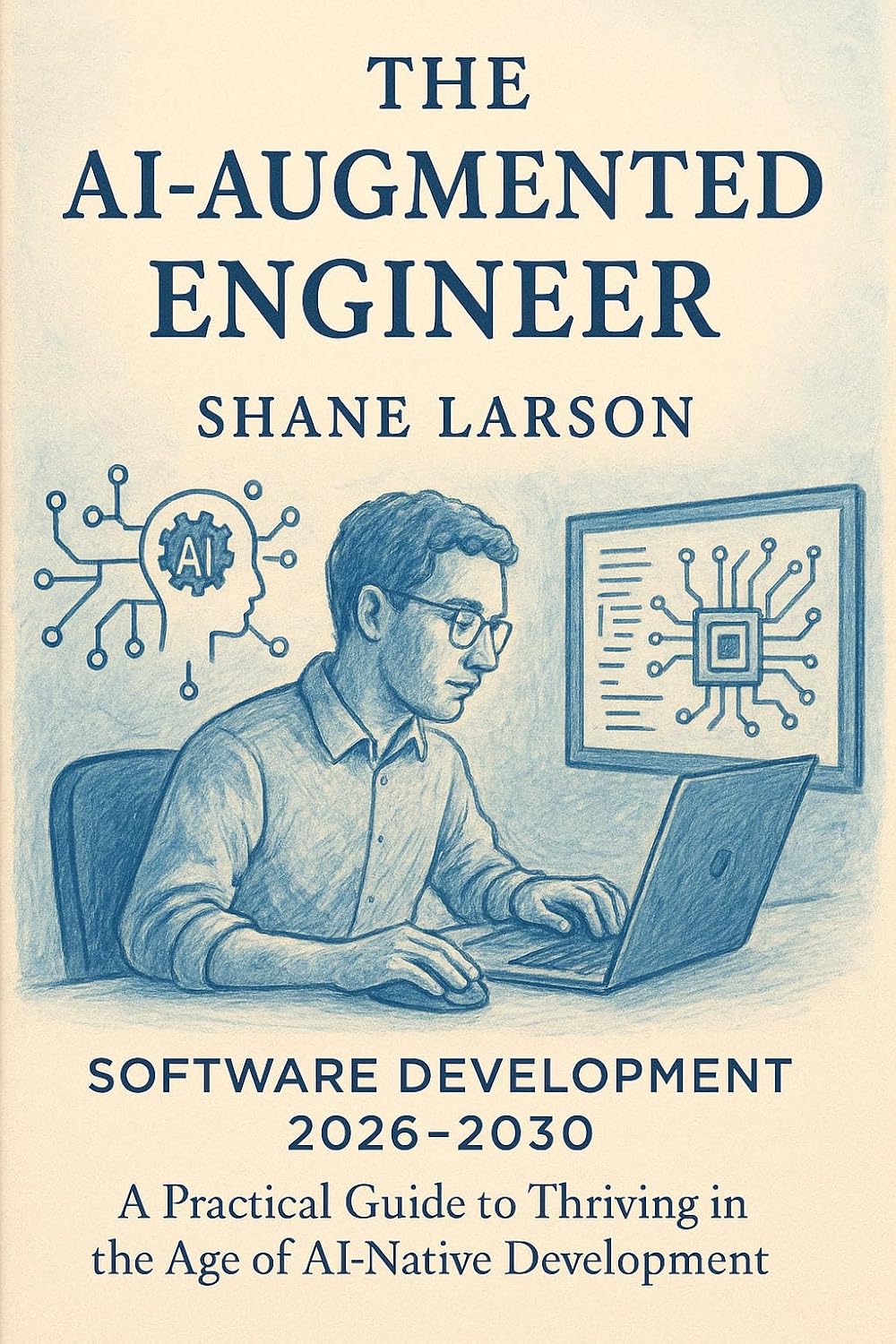
The AI-Augmented Engineer: Software Development 2026-2030 covers the full picture — the economics driving the shift, what's genuinely at risk versus what isn't, the skills that compound, the AI-augmented workflow, and a five-year action plan.
The AI Augmented Engineer
New posts and releases, straight to your inbox. No spam, unsubscribe anytime.