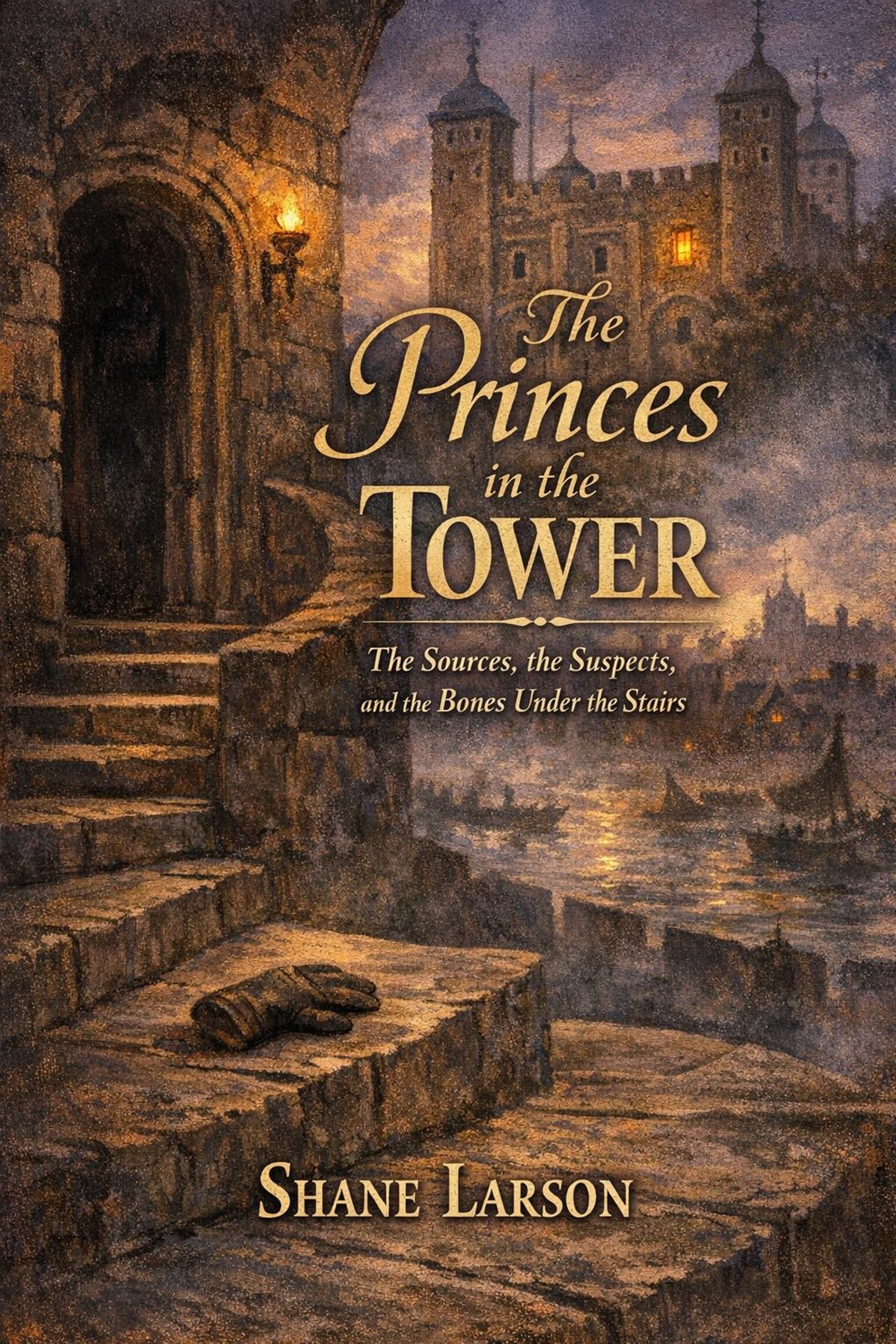
The Princes in the Tower
The Sources, the Suspects, and the Bones Under the Stairs
By Shane Larson
About This Book
On 15 January 1484, at Tours, the Chancellor of France stood up before the Estates-General and told them that the sons of the late King of England had been killed, and that the crown had passed to the man who killed them. It was the first time anyone had said so in public, anywhere. The boys had last been seen, by anyone who wrote it down, about six months earlier, behind the windows of the royal lodgings in the Tower of London. Nobody at Tours had been there either.
That is how the case of the princes in the Tower has always worked. The people who said what happened were not in the room, and the people who were in the room never said. Dominic Mancini, the one writer in London that summer, sailed before the boys vanished and reported only what the city was whispering. The Crowland chronicler sat on the royal council and wrote the deaths up as a rumour. Thomas More, who supplied the names, the night and the staircase, was five years old in 1483 and wrote three decades later from a confession no one has ever produced. Against that thin core sit two small skeletons in a marble urn in Westminster Abbey, and five centuries of argument.
A Case File, Not a Verdict
The Princes in the Tower: The Sources, the Suspects, and the Bones Under the Stairs is built the way a careful investigator builds a file: the victims, the timeline, the witnesses, the suspects, the forensics. Nothing is withheld for a reveal, because the evidence does not contain one.
Part One is the boys: Edward V, born in sanctuary in 1470 while his father was in exile; Richard of Shrewsbury, married at four and widowed at eight; and the eighty-eight days from Edward IV's death to their uncle's coronation, told as a record of who held the children and who could see them. Part Two is the witnesses, every narrative account in the sequence it was composed, so a reader can see a whisper in London become, step by step, a named crime with a method and a date, and judge what each writer knew and had to gain.
Part Three is the suspects, four chapters and one test. Richard III, the Duke of Buckingham, the Duke of Norfolk, Sir James Tyrell, Henry Tudor and Margaret Beaufort, and the possibility that nobody killed the boys at all, are each asked when their motive arose, who had access while the children could still have been alive, how they behaved afterwards, and what cuts against the case. Part Four is the ghosts: Perkin Warbeck, who claimed for eight years to be the younger prince; the 1674 discovery under a Tower staircase and the 1933 examination; and what radiocarbon dating and ancient DNA could decide today.
Only in the Conclusion does the book offer a most-likely reading, labelled as the author's assessment and held on the balance of the evidence, with the open alternatives set beside it.
Why I Wrote This
The Wars of the Roses gave the princes two paragraphs and Richard III gave them one chapter, and both times I stopped where the evidence stopped, which felt honest and also felt like leaving the room. What pulled me back was a sentence I kept meeting in otherwise careful books: that a DNA test on the urn would settle the matter in an afternoon. It would not. The maternal line that identified Richard III runs through his mother, and the boys had a different one. Once I had worked that out, much of what I thought I knew about the case turned out to be in the same condition, repeated often and checked rarely, and every popular book I had read was a brief for one side. I wanted the one that asked each suspect the same questions and said at the end how far the answer would bear leaning on. Nobody had written it, so I did.
Frequently Asked Questions
Do I need to read Richard III or The Wars of the Roses before this book?
No. This is a standalone case file, and it opens in 1470 with Edward V's birth rather than in 1455 with the war. Richard III appears as one suspect among several, and his reign enters only where it bears on the evidence. Readers who want the man himself, or the war that put two children in a fortress, have the two companion volumes on this shelf.
Does the book say who killed the princes in the Tower?
It says what the evidence will bear, which is not the same thing. The Conclusion gives one reading, labelled as the author's and held on the balance of probability rather than beyond doubt, with the next most likely alternative beside it. Richard is tested first because he is the obvious suspect, but as a suspect, not the subject, and the survival hypothesis gets no lower standard for being hopeful. Every detail of how the deaths might have happened is traced to More and treated as a sixteenth-century account, not as fact.
Does it cover Philippa Langley and the Missing Princes Project?
Yes, in Chapter 10 and again in the Conclusion. The project's central claim, as its members have stated it, and the three lines of evidence it has presented are described, followed by the objections historians have raised to each. The book reports this as the unsettled dispute it is.
Could DNA testing identify the bones in Westminster Abbey?
Only partly, and only with the right comparison. Radiocarbon dating could show whether the bones are late medieval at all; ancient DNA could establish sex and kinship. But mitochondrial DNA passes from mother to child, so the princes carried Elizabeth Woodville's line, inherited from Jacquetta of Luxembourg, and a documented living descendant of that line would have to be found and verified first. Chapter 13 explains why no result from the urn could ever say who was responsible.
If You Liked This, You Might Like
- The Hundred Years' War — the French war whose ending sent England's soldiers home to fight each other, and the reason a nine-year-old could hold a dukedom and a twelve-year-old a crown.
- Tutankhamun — another royal child whose body became the evidence, and whose examination showed how much a skeleton can tell and how much it cannot.
- Linear B — the same discipline applied to a different puzzle: what the surviving marks actually say, who read them, and how a confident answer was built on very little.
- Catherine of Aragon — the princess whose parents wanted Perkin Warbeck dealt with before they would send her to marry into the Tudor house, and the next chapter of the English shelf.
Two boys were taken into the keeping of the man who took their throne, and were never seen again. This is the file on what can honestly be said about why.
A standalone case file on the English shelf, beside The Wars of the Roses and Richard III.
What You'll Learn
- **The last sighting, and why historians disagree about it by months.** The boys shooting in the Tower garden, a physician's report that the elder expected to die, a failed rescue in July, and a king's letter about an unnamed "enterprise".
- **Richard's silence weighed four ways.** The most important negative fact in the case, with the readings that require him to have chosen it and the one that does not.
- **Buckingham, Norfolk and Tyrell on the same footing as Richard.** The College of Arms note, the Mowbray inheritance, two unexplained pardons in 1486, and the wardrobe warrant that both corroborates More and may explain him.
- **The Tudor case taken seriously.** Henry's motive, the repeal of *Titulus Regius* unread, an attainder that speaks of infants' blood without naming any, and the problem of a suspect who was in Brittany.
- **The survival hypotheses as a live dispute.** What the Missing Princes Project and Philippa Langley's 2023 book claim the Lille, Arnhem and Devon material shows, and the objections historians have raised, each attributed and neither adjudicated by assertion.
- **The bones and the lab.** What Tanner and Wright found in 1933, what has been reread since, and why the mitochondrial line that identified Richard III in Leicester cannot identify his nephews.
New Medieval History releases and free chapters — no spam, unsubscribe anytime.
More in This Genre
View all →