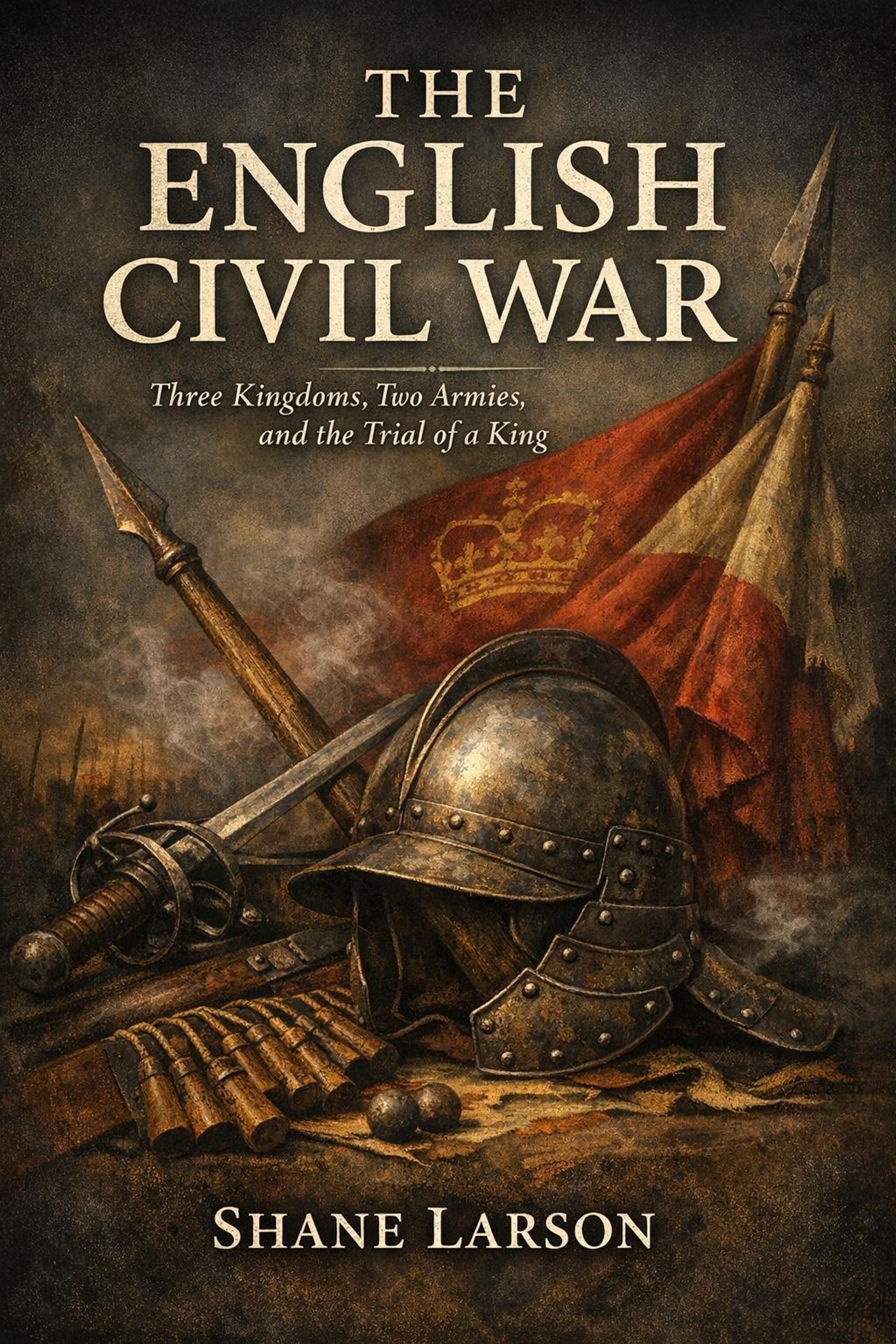
The English Civil War
Three Kingdoms, Two Armies, and the Trial of a King
By Shane Larson
About This Book
In November 2013, builders digging the footings for a café on Palace Green in Durham cut into two pits of human bones. There were at least seventeen people in them, most of them young, and the chemistry of their teeth said they had grown up in Scotland. They were prisoners from the battle of Dunbar, taken by an English army on 3 September 1650, marched a little over a hundred miles south in about a week and locked in Durham Cathedral, where more than half of the three thousand who arrived died of hunger, cold and disease.
That is the English Civil War seen from a hole in the ground: a Scottish army, an English one, a cathedral used as a prison, and a death toll nobody recorded at the time. It does not look much like the war most of us carry around, the quarrel between a king and his Parliament, with Roundheads and Cavaliers and a scaffold at the end.
The quarrel was real and so was the scaffold. Between them lay nine years of fighting across three kingdoms, and what has gone missing from memory is how many people they killed.
Three Kingdoms and One Stubborn King
The English Civil War: Three Kingdoms, Two Armies, and the Trial of a King opens in 1625, with a shy young man of twenty-four becoming king of three countries with three churches, and follows him and his enemies to the last battle in 1651. The frame is the one historians have used since the 1990s, the Wars of the Three Kingdoms: a Scottish rebellion the king could not afford to crush, a Parliament summoned to pay off the Scots that stayed to fight him instead, an Irish rising that settled who would command the next army, and only then an England split in two. The book takes the people who fought at their word: most said it was about God before they said it was about Parliament, and it explains what they meant by bishops, altar rails and popery rather than translating it into a quarrel over tax.
Five people run through all of it: Charles I, who let Strafford go to the block in 1641 and said on the scaffold that he was being punished for it; Cromwell, whose letters are the spine of the second half; Rupert; Fairfax, who won the war and resigned rather than invade Scotland; and John Lilburne, tried for his life three times and acquitted three times by London juries.
The second half is the part the school version skips. An unpaid army refuses to disband, seizes the king, and sits down in a church at Putney to argue about the franchise. The captive king starts a second war with Scottish help; the army wins it in three days at Preston and decides it must be the last. Fifty-nine men sign a warrant. And the war goes on for two more years after the king is dead, at Drogheda, Wexford and Dunbar, until his son is hiding in an oak tree. The civilians are on every page: the plunder, the free quarter, and the camp fevers that, by the estimate the book opens with, killed more people than the battles.
Why I Wrote This
I had already written about the Thirty Years' War, and kept running into Englishmen and Scots in it: a Scottish field marshal under Gustavus Adolphus, a Palatine prince whose mother was a Stuart princess, hundreds of officers serving the Dutch. When those men came home in 1638, I wanted to know what they did next. The honest answer was that they fought a war I thought I knew and did not. I had it filed as English and constitutional. It started in Scotland over a prayer book, its first and last battles were fought against Scottish armies, and its worst years, proportionally, were in Ireland. What held me after that was a shorthand notebook. For two centuries the only record of ordinary soldiers debating who should vote sat unread in an Oxford college. When it was printed in 1891, the argument in it turned out to be one we are still having.
Frequently Asked Questions
How many people died in the English Civil War?
Nobody counted at the time, so every figure is an estimate. The most cited is Charles Carlton's, from 1992: the reported dead of every engagement he could find in print, a little under 85,000 for England and Wales, plus roughly 100,000 for disease by analogy with comparable wars, for about 190,000 out of some five million people, close to 3.7 percent. Every step can be argued with, from the partisan newsbooks the battle counts come from to the 1672 guess behind his far higher Irish figure. The book treats it as one careful estimate, disputed.
Why was Charles I executed?
Nobody set out to kill him in 1642, and after his surrender in 1646 Parliament and the army spent eighteen months trying to restore him on terms. Then, as a prisoner, he signed a secret Engagement with the Scots that brought a Scottish army into England in 1648, and the officers who destroyed it at Preston concluded that a king who would restart a lost war could never be trusted with a settlement. A purged Parliament set up a High Court of Justice, and Charles was tried in Westminster Hall as a tyrant, traitor and murderer. He refused to plead; fifty-nine commissioners signed the warrant.
What were the Putney Debates?
In October and November 1647 the General Council of the New Model Army met in St Mary's church at Putney to debate a proposed written constitution, the Agreement of the People. On 29 October the argument turned to who should vote: Colonel Thomas Rainsborough held that the poorest man in England ought to consent to the government he lived under, and Henry Ireton answered that only men with a permanent fixed interest in the kingdom, meaning property, should choose its lawmakers. The council's secretary took it down in shorthand; it was not published until 1891.
What happened at Drogheda?
On 11 September 1649 Cromwell's army stormed Drogheda after its governor refused a summons. Cromwell's own letters say he forbade his men to spare any in arms, that about two thousand were put to the sword that night, and that officers who had surrendered on Mill Mount were killed on his order. Total deaths are usually put between 2,500 and 3,500, mostly the garrison; civilians also died, uncountably. The book lays out the dispute, from Carlyle's defence in 1845 to Tom Reilly's revisionist case and its critics, and gives its own view: a garrison killed by order, beyond the custom for men who had surrendered, and neither the extermination of a town nor the act of an honourable enemy.
Was the English Civil War really an English war?
Not for most of its length. England itself was at war only from 1642 to 1646; the fighting started in Scotland, Ireland escalated it, and it was to a Scottish army that Charles surrendered. The second war was a Scottish invasion, the Commonwealth's first campaign after the king's death was in Ireland, and the last battles, Dunbar and Worcester, were against Scots who had crowned his son. The war cannot be explained from inside any one of its kingdoms.
If You Liked This, You Might Like
- The Thirty Years' War — the war next door for the whole of Charles's reign, which trained Rupert, Leven and hundreds of officers on both sides of this one.
- The Hundred Years' War — the earlier English war fought by kings who had to ask Parliament for every army, a habit that came back to ruin Charles.
- The Black Death — plague came back with the sieges of the 1640s, and disease killed more people in this war than the battles.
- The Norman Conquest — the other time England's rule was decided by an army in one afternoon and then took a generation to settle.
A war that began over a prayer book and ended on a scaffold, told across all three kingdoms that fought it, with the dead counted as carefully as the record allows.
A standalone military history on the English-history shelf, after The Powder Treason and beside The Thirty Years' War.
What You'll Learn
- **The arithmetic of the dead.** Charles Carlton's 1992 estimate, the method behind it, and what still stands if he is wrong by half.
- **The women who held the castles.** Brilliana Harley at Brampton Bryan, the Countess of Derby at Lathom, and the camp followers killed after Naseby, with the numbers hedged.
- **Putney, in full.** The only verbatim record of ordinary soldiers arguing about who should vote, taken in shorthand and unread for two centuries.
- **The trial, day by day.** Pride's Purge, Bradshaw in his steel-lined hat, the masked woman in the gallery, the warrant with its erasures.
- **Ireland and Scotland as more than a coda.** Drogheda and Wexford from Cromwell's own letters; the Dunbar prisoners; the land settlement that followed.
- **Two appendices.** Every significant battle and siege from 1639 to 1651, with where to stand on the field, and a who's who with a chronology across all three kingdoms.
New Early Modern History releases and free chapters — no spam, unsubscribe anytime.
More in This Genre
View all →