
Why Your AI Project Died in a Browser Tab: The Gap Between Demos and Systems
September 21, 2026 · 6 min read
You have done this at least once. You saw a demo of some AI tool doing something impressive. You opened up ChatGPT or Claude, typed a prompt, got a surprisingly good response, and thought: I could build something with this.
Then you spent an evening playing around. Maybe a weekend. You got some cool outputs. You showed a friend. And then nothing. The project drifted. The tab stayed open for a few days. Eventually you closed it and moved on to the next interesting thing.
This is the single most common pattern in AI adoption. The excitement-to-abandonment pipeline is remarkably efficient, and it happens to experienced developers just as often as it happens to curious beginners.
The problem is almost never the technology. The problem is the approach.
The Distinction That Kills Most Projects
A demo is something that works once, under controlled conditions, when you are watching it. A system is something that works repeatedly, under varying conditions, whether you are watching or not.
Almost everything you see about AI is a demo. The blog posts, the Twitter threads, the YouTube tutorials, the conference talks. They show you the model doing something impressive in a carefully constructed scenario. They do not show you what happens when the input is messy, when the model hallucinates, when the API goes down at 2 AM, or when the output needs to feed into another process that expects a very specific format.
Consider a concrete example. You build a script that uses an LLM to summarize customer support emails. You test it with ten emails and the summaries are great. Demo quality. But when you run it on a thousand emails, you discover that 3% of the summaries are completely wrong, 8% include information that was not in the original email, and 15% do not match the format your downstream system expects.
Your demo worked. Your system does not exist yet.
The gap between demo and system is where most AI projects die. It is not glamorous work. It is data validation, error handling, output parsing, retry logic, cost management, and monitoring. It is all the things that turn a clever script into something you can actually rely on.
A useful AI system meets three criteria. First, it does work you would otherwise have to do yourself — not work that sounds cool, but work that actually needs to get done. Second, it runs reliably enough that you trust it — you do not have to check every output or babysit it. Third, it saves more time than it costs to build and maintain. A staggering number of AI projects fail that third test. People spend weeks building an automated system that saves twenty minutes a day, then spend an hour a day fixing it when it breaks.
Here is a simple litmus test: if your AI system disappeared tomorrow, would you notice? Would you miss it? If the answer is "I'd probably forget it existed," you built a demo.
Hallucinations Are a Design Problem, Not a Model Problem
The defining challenge of building reliable AI systems is not getting the model to produce good outputs. It is preventing the model from confidently producing incorrect ones.
Language models do not retrieve information. They predict the next most likely token based on patterns in their training data. When the model generates output, it is not checking facts. It is completing a pattern. This means it will confidently generate plausible-sounding content even when it does not have the information to produce a correct answer. It is not lying — it does not have a concept of truth. It is pattern-matching.
This sounds like a dealbreaker, but it is manageable once you understand the conditions that make hallucination more or less likely.
Your First Useful AI System
Hallucination risk is high when you ask the model about specific facts, numbers, or dates. When the input is ambiguous. When you ask it to generate content from scratch. When the topic is outside its training data.
Hallucination risk is low when the model is classifying input into predefined categories. When it is extracting information explicitly present in the input. When it is summarizing content you provided in the prompt. When the output options are constrained.
This is good news for most practical systems. The most common use cases — classification, extraction, summarization, transformation — are exactly the cases where hallucination is most manageable.
The primary defense is grounding: connecting the model's output to verifiable source material. Instead of asking the model to generate answers from its training data, you give it the source material and ask it to work from that. Add explicit instructions: "Only include information that is explicitly stated in the document. If information is not present, respond with NOT FOUND. Quote the relevant text to support each extraction."
The instruction to quote source text is particularly effective. It forces the model to point to evidence, and you can verify whether the quote actually appears in the input.
Constrained outputs are the second layer. The tighter you constrain what the model can produce, the less room there is for hallucination. For categorical outputs, provide the exact list of valid options. For format, specify the exact structure. For length, set hard limits. Use structured output modes that guarantee the response matches your schema — the model literally cannot return an invalid category.
For critical systems, add a verification step: ask the model to check its own work against the original input. Self-verification is not perfect — the same model can confirm its own mistakes — but it catches many errors, especially format issues and obvious misclassifications.
Start With the Problem, Not the Technology
The most common wrong turn developers take is building a solution looking for a problem. You learn a new AI capability and immediately start thinking about where to apply it, instead of starting with a real problem and asking whether AI is the right tool.
The second most common: the boil-the-ocean project. You decide to build an "AI-powered everything" system that automates your entire workflow. The scope is so large that you never finish.
The third: the perfection trap. You spend weeks trying to get 99% accuracy on a task where 85% accuracy with human review would have been useful months ago.
The shift that matters is from "what can this model do?" to "what problem am I solving?" From "how good is the output?" to "how reliable is the process?" From "this is cool" to "this saves time." A single good output means nothing. A thousand consistently adequate outputs means everything.
Pick one task you do regularly that is repetitive, time-consuming, or tedious. Design the system on paper before writing code. Build the core pipeline. Handle the errors and edge cases. Deploy it so it runs without you. Then improve it based on real-world performance.
Every chapter in this process produces a concrete deliverable. By the end, you have a working system and the skills to build the next one. That is the difference between experimenting with AI and building with it.
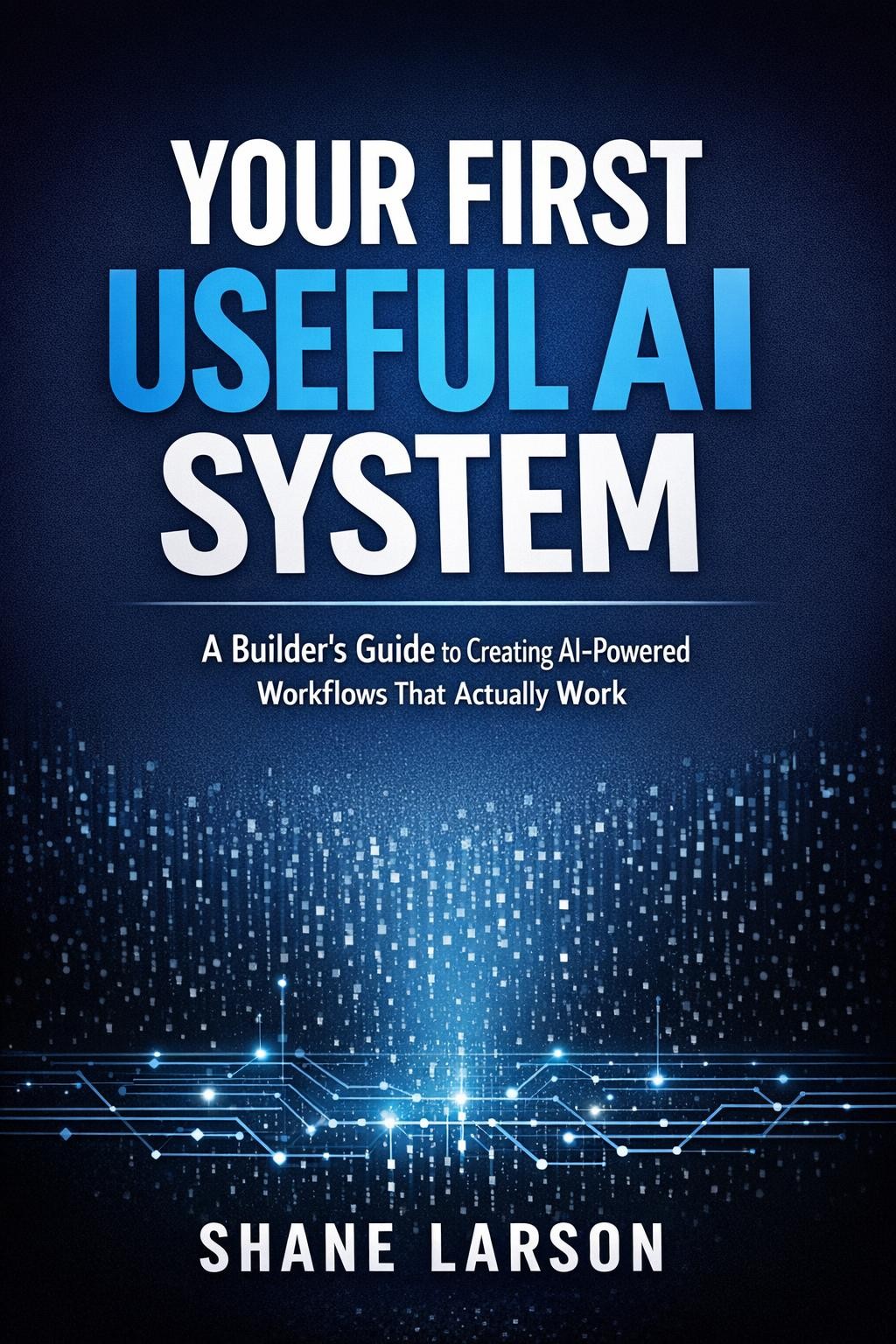
This article draws on Your First Useful AI System: A Builder's Guide to Creating AI-Powered Workflows That Actually Work , a practical guide that carries one small system — support-email triage — from a blank problem statement to a scheduled job with logs, alerts, a measured cost, and a feedback loop. Coming soon from Peak Grizzly Publishing.
Your First Useful AI System
New posts and releases, straight to your inbox. No spam, unsubscribe anytime.