Your AI Governance Framework Was Designed for a World That No Longer Exists
March 31, 2026 · 6 min read
There is a credit union that lost $340,000 in undetected fraud. Not because their fraud detection model was bad. The model worked. It was their governance process that failed.
The model was initially approved through an eight-week review. It performed well in month one. By month three, fraud patterns had shifted and the model's detection rate was declining. The data science team retrained the model in two days. Getting the retrained model through governance approval took another six weeks.
During those six weeks, fraudsters walked through the front door while the updated model sat on a shelf waiting for a signature.
This is not an edge case. It is the default outcome when you apply governance frameworks designed for quarterly software releases to AI systems that need weekly updates. And it is happening right now in financial services, healthcare, and government organizations across the country.
The Five Ways Traditional Governance Breaks Under AI
Traditional IT governance works for traditional IT. Enterprise software releases on predictable schedules. Database changes go through change advisory boards. Infrastructure modifications follow ITIL processes refined over decades. These frameworks solved real problems because the systems they governed changed slowly, behaved deterministically, and produced outputs humans could directly inspect.
AI systems are none of these things. They change continuously. They behave probabilistically. Their outputs emerge from mathematical relationships no human can directly inspect. When you apply governance designed for deterministic, slow-changing systems to probabilistic, continuously-evolving ones, the frameworks do not just become inefficient. They break in five specific, compounding ways.
The approval bottleneck is the most visible failure. Machine learning models degrade over time through model drift. They need frequent retraining. If every retrained version must pass through the same multi-week approval gates as a conventional software release, governance becomes a permanent bottleneck. Worse, it creates perverse incentives. Teams learn to avoid triggering governance. They stretch the definition of "minor update." They deploy "temporary" workarounds that bypass the process entirely. The framework intended to ensure oversight actually drives behavior underground where there is no oversight at all.
The documentation lag compounds the problem. A model risk assessment completed today may not accurately describe the model's behavior next week. Most organizations respond by requiring more documentation, more often. This is precisely the wrong response. Manual documentation cannot keep pace with systems that change continuously. You end up with governance teams spending most of their time writing documents that are outdated by the time they are finished.
The audit gap creates false confidence. A bank's lending model passes its annual validation with strong marks. Three months later, a shift in the applicant population changes the data distribution. The model's fairness metrics deteriorate. But the next validation is nine months away. The bank operates with a non-compliant model, protected by the false assurance of a passed audit that no longer reflects reality.
The expertise bottleneck means reviews miss what matters. A compliance officer cannot read a neural network's weight matrix and assess whether it will produce biased outcomes. A risk manager cannot look at a model's architecture and determine robustness to adversarial inputs. Organizations either hire scarce AI governance specialists or rely on existing teams who apply conventional frameworks to unconventional systems — and approve things they do not fully understand.
The scale problem makes all of it worse. An insurance company deployed 47 AI models, each retrained monthly. That is 564 model validations per year. At 40 hours per validation, their four-person team needed 22,560 hours of work against 8,000 available hours. The math was simple and devastating.
These failures compound. The approval bottleneck slows deployment. Stale documentation makes reviewers more cautious, feeding back into the bottleneck. The audit gap lets problems fester undetected, creating regulatory risk that makes governance more conservative, which intensifies the bottleneck further.
The Architecture That Actually Works: Continuous Compliance
The path forward is not to discard governance. AI systems that make consequential decisions about people's health, finances, and public services need more governance, not less. But they need governance designed for what they actually are.
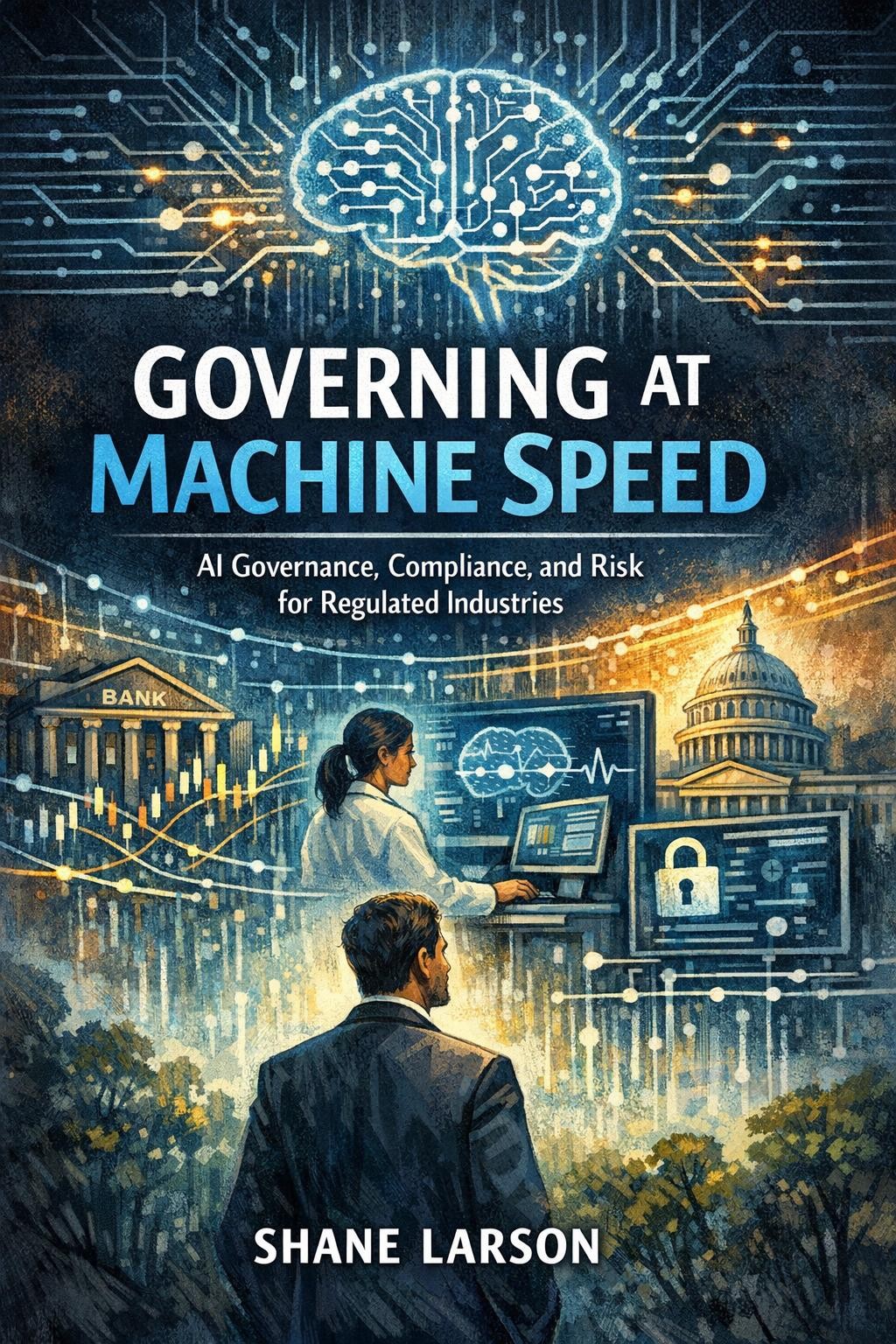
Governing at Machine Speed
The core architectural shift is from point-in-time compliance to continuous compliance. Instead of an auditor arriving once a year to check a system that has been running unsupervised, you build always-on monitoring that verifies compliance every minute of every day.
This changes the auditor's question from "is this system compliant?" to "is your monitoring system reliably detecting non-compliance?" The audit does not disappear. It transforms from the primary mechanism of compliance assurance into a verification that your continuous monitoring infrastructure actually works.
The architecture has four layers:
Data collection captures every AI decision with full context — inputs, outputs, feature importance, confidence levels, alternative outcomes considered. This is not application logging. It is decision telemetry, and without it, you are monitoring shadows on a wall.
Monitoring and analysis operates at three levels. Statistical monitoring tracks aggregate metrics over rolling windows to detect gradual drift. Rule-based monitoring evaluates individual decisions against regulatory constraints in real time. Pattern-based monitoring uses machine learning to detect anomalies too subtle for rules and too rapid for statistics.
Alerting and escalation converts monitoring signals into organizational responses, with severity-based routing that gets the right issue to the right person at the right speed.
Audit and reporting provides continuous evidence of compliance status, replacing the scramble to assemble evidence for the annual audit with an always-current compliance dashboard.
A health insurer deployed all three monitoring levels for its AI prior authorization system. Statistical monitoring tracked approval rates by demographics and diagnosis. Rule-based monitoring verified every denial included required clinical rationale. Pattern monitoring caught an unusual cluster of denials at a specific hospital that turned out to be a data quality issue — something the other two layers missed because aggregate numbers looked fine and individual denials were technically valid.
No single layer catches everything. The layers work together.
Using AI to Audit AI — Without the Fox Guarding the Henhouse
Here is the part that makes governance professionals uncomfortable: the only practical way to govern AI systems at scale is with other AI systems.
A human audit team examining a lending model might review a thousand decisions — roughly 0.03 percent of annual volume. Any compliance issue affecting a small subpopulation or developing gradually will fall outside the sample. An AI audit system evaluates every decision. One hundred percent coverage eliminates sampling risk entirely.
The objection that this amounts to AI "marking its own homework" is valid when the audit system shares architecture, training data, or development teams with the system it audits. It is far less valid when you implement proper independence architecture: organizational independence (separate teams, separate reporting lines), technical independence (separate infrastructure, separate data pipelines), and methodological independence (different modeling approaches, so the audit system does not share the production system's blind spots).
A healthcare system implemented a deep neural network for diagnostic recommendations and deliberately chose a rule-based system augmented with statistical analysis for the audit function. The neural network was good at recognizing complex patterns but poor at explaining reasoning. The rule-based audit was good at checking against clinical guidelines but would have missed the complex patterns. Together, they provided more robust governance than either could alone.
The practical implementation follows a four-level progression. Start with automated rule-based checks — deterministic rules applied to decision data. Add statistical monitoring for trend detection. Deploy purpose-built ML audit models for deeper analysis. Graduate to adversarial testing that actively probes production models for weaknesses.
Start at Level 1. The organizations that try to leap to Level 4 get complexity without value.
The organizations that win the AI race in regulated industries will not be the fastest or the most compliant. They will be the ones that figured out how to be both. That requires governance architecture that operates at the same speed as the systems it governs — not faster, not slower, but at machine speed.
Governing at Machine Speed
New posts and releases, straight to your inbox. No spam, unsubscribe anytime.