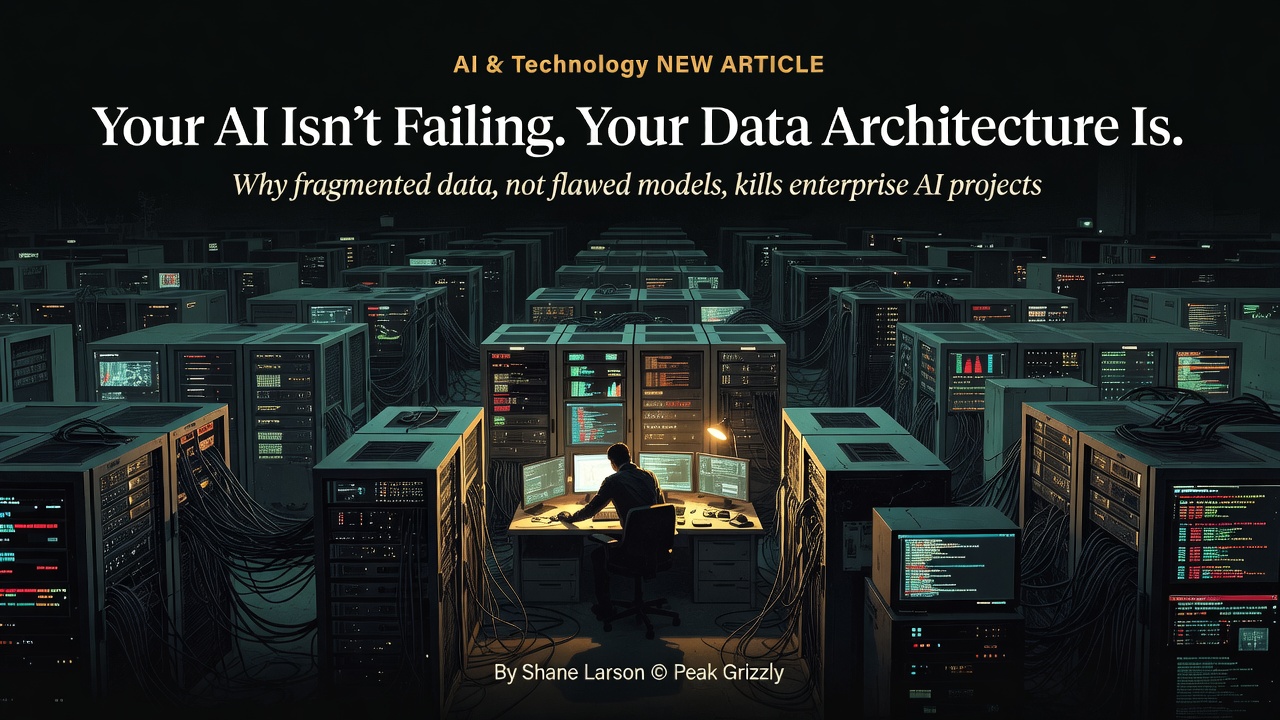
Your AI Isn't Failing. Your Data Architecture Is.
July 30, 2026 · 7 min read
I have looked at a lot of failed AI initiatives, and I want to tell you the single most useful thing I have learned, because it will save you a great deal of money and embarrassment: when an enterprise AI project dies, the autopsy almost never says "the model wasn't good enough." It says something else entirely, and if you learn to hear it, you will stop investing in the wrong things.
Here is what the honest postmortem actually says. It says the training data lived in six different systems that didn't agree on what "customer" meant, so the model learned from a picture of the business that no single part of the company would have recognized — one system treated a customer as an account holder, another as a household, a third as a transaction counterparty, and the resulting feature set was a Frankenstein of mismatched identifiers. It says the retrieval pipeline was serving documents that were months out of date, because it turned out nobody actually owned the job of keeping the index fresh; the source systems kept updating, but the crawler had no schedule and no owner, so relevance quietly decayed. It says the vector store that performed beautifully in the demo, with ten thousand records, quietly collapsed at a hundred million in production because the indexing strategy that worked for small scale produced unacceptable query latency once partitions and filtering entered the picture. It says the compliance team discovered the pipeline existed only after it shipped — and then discovered it had been training on data the company had no legal right to use because consent flags and retention rules lived in a separate system that was never consulted. It says the bill arrived and nobody could explain it, because token usage, embedding calls, and re-indexing jobs were all metered separately with no single place tracking the cumulative cost.
In every one of those cases, the model was fine. The data architecture underneath it was not. And that is the thesis I want to plant in your head: AI, at the scale where it either creates value or embarrasses everyone, is a data architecture problem wearing a machine-learning costume.
The Costume Gets All the Attention
The costume is doing a lot of work to distract us. The public conversation about AI is almost entirely a conversation about models — which one is smartest, which benchmark it topped, how many parameters it has. That conversation isn't wrong, but it has created a dangerous blind spot in exactly the places where AI actually gets built, because it trains organizations to believe the hard, valuable, worth-investing-in part is the model. The pattern is familiar from earlier technology shifts: when relational databases first arrived, the excitement centered on query languages and optimization algorithms while the real work of consistent schemas, indexing strategies, and backup discipline received far less attention until the first production outages made the imbalance obvious.
Here is the uncomfortable truth about that belief: the model is increasingly a commodity you rent. You can call a frontier model by the token. So can your competitor — the same model, on someone else's improvement schedule. The model you build on today is next year's baseline. Betting your AI strategy on a specific model is building on sand. What you cannot rent, what you actually have to build, and what determines whether any model you rent delivers value, is the data foundation underneath it. And when you pull the costume off and look at the body, you find that nearly every "AI problem" is a data problem in disguise. "The model hallucinates" is very often "the retrieval layer fed it the wrong context" because the top-ranked chunks came from policy documents that had been superseded three months earlier. "The model is biased" is very often "the training data was skewed and nobody checked" — for instance, a customer-support model trained only on tickets from one region because that region's logs were the easiest to export. "The AI is too slow" is very often "the data assembly at inference time blew the latency budget" when feature joins that looked trivial in a notebook turned into multiple round-trips across services. "We can't ship it in our regulated business" is very often "we can't prove what data the model saw, or control who its outputs expose" because the inference path had no immutable log of inputs or outputs. None of those are machine-learning problems. They are data architecture problems, solved — or not — by design decisions an architect makes.
That is a warning, but it is mostly an opportunity. Because if most AI failures are data failures, then the person who fixes the data foundation holds the highest-leverage position in the entire AI effort. The foundation is not a supporting act to the "real" AI work. It is the real work.
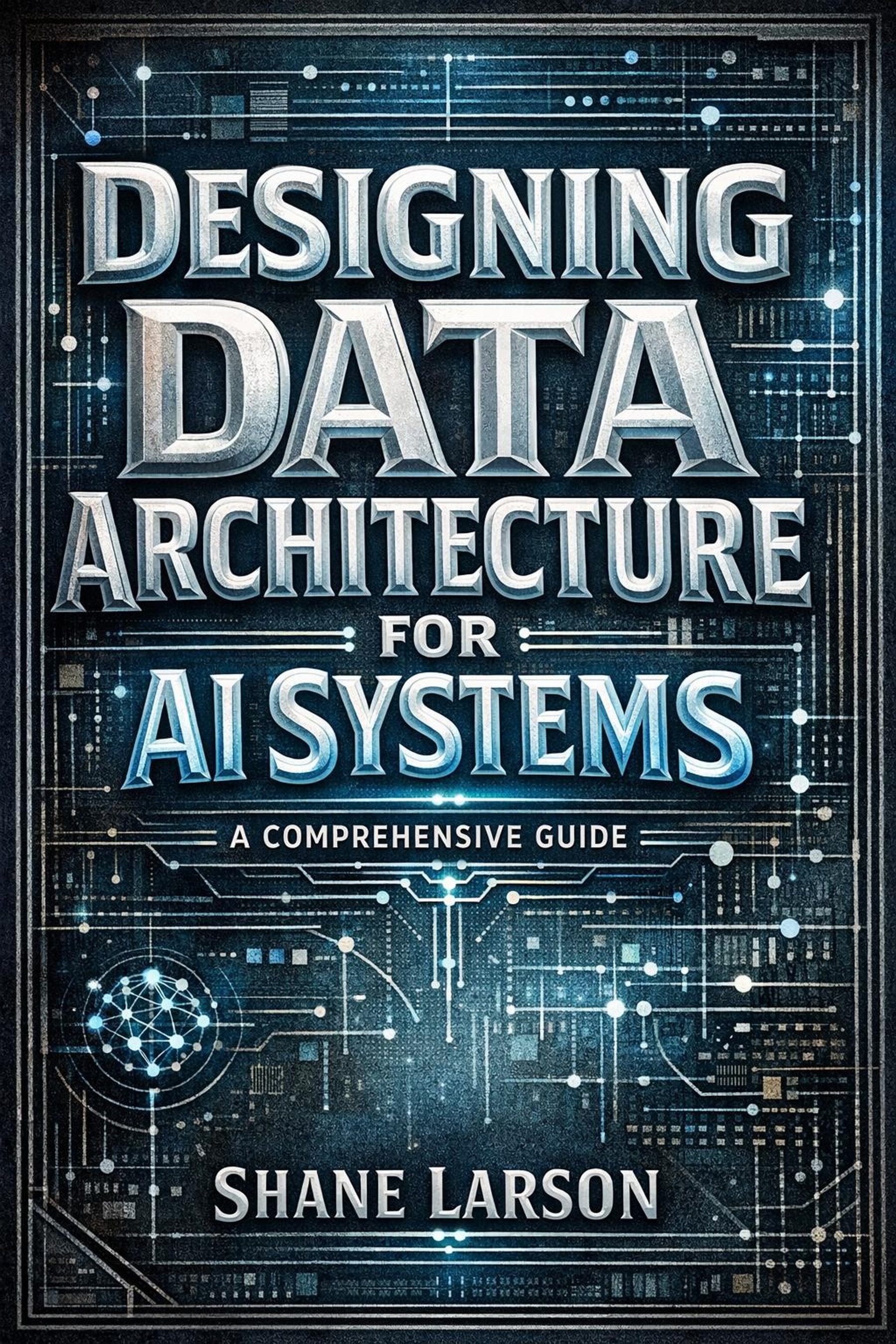
Designing Data Architecture for AI Systems
The One Distinction That Prevents Most Incidents
If I could give an architecture team just one idea from the book, it would be this: training, inference, and RAG are three different pipelines, not one. Treating them as a single undifferentiated "data pipeline" is the most common — and most expensive — design error in enterprise AI, and it causes a startling share of production incidents.
They are different because they occupy opposite corners of the same tradeoff space. A training pipeline is typically batch and throughput-oriented; nobody is waiting on it, so it can take its time. But it lives or dies on reproducibility: six months from now, when the model behaves strangely or an auditor asks, you must be able to reconstruct the exact dataset it trained on. A warehouse that overwrites yesterday's data with today's is actively hostile to that requirement; the correct pattern is immutable snapshots or explicit versioning so the training run can be replayed exactly. An inference pipeline is the opposite. It runs while a user waits, so it is defined by a strict latency budget — everything the data layer does to assemble the model's inputs happens on the critical path, measured in milliseconds. And it must produce features consistent with what the model saw in training, or you get training/serving skew: a silent, corrosive failure where the same feature is computed differently at training and serving time, quietly degrading the model with no error anywhere. A RAG pipeline — the data engine behind retrieval-augmented generation — has its own distinctive demands: freshness (keeping the index true to constantly changing source documents, which is where "nobody owned freshness" bites), chunking strategy (an architectural decision, not a default — fixed-size chunks may split mid-sentence while semantic chunking preserves meaning but costs more to compute), relevance, and — critically in an enterprise — access control enforced at the retrieval layer, because a RAG system that surfaces restricted documents into an answer is a security incident. Freshness, latency, lineage, reproducibility: the three pipelines pull these dimensions in different, sometimes opposite, directions. A pipeline tuned for one is wrong for the others. Build each to its own requirements, and a whole category of production failure simply never happens. Blur them together, and you will meet all of those failures at once.
Design the Foundation, Not the Model
The rest of the work follows from taking the foundation seriously. Data quality stops being a cleanup task and becomes an architectural property you design for, with data contracts, validation at ingestion boundaries, clear ownership, and observability — because "garbage in, confident garbage out" is far more dangerous when the output is a fluent falsehood or an autonomous action than when it's a wrong number on a dashboard. A contract that declares the expected schema, freshness SLA, and allowed values for a customer identifier prevents the silent mismatch that later appears as model drift. Vector infrastructure stops being "install a vector database" and becomes a real engineering problem of recall-versus-latency-versus-cost tradeoffs, filtering, multi-tenancy, and the re-embedding bill nobody budgets for; when source documents change, the cost of re-embedding every affected chunk can exceed the original indexing cost if the system was not designed with incremental updates in mind. Governance stops being after-the-fact paperwork and becomes a design input: architecting so that lineage, access control, and audit evidence are byproducts of the system rather than a scramble when the examiner arrives. And cost stops being a surprise and becomes a first-class dimension, because the second postmortem after quality is always the bill.
I wrote the book this post is drawn from because I live this from the architect's seat — I design data-intensive platforms inside a heavily regulated financial institution, where lineage and audit questions are my Tuesday — and because the book I wanted did not exist. The data-engineering classics predate the AI-workload shift; the ML books assume the data platform already exists; the vendor content sells products. Nobody had written the vendor-neutral, design-level guide to the data architecture that AI specifically demands, from the seat of the person actually responsible for building it.
The through-line, and the note I'll end on, is the one that should change how your organization spends: the model is temporary, and the data architecture is the asset. Models will keep changing — every few months, better than the last. The organization that pours its energy into chasing them while running on a broken foundation will keep writing the same postmortem. The one that invests in the foundation can put any model on top and have it work: this year's, and next year's, and the one after that. Build the thing underneath. It's the only part of your AI stack that appreciates.
Designing Data Architecture for AI Systems
New posts and releases, straight to your inbox. No spam, unsubscribe anytime.