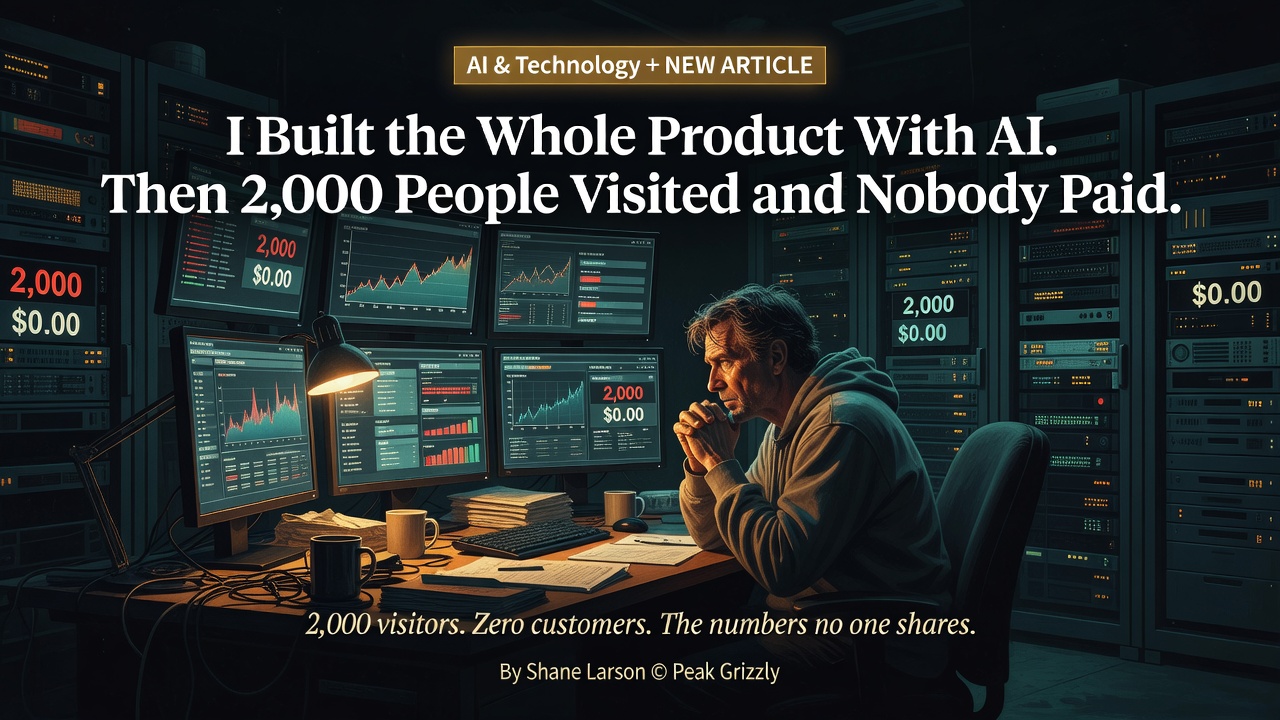
I Built the Whole Product With AI. Then 2,000 People Visited and Nobody Paid.
August 5, 2026 · 5 min read
Here is the part of the AI-built-a-business story that usually gets left out.
After a week of running ads:
- ~2,000 visitors
- ~50 signups — a 2.5% signup rate
- ~10 people who actually used the product
- 0 payments
Two thousand people arrived. None of them paid anything.
The software was not the problem. The software worked. It had been built almost entirely through AI agents, it deployed, it handled real traffic, payments were wired up and functioning, analytics were in place. By every measure that the "you can build a product without traditional coding" genre cares about, it was a success.
And it converted nobody. The gap between a working product and a working business showed up immediately in the numbers, and those numbers refused to move no matter how cleanly the backend ran.
What Vibe Coding Actually Delivers
I want to be fair about this, because the capability is real and I am not walking it back.
Building the thing genuinely got easy. Working through a structured agent workflow — planning tasks, implementing one at a time, rebuilding when the architecture turned out wrong — produced a functioning SaaS product without me writing conventional code. The full rebuild, which in a normal project would be the moment you decide to live with your mistakes instead, was cheap enough to just do. I could spin up a new database schema, adjust the API routes, and redeploy the whole stack in the same afternoon the feedback arrived.
Payments, analytics, monitoring, the maintenance work that usually eats a side project — all of it took a fraction of the time it would have taken five years ago. Logging and error tracking that once required days of setup now sat in place after a single prompt cycle. That is a real change and it is not marketing. The cost of producing software has fallen enormously.
The mistake is assuming that was the binding constraint.
The Constraint Was Never the Code
Traffic without conversions is the most expensive form of market research, and it is very good market research, because it tells you exactly where you are wrong.
The funnel leaked everywhere. 97.5% of visitors never signed up, which is a message about the landing page and, underneath that, about whether the offer was legible in five seconds. The headline and subhead never made the core benefit obvious to someone scanning on a phone. 80% of the people who did sign up never used the product once, which is a message about onboarding and about the gap between what they thought they were getting and what they found. The welcome email sequence and empty-state screens did not guide anyone through the first meaningful action. And of the people who used it, none valued the result enough to pay. Each of those is a different problem. None of them is fixed by better code.
That is the actual lesson, and it is not new — it is the oldest lesson in software, restated for a world where the build step got cheap. When building was hard, the build step felt like the risk, and shipping felt like an accomplishment. Now that building is easy, the risk is exposed: nobody wanted it at that price, and I found that out after building it rather than before.
What I Got Wrong
Four things, in order of how much they cost.
The Vibe Coded SaaS
I built infrastructure before I knew the product worked. The agent workflow, the tooling, the whole machinery — set up before there was any evidence anyone wanted the output. It felt like progress because it was measurable and I was good at it. Validation could have happened with something far cruder, like a single shared Google Sheet or a manual email workflow that mimicked the future product. Instead the infrastructure sat ready for users who never arrived.
I polished before testing. The first version people saw was too finished. Rough versions surface problems earlier, because a rough version invites the feedback "I don't understand what this is," which is the feedback you need. A polished version invites politeness. People smiled, said it looked nice, and left without ever revealing the real confusion.
I over-engineered the payment model. The simplest version was per-image. I built subscriptions before establishing that anyone would pay anything at all. Subscription infrastructure is a bet on retention, made before I had acquisition. A one-time charge would have let me test price sensitivity without also asking users to commit to monthly use they had not yet experienced.
I underestimated marketing by an enormous margin. This is the big one. I assumed the hard part was building and the rest would follow. Building was the easy part by a wide margin, and I had no comparable capability on the other side. The ad copy, audience targeting, and follow-up sequences all required skills that did not improve just because the code shipped faster.
Notice that the AI made the first three mistakes cheaper to make and therefore easier to make. When infrastructure is expensive, you think hard before building it. When it takes an afternoon, you build it, and you skip the thinking that the expense used to force.
Low friction is not free. It removes the natural checkpoint where you ask whether this should exist.
Where This Leaves the Approach
I would use the same method again, with the order reversed.
Find out whether anyone wants the thing first, using the crudest possible artifact — a landing page, a manual version you operate by hand, a conversation with ten people who have the problem. Get to the payment question as early as it can be asked, because willingness to pay is the only signal that is not politeness. A simple Stripe checkout link on a one-page site can answer that question in a day.
Then, once something is actually pulling, use the AI workflow to build it properly. That is where the capability genuinely shines: not in reducing the risk of the venture, but in collapsing the time between knowing what to build and having it.
The honest summary is that vibe coding solved a real problem I had, and the problem I had was not the one stopping me.
Building a product is now a solved problem for a solo operator. Getting anyone to care is exactly as hard as it has ever been, and there are now a great many more products competing for the same attention, because everyone else's build step got cheap at the same time.
The Vibe Coded SaaS: How I Built a Real Business Using AI Agents, Claude Code, and Zero Traditional Coding is the full record — the workflow, the rebuild, payments and analytics, the ad experiment, the conversion failure, the iterations that followed, and what I would do differently.
The Vibe Coded SaaS
New posts and releases, straight to your inbox. No spam, unsubscribe anytime.