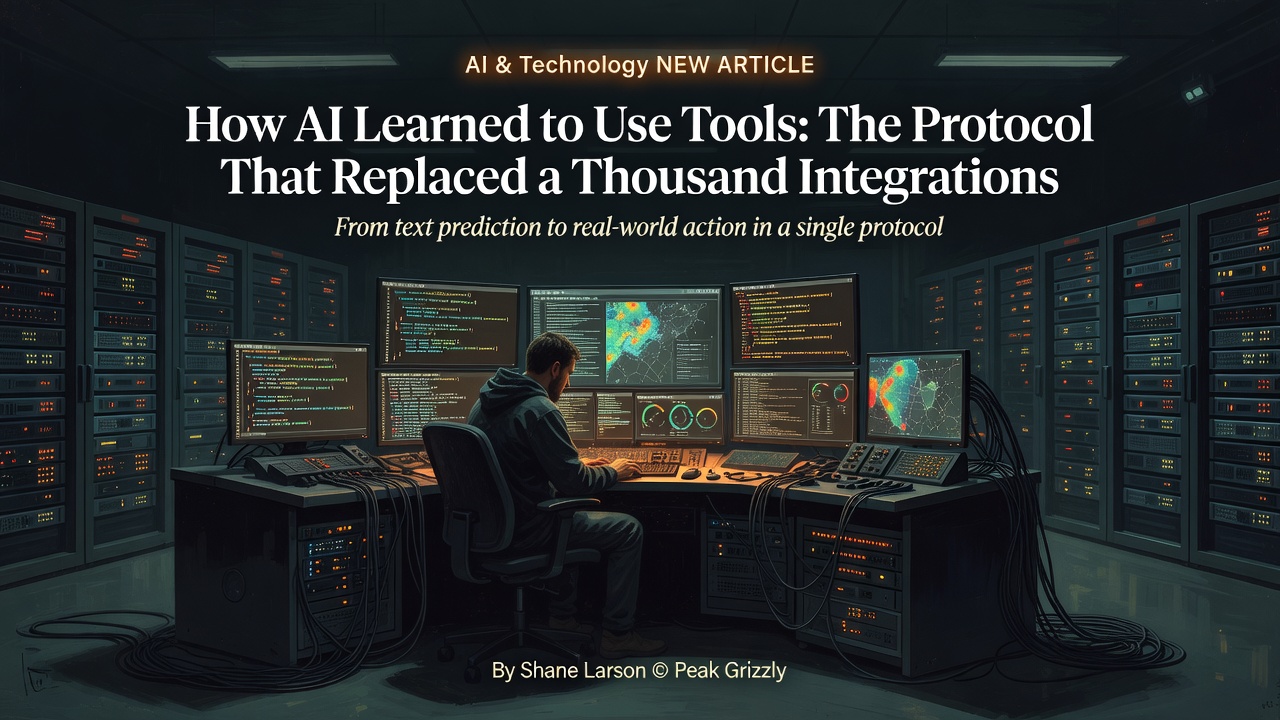
How AI Learned to Use Tools: The Protocol That Replaced a Thousand Integrations
March 25, 2026 · 6 min read
In 2023, the most capable AI systems ever built could explain quantum mechanics to a ten-year-old and draft a merger agreement for a Fortune 500 company. They could not check the weather.
This was not a bug. It was a fundamental architectural constraint. Large language models are text prediction engines. They take tokens in and predict the next token out. Everything impressive they do -- writing, reasoning, coding -- is an emergent property of that prediction process. But the process is self-contained. The model does not reach out to external systems. It does not query databases, read files, or call APIs. It predicts the next word based on what it has already seen, and nothing else.
The most capable AI in the world was, functionally, isolated. It could discuss your calendar but not read it. It could describe how to query a database but not run the query. It knew, in a statistical sense, how the world worked. But it could not interact with it.
The industry threw everything at this problem. Function calling. Plugins. Framework abstractions. RAG pipelines. Every solution worked for one specific context and created a new problem for everyone else. Then Anthropic released the Model Context Protocol, and the fragmentation started to collapse into something coherent.
The Integration Tax Everyone Was Paying
Before MCP, building a serious AI application meant paying an enormous integration tax. You wanted your AI to access a database, read files, call external APIs, and interact with business systems. For each capability, you had to choose an integration approach, write a connector for your specific model provider, handle authentication, manage errors, test it end-to-end, and maintain it as APIs evolved.
Multiply that by every tool your application needed -- database connector, file system reader, Slack integration, GitHub client, calendar interface -- and the integration work quickly dwarfed the actual application logic. Developers were spending more time building plumbing than building products.
The real problem was not just the effort. It was the waste. The Slack connector built by Team A could not be used by Team B. The database tool written for Application X had to be rewritten for Application Y. The industry was doing the same work thousands of times, in thousands of slightly different ways, with no accumulation of shared capability.
OpenAI's function calling worked but was provider-specific. A function you wrote for the OpenAI API would not work with Claude, and a tool definition for Claude would not work with Gemini. ChatGPT plugins tried to standardize at the product level but failed within a year -- they were locked inside one product and nobody could use them anywhere else. LangChain standardized at the framework level, which just traded model lock-in for framework lock-in. Your tools were portable across providers but only if everyone used LangChain.
What the industry needed was not another library. It needed a protocol. A library gives you tools within your application. A protocol gives you tools that any application can access.
What MCP Actually Is (And Why "USB-C for AI" Is Not Hype)
MCP is a client-server protocol. An MCP server exposes capabilities -- tools, resources, prompts -- through a standardized interface. An MCP client (typically embedded in an AI application) connects to servers and makes their capabilities available to the model. The host application orchestrates the whole thing.
The architecture has three layers. Servers are where capabilities live. A Postgres MCP server exposes database query tools. A GitHub MCP server exposes repository operations. A Slack MCP server exposes messaging tools. Each server is a standalone process that speaks the MCP protocol. Clients connect to one or more servers, discover what capabilities are available, and present them to the AI model as available tools. Hosts are the applications users interact with -- Claude Desktop, Cursor, VS Code, or your custom application.
The MCP Protocol
The USB-C analogy is overused but accurate. Before USB, every peripheral had its own connector, driver, and protocol. Printers used parallel ports, mice used PS/2, external drives used SCSI. If you wanted to connect a new device, you needed the right port, the right cable, and the right driver. USB replaced all of that with a single standard. One port, one cable, one protocol.
MCP does the same thing for AI tool integration. Before MCP, every AI tool connection required a custom integration for a specific model provider and a specific application. After MCP, you build a server once and any MCP-compatible application can use it. The Postgres MCP server works in Claude Desktop, in Cursor, in VS Code, and in any custom application that implements an MCP client. Build once, use everywhere.
The protocol defines four primitives. Tools are model-controlled functions that perform actions -- the model decides when to call them. Resources are application-controlled data sources -- the host decides when to fetch them. Prompts are reusable templates that structure common interactions. Sampling lets servers request LLM completions through the client, enabling servers to use AI capabilities without managing their own model connections.
Tools are where most of the action is. When Claude reads a file from your hard drive, queries your database, creates a GitHub issue, or sends a Slack message, it is using MCP tools. The tool definition includes a name, a description (which is what the model reads to decide when and how to use it), and a JSON Schema for the input parameters. The description is the most important element -- a bad description is the single most common cause of tools not working correctly.
The Ecosystem Is Already Here
MCP is not a speculative standard. It is already adopted by Claude Desktop, Cursor, VS Code, Windsurf, and dozens of other tools. The open-source ecosystem has hundreds of MCP servers covering databases, developer tools, cloud platforms, and productivity applications. Anthropic maintains a directory, and community contributions are growing fast.
This is the network effect that killed every previous standardization attempt. Plugins failed because they were locked to one product. Framework tools failed because they were locked to one framework. MCP servers are standalone processes that any compatible client can use. Every new server makes every client more useful. Every new client makes every server more valuable.
The security model is worth understanding because it is the part most people skip. MCP introduces real attack surface. A malicious MCP server could exfiltrate data, perform unauthorized actions, or inject instructions into the model's context. The protocol addresses this with capability negotiation (servers declare what they can do, clients consent to what they allow), transport security, and a trust model that puts the user in control. But the confused deputy problem -- where a trusted server is tricked into acting on behalf of an attacker via prompt injection -- remains an open challenge. If you are deploying MCP in production, the security chapter of the spec is not optional reading.
For developers building AI-powered applications, MCP changes the economics fundamentally. Instead of building every tool integration from scratch, you connect to existing MCP servers. Instead of building tool integrations that only work with one model, you build against a standard that works with any compatible client. The integration tax drops by an order of magnitude, and the time you save goes into building the actual product.
The MCP Protocol
New posts and releases, straight to your inbox. No spam, unsubscribe anytime.