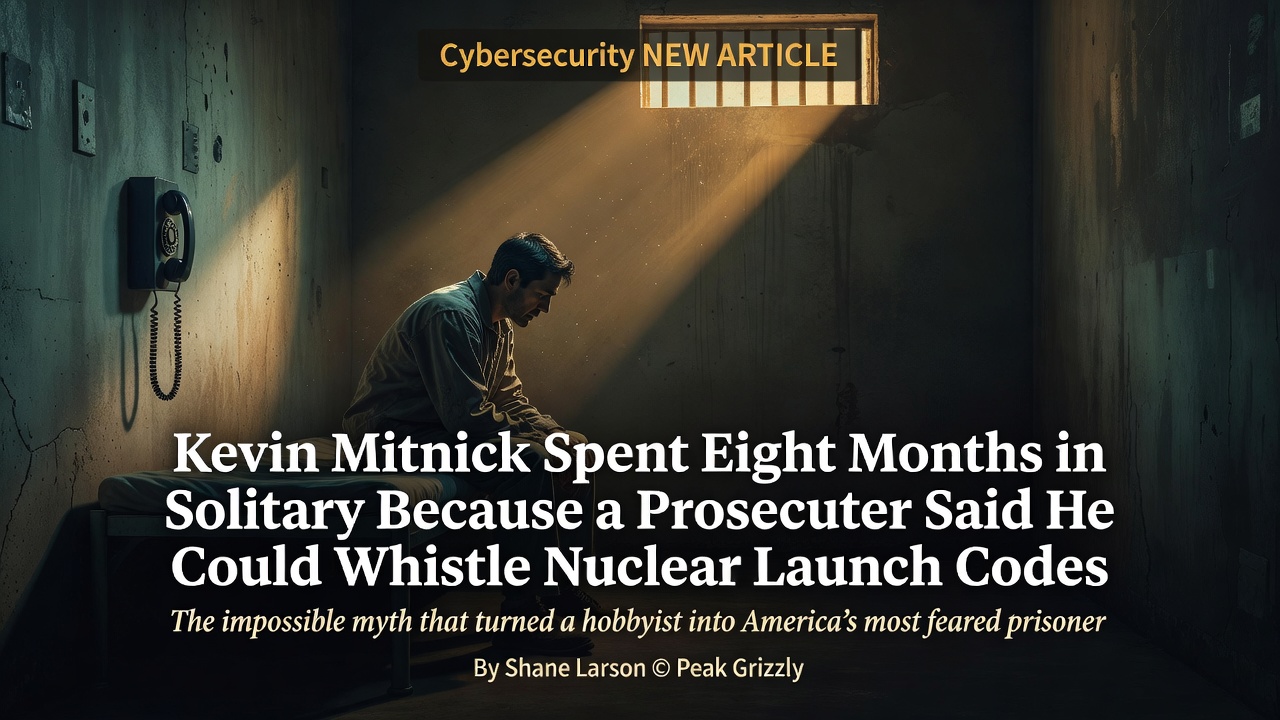
Kevin Mitnick Spent Eight Months in Solitary Because a Prosecutor Said He Could Whistle Nuclear Launch Codes
July 16, 2026 · 6 min read
In the mid-1990s, a federal judge in California kept a prisoner in solitary confinement for eight months and denied him a bail hearing for years. The prisoner was not a murderer or a terrorist. He was a thirty-one-year-old computer hobbyist named Kevin Mitnick, and one of the reasons for his extraordinary confinement was a claim, made in court by a federal prosecutor and apparently believed by the judge, that Mitnick could pick up a telephone, whistle a precise sequence of tones into the mouthpiece, and cause a nuclear missile to launch.
Let me be clear about this, because it matters: that is impossible. It has never been possible. There is no telephone, no whistle, and no sequence of tones on Earth that connects to a nuclear launch system, and every engineer who heard the claim knew it was nonsense. It was the kind of thing you'd expect from a bad movie, not a federal courtroom. And it worked. It helped keep a man in a cell, alone, for the better part of a year.
That single absurdity is the doorway into the real Kevin Mitnick story — because almost everything the public believes about the most famous hacker who ever lived is closer to the whistling claim than to the record. I wrote a book to sort the two apart, and the gap turned out to be the whole point.
The Crimes That Made No Money
Start with what he actually did. Over roughly a decade, Kevin Mitnick broke into the computer systems of some of the largest technology companies in the world — Digital Equipment Corporation, Motorola, Sun Microsystems, Nokia. He copied source code, the closely guarded blueprints of their software. In the language of the indictments, he stole intellectual property valued in the millions of dollars.
Now the part the legend leaves out. He never sold any of it. He never sabotaged a single system. He never used the stolen code to harm a company or a person, never drained a bank account, never made a dollar. He copied the code, studied it, kept it, and showed it around the hacker underground for status — the way a fisherman keeps a photo of the big catch. The "millions of dollars" in the charges were mostly the companies' own costs of investigating and responding to him, not anything he gained. His personal profit from a decade as America's most-wanted hacker was, as near as anyone can determine, zero.
So what was he actually doing? He was a compulsive intruder. He broke in because he could, and because the act of breaking in — specifically, the act of talking his way in — gave him a thrill nothing else in his life did. Understanding that compulsion, rather than assuming a criminal mastermind's greed, is the first correction the record forces on you.
His Superpower Was a Phone Call
Here is the second, and it's the one that actually matters for your life today: Kevin Mitnick's genius was never really about computers. It was about people.
The technical legend imagines a keyboard virtuoso typing furiously through cascading green code. The reality was a man on a telephone, sounding calm and slightly bored, saying he was from the IT department and needed to verify an account. Mitnick's true craft was social engineering — manipulating human beings into breaking their own security rules — and he was, by broad agreement, the best who ever did it.
His method was rarely a single brilliant exploit. It was a patient stack of small, mundane deceptions. One phone call to a company's front desk got him a few employee names. A second call, now armed with those names and dropped casually into the conversation, got him the internal jargon — the project names, the system nicknames, the way real insiders talked. A third call, to a harried employee, used the names and the jargon to sound so thoroughly like a colleague that the employee reset a password or read back a dial-up number without a second thought. Assembled, a dozen harmless-seeming facts became total confidence, and confidence opened doors no firewall could hold shut.
Kevin Mitnick
His first "hack" tells you everything. As a lonely kid in Los Angeles, before he ever touched a computer, Mitnick beat the city bus system — not by forging anything clever at first, but by befriending a driver to learn where transfer punches were sold, then dumpster-diving unused transfer slips and riding the whole city for free. He didn't break a machine. He talked a person into revealing how the machine worked, then exploited the human system around it. Everything he ever did was that trick, scaled up.
This is why he matters now. Every phishing-awareness email your employer sends you, every "the human is the weakest link" training slide, every red-team engagement where consultants try to talk their way into your building — all of it descends from what Mitnick spent thirty years proving. The industry poured billions into technical defenses while he kept demonstrating, intrusion after intrusion, that the reliable way in was to ask a trusting person nicely. The lesson has a brutal corollary that remains true today, through business email compromise and deepfake-voice fraud and every scam in your inbox: you cannot patch a human being.
The Story Told by the People Who Caught Him
The third correction is about the story itself. The dominant public account of Mitnick — the version that became a bestselling book and a movie — came primarily from two men: the security researcher whose systems Mitnick breached in 1994, and the newspaper journalist whose front-page reporting had already made Mitnick a household villain. They co-wrote the triumphant narrative of the 1995 takedown.
Think about that arrangement for a moment. The definitive story of a man's capture was written by the person he embarrassed and the person who built his myth, and it was written to celebrate their victory. That doesn't make it false. But it makes it exactly the kind of source a careful account should weigh rather than repeat — winners narrating their own win. Much of what "everyone knows" about Kevin Mitnick traces back to that single, deeply interested telling, and it hardened into fact through thirty years of repetition. A large part of my book is simply reading it with the skepticism any such source deserves.
Set the interested narratives aside — the prosecutor's whistling claim, the pursuers' bestseller, the boogeyman headlines — and a smaller, sadder, more human figure emerges. A gifted, compulsive outsider who broke rules for the thrill and not for gain; who was held for years without the hearings the Constitution promises; who became, improbably, a civil-liberties cause under the "Free Kevin" banner; and who then walked out of prison and spent his third act as one of the most respected security consultants in the world, embraced by the industry that had once helped cage him, before his death in 2023.
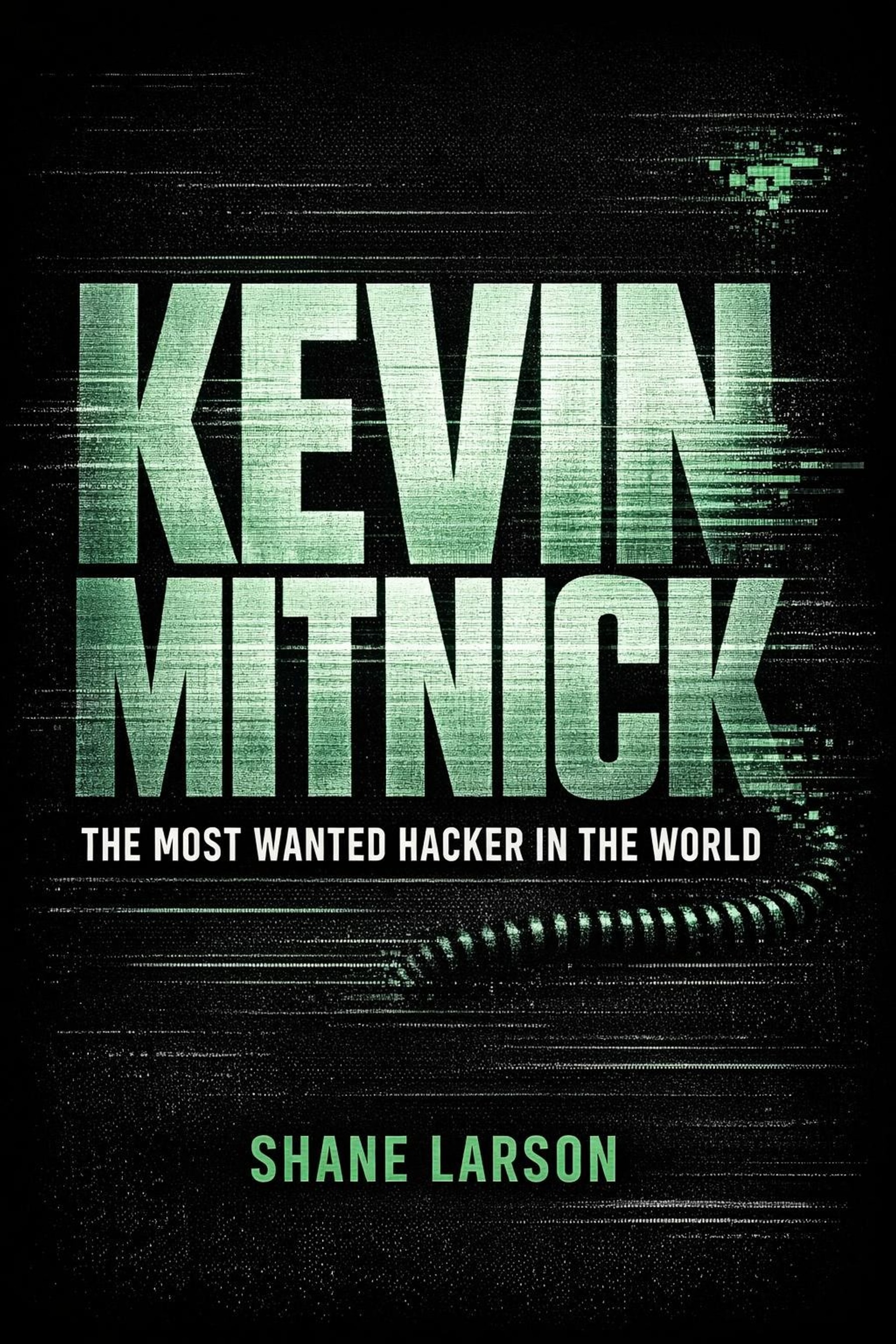
My new book, Kevin Mitnick: The Most Wanted Hacker in the World, is the full, corrected life — the bus-transfer kid, the phone-phreak underground he came up through, the intrusions, the fugitive years, the takedown told critically, the imprisonment, the redemption, and the legacy that shapes how every organization on earth now thinks about its own people. It's the anchor of my Digital Outlaws series, and it exists because the most famous hacker in history deserved, at last, to be described accurately.
Kevin Mitnick
New posts and releases, straight to your inbox. No spam, unsubscribe anytime.