How a Graduate Student's Mistake Created the Template for Every Cyberattack Since
October 5, 2026 · 7 min read
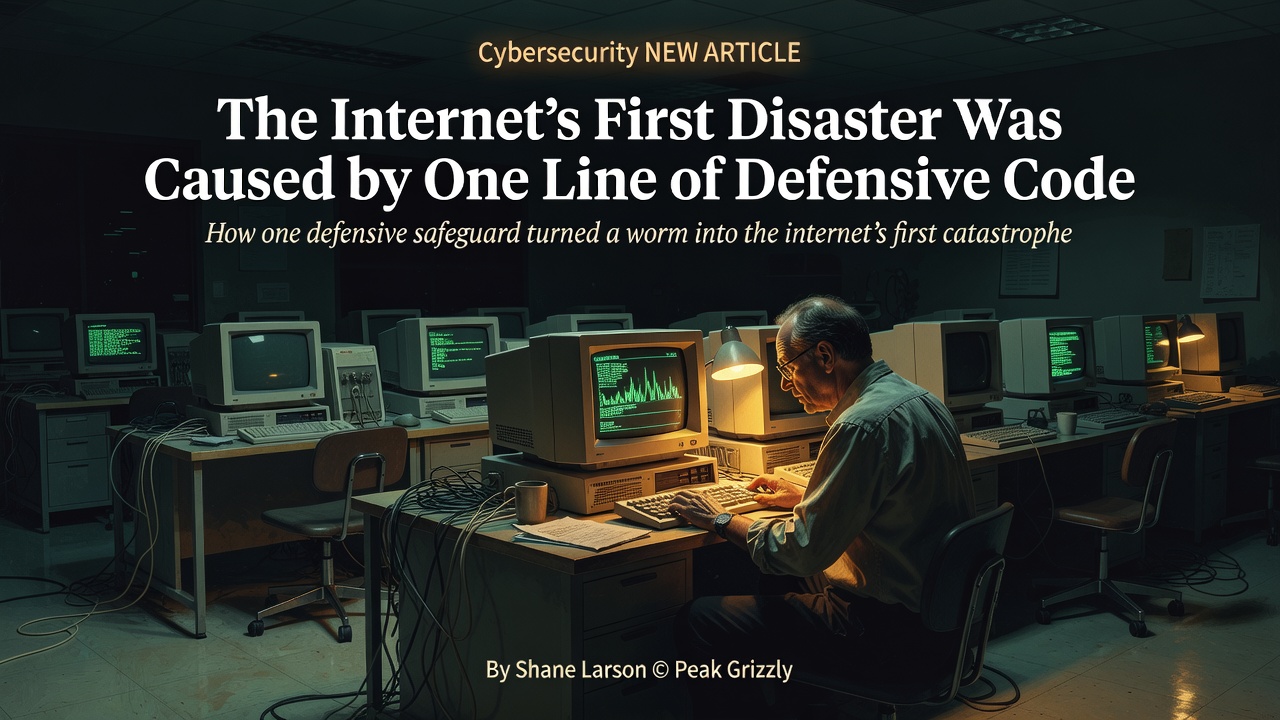
On the evening of November 2, 1988, computers across the United States started behaving strangely. Machines at MIT slowed to a crawl. Systems at UC Berkeley ground to a halt. At the Rand Corporation, administrators watched helplessly as their computers became unresponsive. Within hours, roughly ten percent of the entire internet — about six thousand machines — had been infected by a self-replicating program that nobody could identify, nobody could stop, and nobody could trace.
The person responsible was a 23-year-old Cornell graduate student named Robert Tappan Morris. His father was a cryptographer at the NSA. His intent was not malicious. He wanted to measure the size of the internet — a reasonable question in 1988, when nobody had a clear picture of the network's total scope. His approach was to write a program that would copy itself from machine to machine, exploiting known vulnerabilities in Unix systems. By tracking where it spread, he could estimate how many computers were connected.
The idea was not inherently destructive. But a single design decision turned an experiment into a catastrophe — and in the process, created a template that nearly every major cyberattack has followed since.
The One-in-Seven Mistake
The Morris Worm exploited three categories of weakness: a software configuration error in the sendmail program, a buffer overflow bug in fingerd, and weak passwords that could be guessed by brute force. These three categories — misconfigured software, programming bugs, and weak human behavior — would become the holy trinity of cyberattacks. Nearly four decades later, the most sophisticated nation-state operations still exploit the same three types of vulnerability. The technology changes. The underlying problems do not.
Morris designed the worm to be stealthy. It included code to prevent infecting the same machine twice — if a machine was already infected, the worm would check and move on. But Morris worried that system administrators might create fake positive responses to trick the worm. So he programmed it to re-infect machines one out of every seven times, even if they reported an existing infection.
That single parameter — one in seven — was the difference between an invisible measurement tool and a program that crashed a tenth of the internet. Busy machines, the ones most central to the network, accumulated dozens and then hundreds of copies of the worm. Each copy consumed processing power. Each spawned new copies. The exponential growth overwhelmed systems within hours.
There was no incident response playbook. There was no organization responsible for coordinating a response to network-wide emergencies. System administrators at affected institutions worked independently, trying to understand what was happening. Some disconnected their machines entirely — the digital equivalent of quarantine. At Berkeley, a team decompiled the worm, figured out how it propagated, and shared patches through the same network the worm was attacking.
Morris was convicted under the Computer Fraud and Abuse Act — the first person convicted under it. He received probation and community service. He went on to co-found Y Combinator and become a tenured professor at MIT. The worm became a footnote in his biography but a foundational chapter in the history of cybersecurity.
The important thing is not what happened to Morris. It is what the worm proved.
The Five Principles That Never Changed
The Morris Worm was primitive by any modern standard. It had no payload — it did not steal data, did not encrypt files for ransom, did not exfiltrate secrets to a foreign government. It was the most benign possible version of the threat it represented. But it demonstrated five principles that have defined every subsequent decade of cyber conflict.
The network is the vulnerability. The internet was designed for openness and interoperability, not security. The same features that make it useful — the ability for any connected machine to communicate with any other — make it inherently vulnerable to programs that exploit that connectivity. This fundamental tension between openness and security has never been resolved. Every cyberattack in history exists in the gap between what the network was designed to do and what we wish it could not.
Trust is the attack surface. The systems the worm infected trusted each other. They trusted that incoming connections were legitimate. They trusted that programs would only receive well-formed inputs. They trusted that users would choose strong passwords. Every one of those trust assumptions was exploitable in 1988. Every one remains exploitable today, just at a larger scale with higher stakes. When Russian intelligence slipped a backdoor into SolarWinds software in 2020 and pushed it to 18,000 organizations, they exploited the same principle: organizations trusted their own software update mechanisms, and that trust was weaponized.
Small mistakes have outsized consequences. The difference between a harmless experiment and a program that crashed ten percent of the internet was one parameter. In a networked world, the relationship between cause and effect is nonlinear. This principle scaled in terrifying ways. In 2017, a Russian cyberattack targeting Ukraine — a piece of malware called NotPetya — escaped its intended target and caused an estimated ten billion dollars in collateral damage worldwide. Shipping giant Maersk had to rebuild some 45,000 PCs and 4,000 servers, and lost its booking system for days. All because the malware spread faster and farther than its creators intended, exactly like the Morris Worm had 29 years earlier.
The law is always behind. The Computer Fraud and Abuse Act was two years old when Morris was charged. It had been written to address a problem legislators understood in abstract terms, and it was immediately tested by a scenario that did not fit neatly into its categories. Was Morris a criminal or a researcher? Was the worm an attack or an experiment? These ambiguities have only deepened. There is still no international treaty governing cyberweapons. There is no agreed-upon threshold for what constitutes an act of war in cyberspace. The legal frameworks built for nuclear, chemical, and biological weapons have no equivalent in the cyber domain.
Defense is reactive. The response to the Morris Worm was ad hoc, uncoordinated, and dependent on the goodwill of individual system administrators. In the aftermath, the U.S. government created the Computer Emergency Response Team at Carnegie Mellon — the first formal organization for coordinating responses to computer security incidents. It was the right response, but it was a response. Defense has been playing catch-up ever since, and the gap between offense and defense has only widened.
From Curiosity to Stuxnet to the Present
The Morris Worm was the first shot in an arms race that has never stopped escalating. What started as a graduate student's experiment in 1988 has become the most dangerous arena of geopolitical competition on earth.
In 2010, the world discovered Stuxnet — a piece of malware, widely attributed to the United States and Israel, designed to physically destroy centrifuges at Iran's Natanz nuclear enrichment facility. The code infiltrated an air-gapped facility via USB drives, identified the specific industrial control systems running the centrifuges, and drove them to destructive speeds while feeding normal readings to the monitoring systems. Iranian engineers knew their centrifuges were failing at abnormal rates but could not determine why. Their own instruments told them everything was fine.
Stuxnet was the first cyberweapon to cause physical destruction. It crossed the line between the digital and physical worlds, and that line has never been re-established.
Iran learned from Stuxnet — not by retreating, but by building its own offensive cyber capabilities. In 2012, Iranian malware destroyed data on 35,000 computers at Saudi Aramco. North Korea attacked Sony Pictures over a movie. Russian interference in the 2016 U.S. election showed that stolen information could be weaponized as effectively as stolen technology. WannaCry and NotPetya demonstrated that a cyberattack on one country could devastate the global economy. Colonial Pipeline showed that ransomware could shut down the pipeline carrying nearly half the East Coast's fuel.
Every one of these incidents — from the most sophisticated nation-state operation to the most opportunistic ransomware gang — follows the template the Morris Worm established in 1988. Exploit trust. Exploit known weaknesses. Spread through connected systems. Cause damage far exceeding the attacker's original intent.
The three categories of weakness Morris exploited — software configuration errors, programming bugs, and weak human behavior — are still the three categories that matter most. Consider the systems you interact with daily: your email, your bank, your employer's network, the power grid that keeps your lights on. How many of those same weaknesses exist in those systems right now?
The answer, almost certainly, is all three.
The whole arc, from the Morris Worm to the ransomware era and what comes next, is in Zero Day: The History of Cyber Warfare, available now in ebook from all major stores.
New posts and releases, straight to your inbox. No spam, unsubscribe anytime.