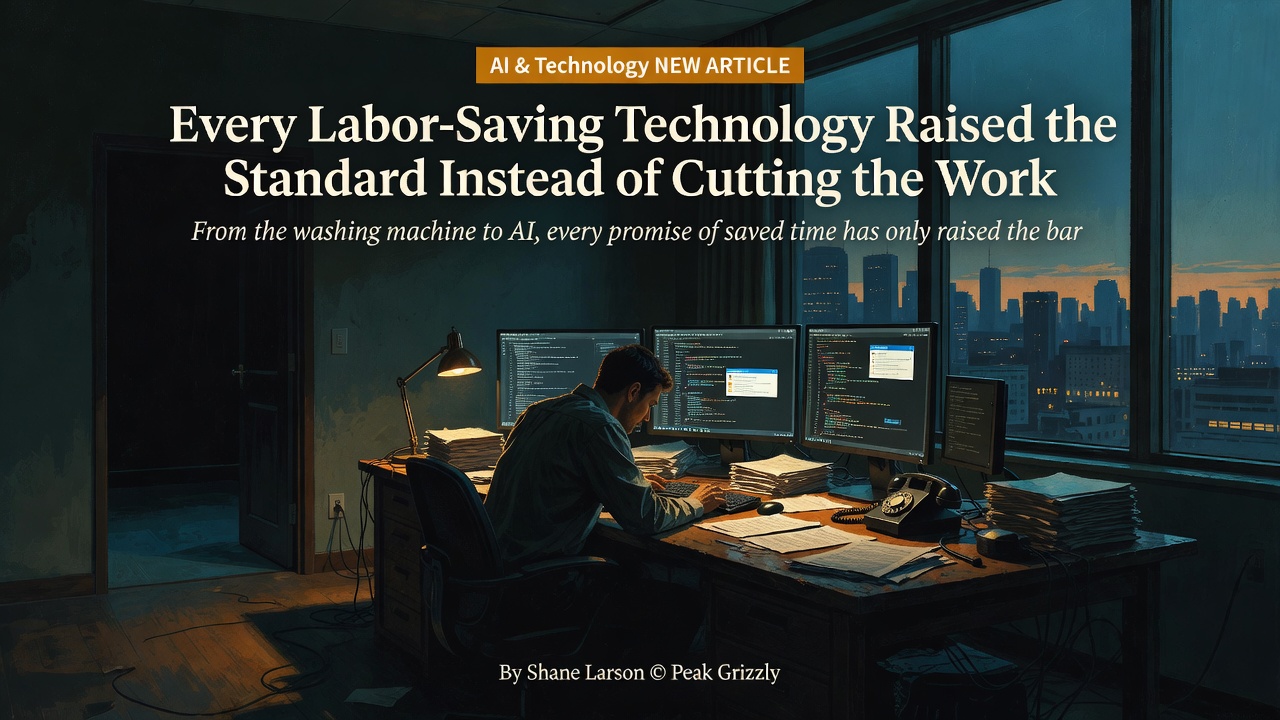
Every Labor-Saving Technology Raised the Standard Instead of Cutting the Work
August 5, 2026 · 5 min read
Every technology that promised to give you time back has instead raised the standard until the savings disappeared.
The washing machine was going to free households from a full day of labour each week. Instead, standards of cleanliness rose. Clothes that used to be worn for a week became things you washed after one day. Time spent on laundry did not fall nearly as much as the technology made possible.
Email was going to eliminate the delay of postal mail. It did, and in exchange it created an expectation of same-day response, then same-hour, then a low-grade obligation to be reachable at all times.
The smartphone was going to let you work from anywhere, which sounded like an argument for working less at the office. What it produced was availability at dinner, on holiday, at your kid's recital.
The pattern is consistent enough to plan around: a technology that makes a task cheaper does not reduce the time spent on it. It raises the expected output until the time is filled again.
AI is running the same play right now, and it is running it faster because the promise is being made explicitly. Every piece of coverage promises the same thing — do more. Write more. Ship more content. Manage more projects. Get 10x output from every hour.
Almost nobody asks the obvious question, which is: why would you want that?
The Trap Has a Shape
The mechanism is not mysterious. It works because efficiency gains are captured by whoever sets expectations, and that is rarely the person doing the work.
If you can now produce four reports in the time that used to produce one, and your organisation measures reports, you will be producing four reports. The gain went to the output metric. Your Tuesday is exactly as full as it was, and the work is now more monotonous, because the thinking-per-hour ratio dropped.
This happens by default. Not through anyone's malice — through the ordinary operation of a system where visible output is the thing that gets noticed and time-not-worked is invisible.
Which means the useful question is not how much faster you can go. It is who captures the difference, and whether you have decided that in advance.
Deciding Before You Start
The intervention is simple and it has to happen first, because after the fact the time is already gone.
Before automating anything, write down what the recovered time is for. Specifically. Not "more balance" — an actual thing: leaving at four on Thursdays, the project you have been putting off for two years, an hour of reading that is not work-related, being present at dinner without a phone.
If you cannot name it, the time will be absorbed. That is not a moral failing. It is what happens to unallocated capacity in any system: something expands to fill it, and the thing that expands is usually work, because work has advocates and your evening does not.
The Skill Nobody Teaches: Good Enough
The second half of this is harder than the automation, and it is where most people quietly fail.
The Anti-Hustle AI Guide
An enormous amount of the time you could reclaim is currently spent making things better than they need to be. The internal memo polished to publication standard. The slide deck redesigned twice for a meeting where three people will glance at it. The email rewritten for tone when the first version was fine.
AI makes this worse rather than better, because the marginal cost of another revision drops to nearly nothing. When a rewrite costs twenty minutes, you stop. When it costs thirty seconds, you keep going — and the fifth version is not meaningfully better than the second, but it consumed the time that the tool was supposed to have saved you.
The discipline is deciding what standard a given piece of work actually needs, and stopping there. Some things need to be excellent. Most things need to be adequate and finished. Knowing which is which is a real skill, and it is worth more than any technique for producing faster.
Boundaries That Survive Contact With Reality
The failure mode of this whole project is that the tools erode the boundary between work and not-work, because they make work available in smaller increments.
Answering an email used to require sitting down. Now it is a two-minute task you can do anywhere, which means it happens everywhere. The friction that used to enforce the boundary was doing real work, and removing friction removed the boundary with it.
Rebuilding it has to be deliberate: hours when work tools are closed, a physical or digital separation that costs something to cross, and a rule about what genuinely constitutes an emergency, decided while you are calm rather than at nine on a Sunday.
The Part People Are Not Ready For
There is an uncomfortable finding at the end of this, and it is worth naming.
Some people successfully reclaim the hours and then have no idea what to do with them. The time evaporates into scrolling, or into more work, or into a vague dissatisfaction that is harder to articulate than being busy was.
Busyness answers a question. It tells you what you are for, it fills the day, and it provides a socially acceptable response to how things are going. Removing it without having anything ready to put in its place is genuinely disorienting, and for some people it surfaces things that the work was successfully occluding.
That is not an argument for staying busy. It is an argument for treating the question — what is this time actually for — as the hard part of the project rather than an afterthought.
The technology is real. It genuinely can compress the work. Whether that produces a life with more room in it or simply a higher output quota depends entirely on a decision you make before you start, and which nobody else has any incentive to help you make.
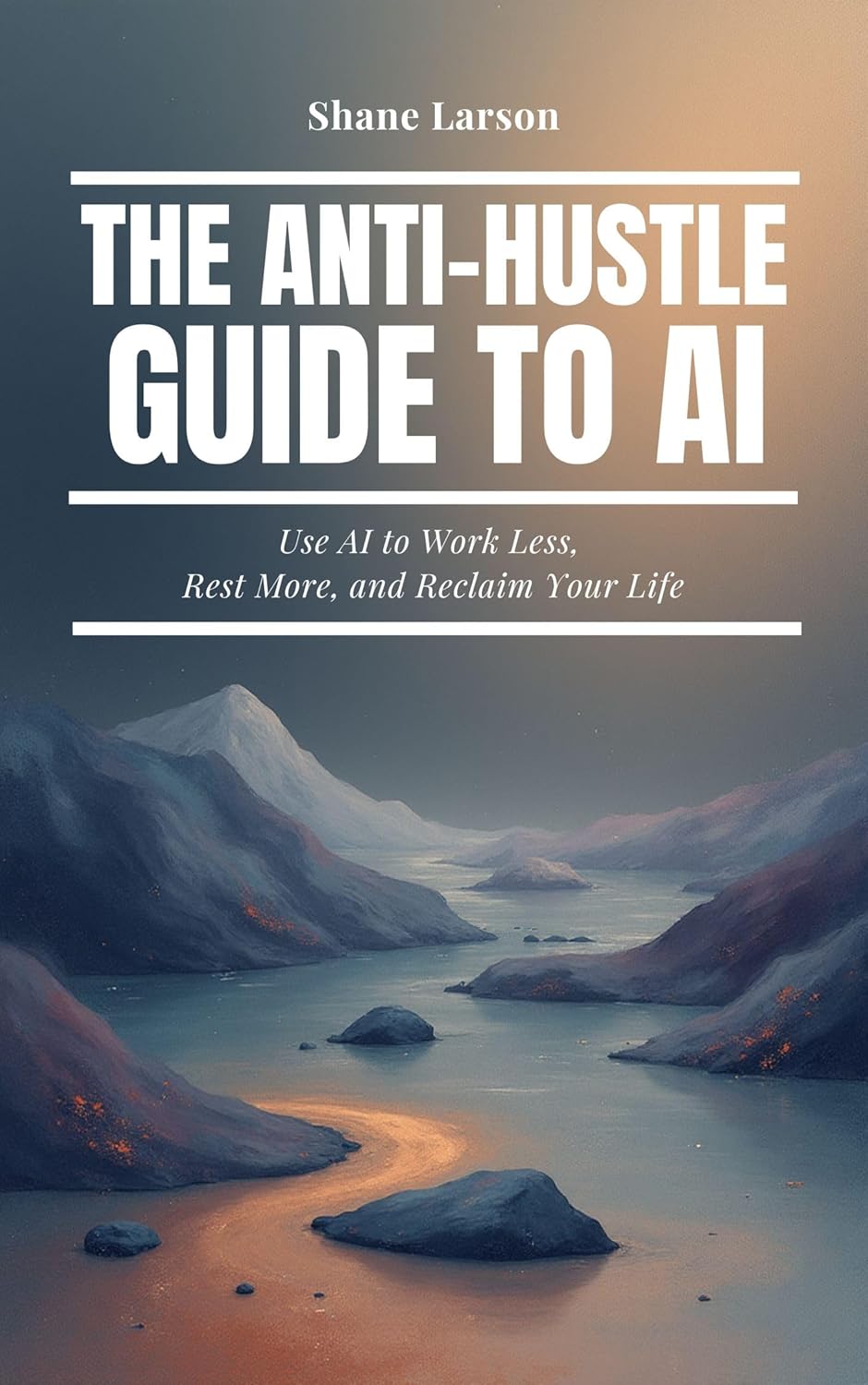
The Anti-Hustle AI Guide: Use AI to Work Less, Rest More, and Reclaim Your Life covers the productivity trap, finding your time thieves, the art of good enough output, boundaries that stick, protecting your off-hours, and what to do with the time once you have it.
The Anti-Hustle AI Guide
New posts and releases, straight to your inbox. No spam, unsubscribe anytime.